
The S&P 500. Five hundred companies, give or take. A little club of American commerce. They say it’s diversified. Which is a nice way of saying they’ve thrown enough darts at the board that something is bound to hit. It requires a minimum market cap, naturally. Being small and scrappy doesn’t get you in. Just the big boys. And they have to be profitable, which, these days, seems almost quaint.
It’s averaged a 10.6% return since 1957. A long time. Before most of us were born, or at least, before we had any sense. But 2026 started…uneasily. A 5% dip. Geopolitics, they call it. Always something. Always a reason for things to wobble.
The Vanguard S&P 500 ETF (VOO). A way to own a piece of that wobble, and hopefully, a piece of the recovery. It’s just a bundle, really. A basket of hopes and fears, neatly packaged. The question is, do you buy the basket when it’s on sale? History, if you believe in such things, suggests you might.
A Diversification, Of Sorts
The S&P 500 weights companies by size. Bigger companies have a bigger say. It’s not a democracy, naturally. It’s capitalism. So, while it includes eleven sectors, some sectors shout louder than others. It’s like a family dinner. Some relatives dominate the conversation.
Here’s the pecking order, as of late:
| S&P 500 Sector | Weighting | Most Valuable Companies |
|---|---|---|
| 1. Information Technology | 32.4% | Nvidia, Apple, Microsoft |
| 2. Financials | 12.5% | Berkshire Hathaway, JPMorgan Chase, Visa |
| 3. Communication Services | 10.5% | Alphabet, Meta Platforms, Netflix |
| 4. Consumer Discretionary | 10% | Amazon, Tesla, Home Depot |
| 5. Healthcare | 9.8% | Eli Lilly, Johnson & Johnson, AbbVie |
Industrials, consumer staples, energy, utilities, materials, and real estate round out the list. A little bit of everything.
Information technology, of course, is the king. Nvidia, Apple, Microsoft. A trinity of tech. A combined market cap of $10.9 trillion. It’s a lot of money. Enough to make a person feel…small. Broadcom and Taiwan Semiconductor Manufacturing are in the mix, too. They’re just quietly building the future.
Over the last decade, the S&P 500 has climbed 128%. But without information technology? Just 85%. The future, it turns out, is expensive. So it goes.
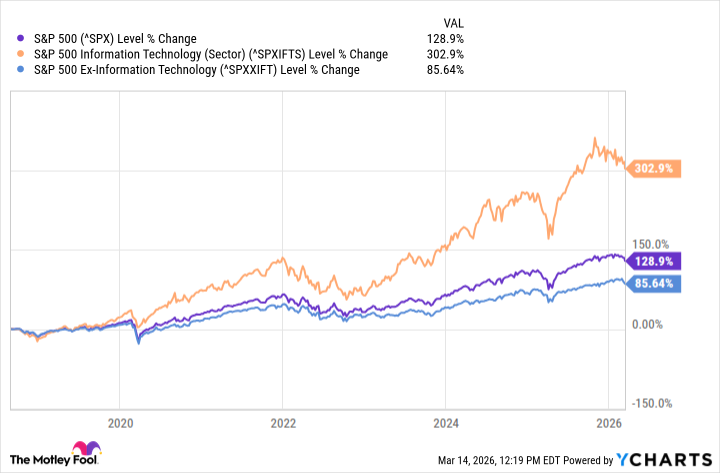
The S&P 500 gives you exposure to companies that are, at least theoretically, building something new. Artificial intelligence, mostly. But it also throws in a little bit of everything else. A little bit of safety. A little bit of stability. A little bit of…hope.
The Vanguard S&P 500 ETF costs 0.03% to own. For every $100,000 invested, you pay $30 a year. It’s not a fortune. It’s just…the price of participation.
Should You Buy?
Volatility is normal. The market goes up, the market goes down. It’s a law of physics, almost. The S&P 500 drops 5% once a year, on average. A 10% correction every 2.5 years. A bear market every six years or so. It’s predictable, in a depressing sort of way.
Since 1957, the S&P 500 has returned 10.6% a year. After all the dips, corrections, and bear markets. So, the downturns, historically, have been opportunities. But history, of course, is just a collection of stories. And stories can be rewritten.
Geopolitical tensions, like the situation in Iran, could cause further trouble. Supply chain disruptions. Soaring oil prices. It’s always something. Trying to time the market is a fool’s errand. You’ll probably just miss out.
So, buying the Vanguard S&P 500 ETF might be a good idea. If you plan to hold it for the long term. Three to five years, at least. If you’re uncomfortable with the volatility, you could buy a little bit each month. Dollar-cost averaging, they call it. It won’t make you rich, but it might save you from yourself. So it goes.
Read More
- Silver Rate Forecast
- Gold Rate Forecast
- 22 Films Where the White Protagonist Is Canonically the Sidekick to a Black Lead
- 15 Films That Were Shot Entirely on Phones
- Unveiling the Schwab U.S. Dividend Equity ETF: A Portent of Financial Growth
- How to Do Sculptor Without a Future in KCD2 – Get 3 Sculptor’s Things
- 20 Movies Where the Black Villain Was Secretly the Most Popular Character
- Brent Oil Forecast
- New HELLRAISER Video Game Brings Back Clive Barker and Original Pinhead, Doug Bradley
- Superman Flops Financially: $350M Budget, Still No Profit (Scoop Confirmed)
2026-03-19 17:52