The transition of leadership at any long-established enterprise invites scrutiny. At Berkshire Hathaway (NYSE: BRKA) (BRKB), the succession from Warren Buffett to Greg Abel has prompted predictable market reassessment. Recent actions by Mr. Abel, however, offer discernible, if not entirely novel, signals regarding the company’s strategic direction and his approach to capital allocation.
Leadership Transition and Market Perception
For six decades, Warren Buffett’s imprimatur effectively constituted Berkshire Hathaway’s valuation premium. His track record, predicated on value investing and disciplined capital deployment, engendered a degree of investor confidence rarely observed. The announcement of his retirement, while anticipated, introduced a period of recalibration. The market, in essence, began to discount the ‘Buffett premium’ and assess Berkshire Hathaway on its underlying fundamentals. This is not an uncommon phenomenon; the departure of a founding or iconic leader invariably necessitates a reassessment of future prospects.
Initial market performance following the announcement reflected this shift. While not precipitous, the stock underperformed the S&P 500 index over the past year, a divergence that prompted analysis of both macro-economic factors and company-specific developments. The onus, therefore, fell upon Mr. Abel to demonstrate not merely continuity, but a viable path toward sustained value creation.
Signals of Intent: Insider Purchases and Share Repurchases
Recent actions suggest a deliberate attempt to address market concerns. Mr. Abel’s personal investment of $15 million in Berkshire Hathaway stock – equivalent to his after-tax annual salary – represents a conventional, yet symbolically important, gesture of confidence. Insider purchases, while not determinative, often signal management’s belief that the stock is undervalued. More significantly, the resumption of share repurchases, following a hiatus since 2024, indicates a willingness to deploy capital when management perceives a discrepancy between market price and intrinsic value. Berkshire Hathaway purchased $225 million worth of stock on March 4th, further reinforcing this signal.
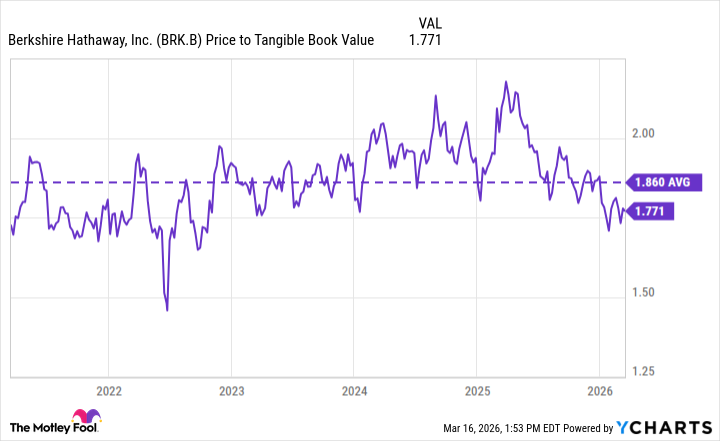
This approach aligns with Mr. Buffett’s established principles. The company has historically maintained a disciplined share repurchase policy, contingent upon valuation metrics. The current environment, characterized by a market price trading below tangible book value (TBV), appears to have triggered this policy. TBV, a measure of equity adjusted for intangible assets, provides a conservative assessment of a company’s liquidation value and is a common metric for valuing financial institutions.
Continuity and Capital Allocation
Mr. Abel’s first annual letter to shareholders confirmed the continuation of this established policy. The emphasis on share repurchases, coupled with a conservative approach to acquisitions, suggests a preference for returning capital to shareholders when compelling investment opportunities are absent. This is not a revolutionary strategy; it is, rather, a pragmatic application of established principles.
The company’s substantial cash holdings – approaching $370 billion in short-term U.S. Treasury bonds at the end of 2025 – provide ample liquidity for both share repurchases and potential acquisitions. However, the absence of a significant acquisition in the near term suggests a cautious approach, potentially reflecting a challenging macroeconomic environment or a lack of attractively priced targets.
Concluding Observations
The transition of leadership at Berkshire Hathaway inevitably introduces a degree of uncertainty. Mr. Abel’s actions to date, while not transformative, suggest a commitment to the principles that underpinned Mr. Buffett’s success. The resumption of share repurchases and the insider purchase are logical, if not entirely unexpected, signals of confidence.
However, sustained value creation will depend on Mr. Abel’s ability to navigate a complex and evolving economic landscape. The long-term implications of this leadership transition remain to be seen. The market will continue to evaluate Berkshire Hathaway not on historical performance, but on its future prospects, assessed through the lens of prudent capital allocation and disciplined financial management.
Read More
- Gold Rate Forecast
- Silver Rate Forecast
- Games That Faced Bans in Countries Over Political Themes
- 15 Films That Were Shot Entirely on Phones
- Unveiling the Schwab U.S. Dividend Equity ETF: A Portent of Financial Growth
- 20 Movies Where the Black Villain Was Secretly the Most Popular Character
- Brent Oil Forecast
- New HELLRAISER Video Game Brings Back Clive Barker and Original Pinhead, Doug Bradley
- Superman Flops Financially: $350M Budget, Still No Profit (Scoop Confirmed)
- 14 Movies Where the Black Character Refuses to Save the White Protagonist
2026-03-20 11:32