Author: Denis Avetisyan
A new deep learning framework dramatically improves the ability to localize fleeting gamma-ray bursts, even with limited and noisy data from Compton cameras.
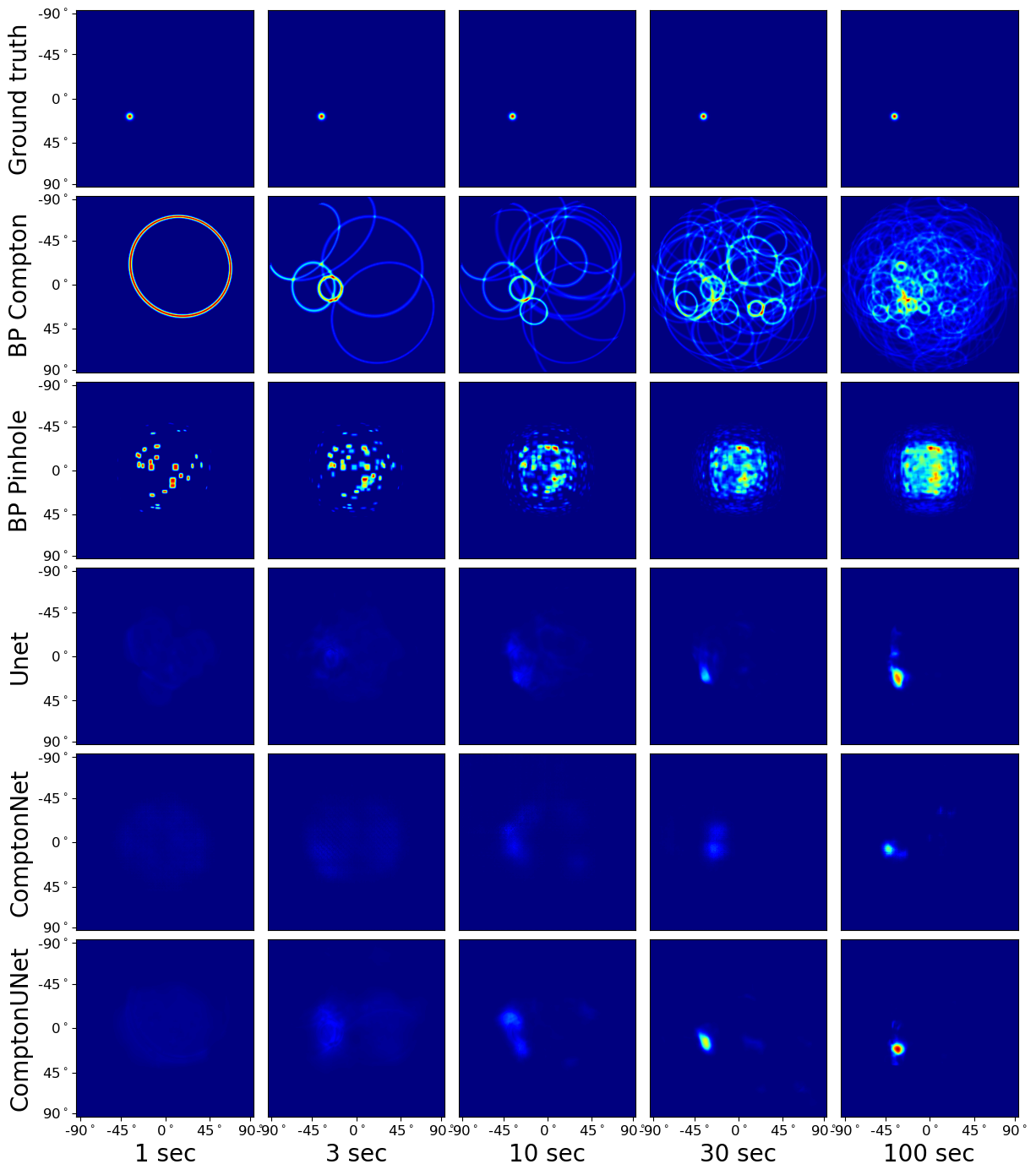
ComptonUNet combines convolutional and multilayer perceptron networks to enhance gamma-ray direction estimation for the INSPIRE mission and multi-messenger astronomy.
Detecting faint gamma-ray bursts (GRBs) remains a significant challenge due to inherent low photon statistics and substantial background noise, limiting our ability to probe the early universe and high-energy astrophysical processes. This work introduces ‘ComptonUNet: A Deep Learning Model for GRB Localization with Compton Cameras under Noisy and Low-Statistic Conditions’, a novel deep learning framework that jointly processes raw Compton camera data and reconstructs images to robustly localize these transient events. By combining the strengths of direct reconstruction with image-based denoising techniques, ComptonUNet demonstrably outperforms existing approaches in simulations of realistic low-Earth orbit conditions. Will this hybrid architecture unlock new possibilities for multi-messenger astronomy and the detection of even more distant and elusive GRBs?
Fleeting Explosions: Probing the Universe’s Most Violent Events
Gamma-ray bursts (GRBs) represent the most energetic explosions in the universe, briefly outshining entire galaxies and releasing immense amounts of energy in mere seconds. These cataclysmic events are thought to originate from the collapse of massive stars into black holes or the merger of neutron stars, processes occurring at vast cosmic distances. The fleeting nature of GRBs, combined with their incredible luminosity, allows astronomers to probe the physics of extreme environments and witness the birth of black holes-phenomena otherwise hidden from direct observation. By studying the afterglows of these bursts across the electromagnetic spectrum, scientists can unravel the composition of distant galaxies and gain insights into the early universe, effectively using GRBs as beacons to illuminate the cosmos.
Historically, the detection of gamma-ray bursts has been hampered by the limitations of conventional instruments. These typically employ a pointed approach, focusing on specific areas of the sky for defined periods. This methodology inherently struggles with the unpredictable nature of GRBs – events that appear suddenly and fade rapidly. Because these instruments must physically reorient to observe different regions, crucial early data – vital for pinpointing the burst’s origin and understanding its initial characteristics – is often lost. Furthermore, pointed detectors offer limited ‘eyes on’ coverage, meaning a significant portion of the sky remains unmonitored at any given time, increasing the likelihood of missing these fleeting and powerful cosmic signals. This necessitates a shift towards instruments capable of continuously surveying the entire sky to capture these transient events effectively.
Advancing the study of gamma-ray bursts necessitates a shift towards instrumentation providing both expansive sky coverage and accurate directional pinpointing. Traditional detectors, designed to focus on specific regions, often miss the initial, crucial moments of these fleeting events, hindering detailed analysis of their origins and properties. Next-generation observatories are therefore engineered with wide-field views, continuously monitoring vast portions of the sky to capture bursts regardless of their location. Simultaneously, these instruments incorporate sophisticated techniques – such as time-resolved imaging and triangulation – to determine the precise source direction with high angular resolution. This combination of broad observation and accurate localization is vital, allowing astronomers to rapidly trigger follow-up observations with more powerful telescopes and ultimately unravel the mysteries behind the universe’s most energetic explosions.
Seeing the Unseen: The Compton Camera Solution
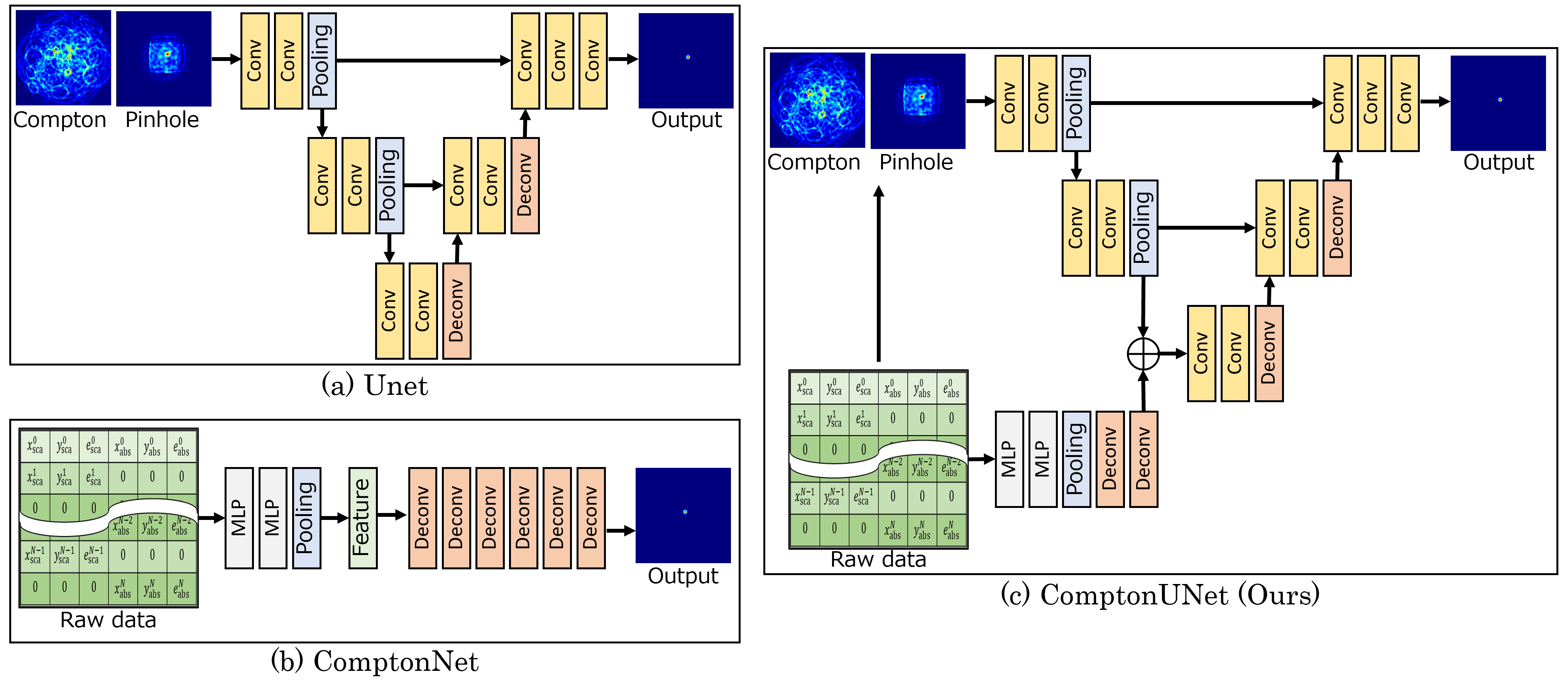
Compton cameras determine the direction of incoming gamma rays by leveraging the Compton scattering effect, wherein incident photons interact with a detector material, losing energy and changing direction. This interaction produces an electron recoil and a lower-energy scattered photon. By measuring the energy deposited by the recoil electron and the direction of the scattered photon, the original direction of the incident gamma ray can be reconstructed. This process allows for a significantly wider field of view compared to collimated or pinhole-based gamma ray detectors, as the camera doesn’t require line-of-sight observation; instead, it relies on reconstructing the path of the scattered photons.
Conventional pinhole cameras, used in gamma-ray imaging, achieve limited field-of-view due to the geometric constraints of the aperture; increasing the field-of-view typically reduces image resolution. Compton cameras overcome this limitation by employing the Compton scattering effect to indirectly determine the incoming direction of gamma rays. This process allows for a significantly wider field-of-view – often exceeding 90 degrees – without the inherent trade-off in spatial resolution experienced by pinhole systems. Specifically, Compton cameras reconstruct the trajectory of the incoming photon based on the energy deposited and the scattering angle, enabling imaging over large areas without the need for a narrow, restrictive aperture. This results in increased sensitivity for wide-area surveys and improved detection capabilities for diffuse sources.
Geant4 simulations are essential to Compton camera development due to the complexity of interactions between gamma photons and detector materials. These Monte Carlo simulations model the full chain of events – from initial photon interaction via Compton scattering, to secondary electron transport and energy deposition – allowing researchers to predict detector response as a function of incident gamma ray direction and energy. By simulating various detector geometries, materials, and configurations, Geant4 enables optimization of key performance parameters such as angular resolution, sensitivity, and background rejection. Furthermore, simulated data sets are used to validate reconstruction algorithms and assess the impact of systematic effects, providing critical information before and during the construction of physical prototypes.
Beyond Reconstruction: Deep Learning’s Role in GRB Localization
Traditional image reconstruction algorithms utilized in Gamma-Ray Burst (GRB) localization, such as Back Projection and Maximum Likelihood Expectation Maximization (ML-EM), present significant computational challenges. These methods require substantial processing time, particularly when dealing with large datasets generated by Compton cameras. Furthermore, their performance can be sensitive to noise and uncertainties in the measured data, leading to reduced robustness and potentially inaccurate source localization. The iterative nature of ML-EM, in particular, contributes to its high computational cost, while Back Projection often suffers from blurring and requires careful parameter tuning to achieve acceptable results. These limitations motivate the exploration of alternative reconstruction techniques, including those leveraging deep learning approaches.
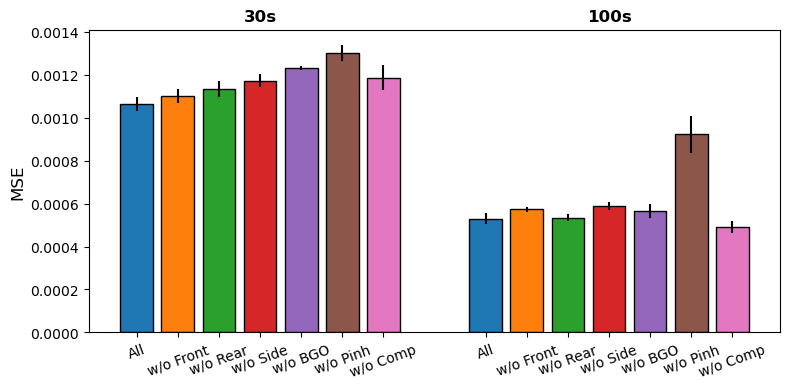
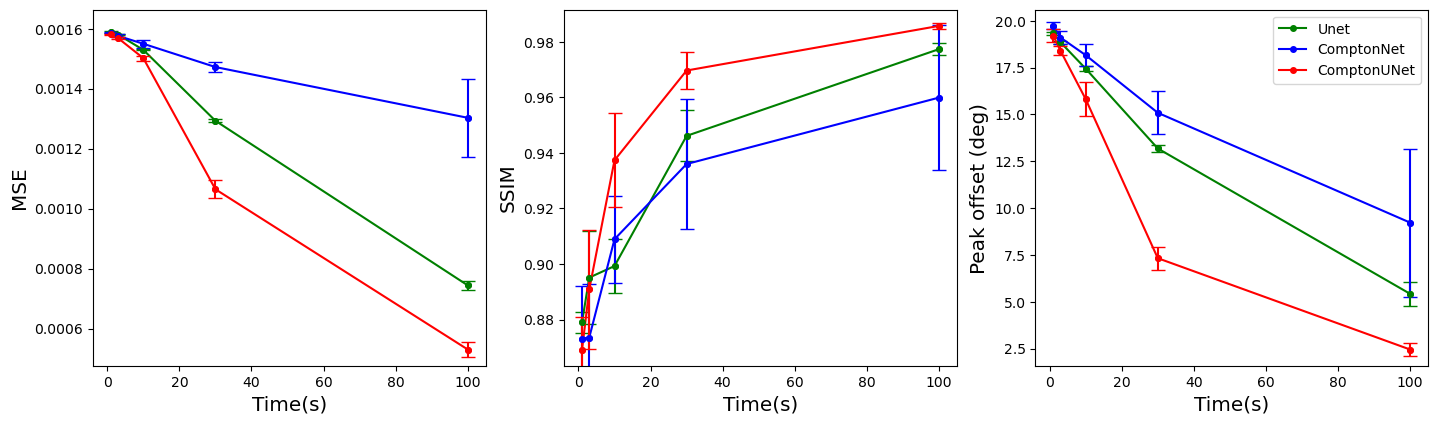
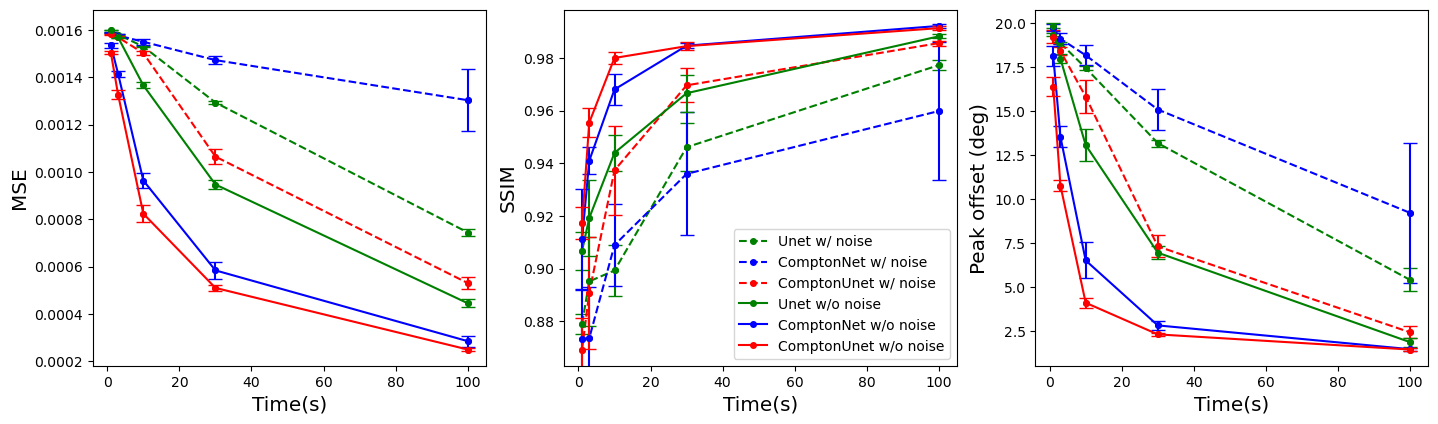
Traditional image reconstruction techniques for Compton Cameras are often limited by computational demands and susceptibility to noise; however, deep learning approaches such as Unet and ComptonNet present viable alternatives. These methods leverage neural networks to directly map raw Compton Camera data to reconstructed images, potentially bypassing the iterative processes inherent in algorithms like Maximum Likelihood Expectation Maximization. Unet, a convolutional network initially developed for biomedical image segmentation, and ComptonNet, specifically designed for Compton Camera data, demonstrate accelerated reconstruction speeds while maintaining, or improving, localization accuracy. ComptonUNet, a hybrid model, further exemplifies this potential, achieving localization accuracies of approximately 3.08-9.03 degrees for long Gamma-Ray Bursts at a flux of 1.0 photons cm-2 s-1.
ComptonUNet, a hybrid deep learning approach for Gamma-Ray Burst (GRB) localization, achieved an accuracy of 3.08 to 9.03 degrees for long GRBs at a flux of 1.0 photons cm-2 s-1, placing its performance on par with the established BATSE instrument. This model incorporates 5,550,593 trainable parameters, significantly more than the 18,817 parameters in Unet and the 3,855,120 in ComptonNet. Despite this increased complexity, ComptonUNet demonstrates efficient memory usage, requiring 2.50 GB of GPU memory during operation, which is less than Unet’s 4.37 GB and more than ComptonNet’s 1.28 GB.
INSPIRE: Ushering in a New Era of GRB Astronomy
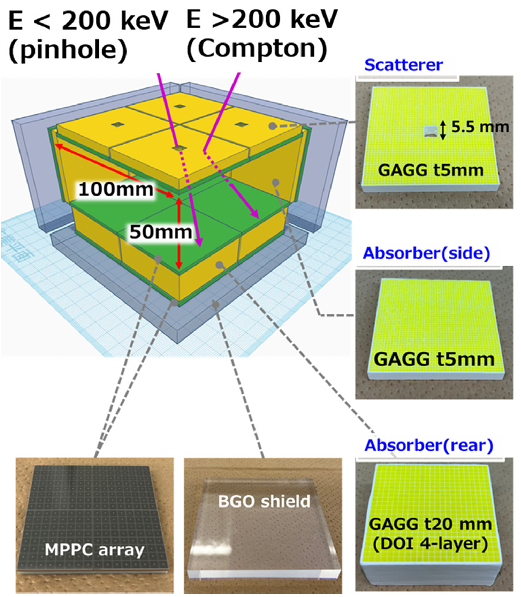
The INSPIRE mission represents a significant leap forward in gamma-ray astronomy, specifically designed as a dedicated Compton camera to detect Gamma-Ray Bursts (GRBs) and other transient high-energy events with greatly enhanced sensitivity. Unlike traditional telescopes that directly image photons, Compton cameras measure the direction of incoming gamma rays by tracking the recoil electrons they produce, allowing for a wider field of view and improved sensitivity to lower-energy gamma rays. This innovative approach promises to reveal a far greater number of GRBs, even those that are faint or obscured, and to pinpoint their locations with unprecedented accuracy. By focusing solely on transient events, INSPIRE is poised to dramatically expand the catalog of known GRBs and unlock new insights into the processes that create these incredibly powerful cosmic explosions, as well as other fleeting phenomena in the universe.
The INSPIRE mission represents a significant advancement in gamma-ray burst (GRB) astronomy through the innovative pairing of Compton camera technology with sophisticated deep learning algorithms. Previous GRB observatories have been constrained by limitations in pinpointing the precise origin of these energetic events and fully characterizing their complex spectra; Compton cameras, unlike traditional telescopes, excel at imaging gamma rays without needing to directly focus them, offering a wider field of view and improved sensitivity. However, the data generated by these cameras is complex, requiring advanced analytical tools; thus, INSPIRE integrates deep learning to sift through this data, rapidly identifying GRB signals and reconstructing their locations with unprecedented accuracy. This synergistic approach promises to overcome the challenges faced by earlier generations of observatories, enabling a more comprehensive understanding of GRB origins, evolution, and their role in the universe.
The anticipated improvements in gamma-ray burst (GRB) astronomy extend beyond simply detecting more of these events; INSPIRE’s enhanced capabilities promise a revolution in how these cosmic explosions are studied. Precise localization will allow astronomers to pinpoint the environments surrounding GRBs, revealing clues about their progenitors – whether massive stars or merging compact objects. Simultaneously, detailed spectral analysis will dissect the emitted radiation, unveiling the physical processes at play and the composition of the emitting material. Crucially, these advancements will facilitate comprehensive population studies, enabling scientists to move beyond individual GRB observations and build a statistical understanding of their occurrence rate, distribution, and evolution across cosmic time, ultimately refining models of star formation, galaxy evolution, and the fundamental physics governing these incredibly energetic phenomena.
Beyond GRBs: Unveiling a Transient Universe
Compton cameras, initially developed for the detection of Gamma-Ray Bursts, possess a unique capability to observe the high-energy sky beyond these dramatic events. Unlike traditional telescopes that focus on direct photon capture, Compton cameras detect photons through their interactions with detector materials, providing information about both the energy and direction of arrival. This innovative approach allows them to identify a wider range of transient sources – fleeting phenomena like X-ray flares from active galactic nuclei, soft gamma repeaters, and even previously unknown cosmic events. When paired with sophisticated image processing techniques, these cameras can disentangle faint signals from background noise, mapping the locations and characteristics of these transient sources with increasing precision and opening a new window onto the dynamic universe.
The universe isn’t simply filled with bright, easily detectable objects; a significant portion of its energy output resides in the faint glow of the Cosmic X-ray Background and the numerous, dim sources contributing to it. Mapping this diffuse background with increasing precision allows astronomers to disentangle the combined light from countless unresolved sources – potentially revealing hidden populations of supermassive black holes, quiescent galaxies, or exotic objects previously undetectable. Resolving these faint sources isn’t merely about cataloging new objects; it’s about understanding the underlying processes driving their emission and, consequently, gaining insights into the formation and evolution of galaxies, the distribution of dark matter, and the broader cosmic ecosystem. This detailed mapping promises a more complete census of the universe’s constituents and a deeper understanding of the forces shaping its history.
The next generation of high-energy astrophysics will be shaped by missions directly evolving from the INSPIRE framework, poised to deliver an unprecedentedly comprehensive view of the transient sky. These endeavors aren’t simply about detecting more events; they aim to create a detailed, all-sky map of fleeting phenomena across the electromagnetic spectrum. By combining wide-field detectors with advanced data processing, future missions will resolve previously unseen sources, pinpoint their locations with exceptional precision, and capture their evolution in real-time. This enhanced capability promises to unlock the secrets of extreme cosmic events – from the birth of black holes and neutron star mergers to the flares of active galaxies and the enigmatic origins of fast radio bursts – ultimately refining models of the universe and revealing the underlying physics governing its most energetic processes.
The pursuit of improved gamma-ray direction estimation, as demonstrated by ComptonUNet, feels predictably iterative. This model, blending convolutional and multilayer perceptron networks, aims to address the challenges of noisy, low-statistic data-problems researchers have been wrestling with for decades. It’s a clever solution, certainly, but one built upon layers of prior attempts and inevitable compromises. As Yann LeCun once stated, “Backpropagation is the engine of modern deep learning, but it’s also a hack.” This feels fitting; ComptonUNet is a sophisticated hack, elegantly packaging existing techniques to squeeze a bit more signal from the noise. It will likely work…until the next source of noise is discovered, and another ‘revolutionary’ framework is required. Everything new is just the old thing with worse docs.
What’s Next?
The promise of ComptonUNet, like all architectures promising to distill signal from intractable noise, rests on a precarious foundation. Improved localization of gamma-ray bursts is, of course, valuable. But each layer of abstraction – convolutional kernels, multilayer perceptrons, the very notion of ‘image reconstruction’ from Compton camera data – introduces a new vector for systematic error. The current framework addresses noise and low statistics, but production data will inevitably reveal edge cases, unforeseen interactions, and the inherent limitations of approximating continuous phenomena with discrete representations.
Future work will undoubtedly focus on expanding the training dataset, incorporating more realistic noise models, and perhaps even exploring adversarial training techniques. Yet, the real challenge lies not in achieving incremental improvements in localization accuracy, but in acknowledging the fundamental uncertainty inherent in these measurements. A statistically rigorous error propagation scheme, accounting for all sources of uncertainty, would be a more valuable contribution than any further refinement of the core algorithm.
The INSPIRE mission, and others like it, will generate a deluge of data. The tools to process it will become increasingly complex. It is inevitable that the ‘elegant’ solutions of today will become tomorrow’s tech debt. CI is the temple – one prays the pipelines hold. Documentation, as always, remains a myth invented by managers.
Original article: https://arxiv.org/pdf/2602.17085.pdf
Contact the author: https://www.linkedin.com/in/avetisyan/
See also:
- 2025 Crypto Wallets: Secure, Smart, and Surprisingly Simple!
- Brown Dust 2 Mirror Wars (PvP) Tier List – July 2025
- Gold Rate Forecast
- Wuchang Fallen Feathers Save File Location on PC
- Banks & Shadows: A 2026 Outlook
- HSR 3.7 breaks Hidden Passages, so here’s a workaround
- Gemini’s Execs Vanish Like Ghosts-Crypto’s Latest Drama!
- QuantumScape: A Speculative Venture
- MicroStrategy’s $1.44B Cash Wall: Panic Room or Party Fund? 🎉💰
- Solel Partners’ $29.6 Million Bet on First American: A Deep Dive into Housing’s Unseen Forces
2026-02-21 09:49