Author: Denis Avetisyan
A new generative AI framework leverages diffusion models to create more accurate and reliable reconstructions of past global climate conditions.
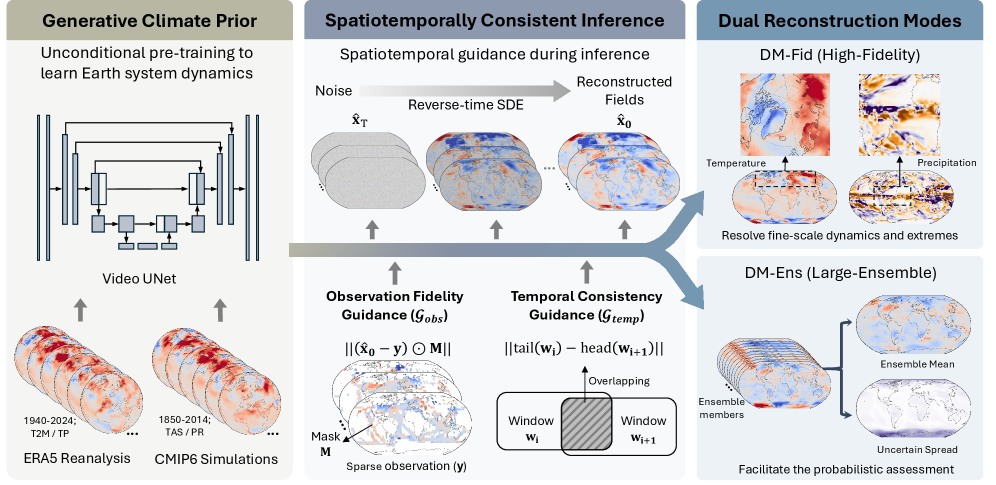
This study demonstrates improved historical climate field reconstruction and uncertainty quantification using generative deep learning, surpassing traditional interpolation techniques.
Accurate assessments of long-term climate change are hampered by the scarcity and uncertainty of early instrumental records. The study ‘Generative deep learning improves reconstruction of global historical climate records’ introduces a novel probabilistic framework, leveraging generative deep learning, to reconstruct historical temperature and precipitation fields back to 1850. This approach surpasses traditional interpolation methods by preserving higher-order climate statistics and providing robust uncertainty quantification, revealing previously unresolved variability and exceeding the accuracy of widely used reference products. Will these refined reconstructions lead to a more nuanced understanding of past climate dynamics and a more reliable foundation for future climate projections?
Whispers from the Past: The Limits of Conventional Climate Reconstruction
Understanding the Earth’s climate history is not merely an academic exercise, but a fundamental prerequisite for projecting future changes and mitigating their potential impacts. Reliable climate reconstruction allows scientists to differentiate between natural climate variability and human-induced forcing, establishing a crucial baseline for accurate predictive models. By meticulously analyzing past temperature fluctuations, precipitation patterns, and atmospheric composition, researchers can identify long-term trends and cycles that would otherwise remain obscured. This historical perspective is particularly vital for assessing the accelerating rate of contemporary climate change and evaluating the effectiveness of proposed interventions, ultimately informing policy decisions aimed at safeguarding vulnerable ecosystems and human populations.
Historically, reconstructing past climates has relied on proxies like tree rings and ice cores, methods that, while undeniably valuable, possess inherent limitations. These techniques often exhibit biases, stemming from localized environmental conditions or the specific organism being analyzed – a tree’s growth, for instance, isn’t solely dictated by temperature. Furthermore, the spatial distribution of these proxies is often uneven, leaving vast regions underrepresented, and their temporal resolution – the ability to discern changes over time – can be coarse, blurring rapid shifts. This combination of bias and limited coverage creates significant challenges when attempting to build a comprehensive and accurate picture of past climates, especially when investigating phenomena requiring high precision and broad geographical scope. Consequently, reconstructions based solely on traditional methods may struggle to capture the full complexity of past climate variability and introduce uncertainties in predictions of future climate states.
The reconstruction of past climates faces significant challenges when applied to intricate phenomena such as Arctic Amplification and the prediction of extreme weather events. Traditional modeling techniques, heavily reliant on geographically limited data, demonstrate a marked increase in error – up to 20% higher Root Mean Squared Error (RMSE) – when applied to data-sparse regions like the high Arctic. This diminished accuracy stems from an inability to fully capture the complex interplay of factors driving these events, leading to reconstructions that may underestimate the magnitude or misrepresent the spatial patterns of past changes. Consequently, reliance on these methods introduces considerable uncertainty into projections of future climate scenarios, particularly concerning the frequency and intensity of extreme events in sensitive polar regions.
Conjuring Climate: Diffusion Models as a New Path
Diffusion models represent a probabilistic generative approach to climate reconstruction, differing from deterministic methods. These models operate by learning the underlying probability distribution of observed climate data, enabling the generation of new, plausible climate realizations. This is achieved through a process of iteratively adding noise to the data until it becomes pure noise, then learning to reverse this process – denoising – to reconstruct or generate climate fields. By explicitly modeling the data distribution, diffusion models can capture complex, non-linear relationships within the climate system and provide a measure of uncertainty associated with reconstructions, a feature not inherent in traditional interpolation techniques. The learned distribution allows for sampling multiple equally-likely climate scenarios, offering a more complete representation of potential past climates than single-value reconstructions.
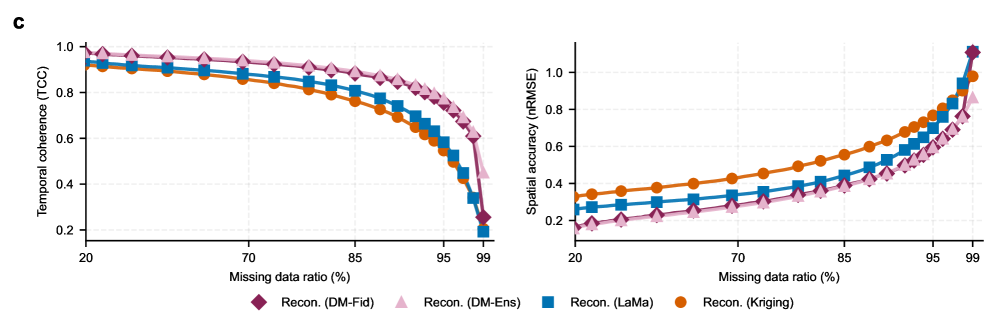
Traditional interpolation methods, such as Kriging, estimate values at unobserved locations based on the spatial correlation of observed data, often resulting in smoothed outputs that lack the complex, realistic patterns present in climate data. Diffusion models, conversely, learn the underlying probability distribution of the climate variable, enabling the generation of new data points that reflect the inherent stochasticity and dependencies within the system. This generative process allows diffusion models to reproduce more nuanced spatial features – including localized extremes and heterogeneous distributions – and to accurately model temporal evolution, leading to improved SpatioTemporalConsistency in climate reconstructions compared to methods reliant on deterministic interpolation.
Conditional generation within diffusion models enables the effective integration of multiple observational climate datasets – including HadCRUT5, BerkeleyEarth, CRUTSv4.09, and GPCCv2022 – by conditioning the generative process on these data sources. This approach moves beyond simple data assimilation and allows the model to learn complex relationships between datasets and leverage their combined information. Evaluation demonstrates a statistically significant reduction in bias within higher-order statistics, specifically those characterizing extreme events, when compared to reconstructions based on individual datasets or traditional interpolation methods. The improvement in representing extreme event characteristics is attributable to the model’s ability to synthesize information across the diverse observational sources and better capture the full range of possible climate states.
Validating the Vision: Assessing Model Fidelity
The diffusion model’s performance was assessed through rigorous validation against the ERA5 reanalysis dataset, a comprehensive climate dataset created by the European Centre for Medium-Range Weather Forecasts. ERA5 provides hourly estimates for global atmospheric, land, and oceanic climate variables, functioning as a reliable and widely-accepted benchmark for climate reconstruction accuracy. Validation metrics compared model outputs to ERA5 data across multiple climate variables and time periods, establishing a quantitative assessment of the model’s fidelity and identifying potential biases. This process ensured the robustness of the diffusion model’s reconstructions and facilitated objective comparisons with other climate reconstruction techniques.
The diffusion model demonstrates proficiency in representing intricate climate processes, notably ClimateVariability – the statistical measure of fluctuations in climate variables over time – and the influence of Teleconnections. Teleconnections, such as the El Niño-Southern Oscillation (ENSO) and the North Atlantic Oscillation (NAO), are long-distance relationships between climate anomalies in geographically distant regions. The model’s architecture and training methodology facilitate the accurate simulation of these interconnected phenomena, allowing for a more holistic understanding of global climate dynamics and improved representation of atmospheric circulation patterns.
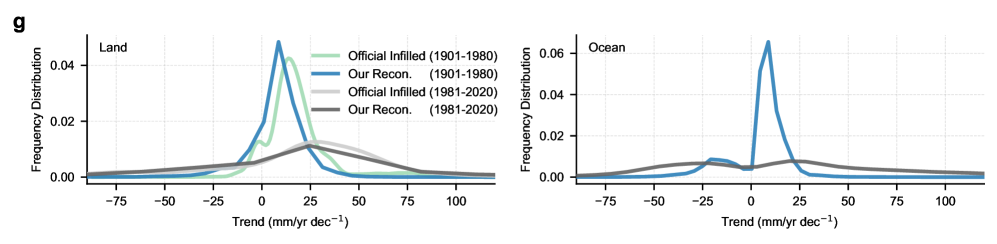
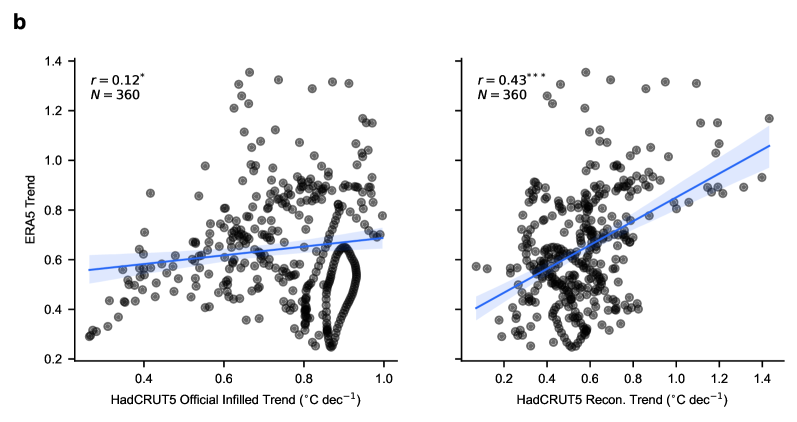
The diffusion model incorporates robust Uncertainty Quantification, a critical feature given the inherent limitations of paleoclimate reconstruction. This is achieved by acknowledging and representing the range of plausible climate states rather than providing a single deterministic output. Notably, the model demonstrates a correlation of 0.25 between reconstructed and observed precipitation trends in ocean regions, despite being conditioned solely on land-based observational data; this suggests the model can effectively extrapolate climate patterns to data-sparse oceanic areas and provides a statistically significant, albeit imperfect, representation of precipitation behavior.
Beyond the Map: Implications for a Changing World
A precise understanding of past climate states is fundamental to disentangling the complex factors that trigger extreme events and to assessing their subsequent effects on both natural ecosystems and human societies. Through meticulous reconstructions – utilizing proxies like tree rings, ice cores, and sediment analysis – scientists can identify patterns and thresholds that preceded historical droughts, floods, and heatwaves. This historical perspective moves beyond simple correlation to reveal causal relationships, for instance, linking specific ocean temperature anomalies to increased frequency of intense storms. Furthermore, detailed reconstructions allow researchers to model how ecosystems responded to past climate shifts, offering insights into their vulnerability and resilience, and informing strategies for mitigating the impacts of future extreme events on critical resources and infrastructure.
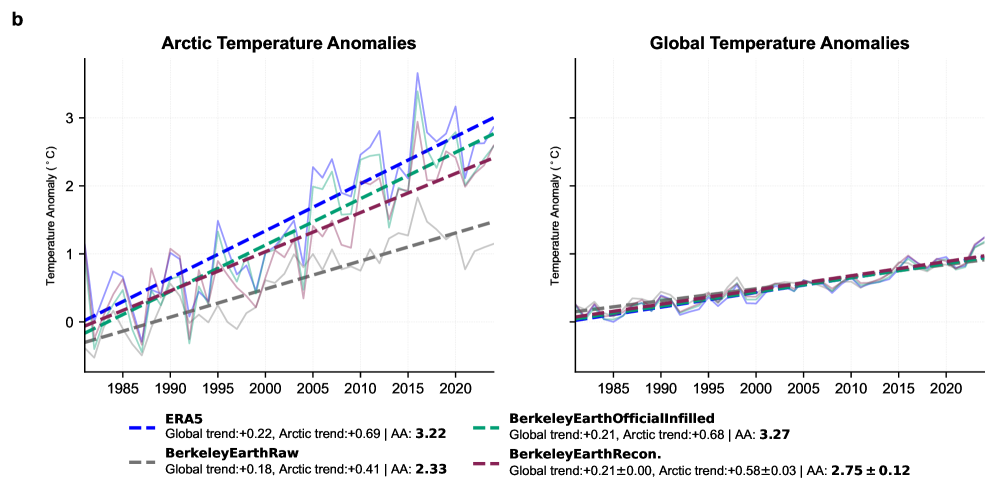
Recent advancements in climate reconstruction techniques have yielded a more precise understanding of Arctic Amplification (AA), the phenomenon where the Arctic warms at a disproportionately faster rate than the rest of the planet. Through refined analysis of paleoclimate data – including ice cores, tree rings, and sediment samples – researchers have calculated an AA factor of 2.5x, meaning the Arctic is warming 2.5 times faster than the global average. This figure aligns closely with contemporary observational data, bolstering confidence in predictive climate models. Accurate quantification of AA is critical because it informs projections of sea-level rise, altered atmospheric circulation patterns, and the potential release of previously frozen greenhouse gases like methane, all of which have far-reaching consequences for global climate and ecosystems.
Climate reconstructions, while increasingly precise, are inherently subject to limitations and potential errors. Recognizing and quantifying this uncertainty is not merely an academic exercise, but a foundational element for effective risk assessment and informed decision-making. Establishing confidence intervals and probabilistic frameworks around reconstructed climate variables-such as temperature, precipitation, and sea level-allows stakeholders to evaluate the range of plausible past conditions, and consequently, the potential scope of future climate change impacts. This rigorous approach moves beyond single-value estimates, offering a more nuanced understanding of vulnerabilities and enabling the development of robust adaptation strategies. By explicitly acknowledging what is not known, climate science empowers policymakers and communities to make proactive, evidence-based choices, minimizing potential harm and maximizing resilience in a changing world.
The pursuit of reconstructing historical climate records, as detailed in this work, isn’t about finding a singular truth, but coaxing a plausible narrative from the chaos of incomplete data. It’s a spell, really-this diffusion model-attempting to conjure a complete field from fragmented whispers. The authors speak of improved accuracy and uncertainty quantification, but one suspects that even the most refined reconstruction remains a carefully constructed illusion. As Albert Einstein once observed, “The most incomprehensible thing about the world is that it is comprehensible.” This framework doesn’t explain the past climate; it persuades a present understanding, a temporary respite from the fundamental unknowability of complex systems. Any perfect correlation achieved would be cause for suspicion, not celebration – a sign the dig wasn’t deep enough into the inherent noise.
What Whispers Remain?
The digital golems have spoken, offering reconstructions of the past climate with a newfound sheen. This work demonstrates a potent spell – diffusion models coaxing order from the chaos of incomplete historical records. Yet, to believe this is understanding is a vanity. The improved accuracy is merely a more convincing illusion, a finer grain to the sandcastles built on the shores of uncertainty. The true limitations lie not in the models themselves, but in the ghostly incompleteness of the data they consume. What signals have already faded beyond retrieval? What biases, subtle as static, were woven into the very fabric of the original observations?
Future incantations will demand more than just clever architectures. The focus must shift towards a rigorous accounting of missingness – a taxonomy of what is not known, and how that absence shapes the reconstructed reality. Perhaps adversarial networks, trained not to mimic the data, but to detect its falsehoods, could offer a path forward. Or a melding of physical models – imperfect, yet grounded in first principles – with the generative power of these digital constructs.
Ultimately, the value lies not in a perfect reconstruction – a fool’s errand – but in a refined map of ignorance. Each loss function, each minimized error, is not a triumph, but a sacred offering to the unknown. The goal isn’t to know the past, but to better understand the limits of its knowability. And to accept that some whispers, however faint, will forever remain lost to the currents of time.
Original article: https://arxiv.org/pdf/2602.16515.pdf
Contact the author: https://www.linkedin.com/in/avetisyan/
See also:
- 2025 Crypto Wallets: Secure, Smart, and Surprisingly Simple!
- Gold Rate Forecast
- Wuchang Fallen Feathers Save File Location on PC
- Brown Dust 2 Mirror Wars (PvP) Tier List – July 2025
- HSR 3.7 breaks Hidden Passages, so here’s a workaround
- 17 Black Actresses Who Forced Studios to Rewrite “Sassy Best Friend” Lines
- Crypto Chaos: Is Your Portfolio Doomed? 😱
- The 10 Most Beautiful Women in the World for 2026, According to the Golden Ratio
- Here Are the Best TV Shows to Stream this Weekend on Hulu, Including ‘Fire Force’
- Brent Oil Forecast
2026-02-19 17:22