In a room where the hum of servers depends on luck and coffee, Vincent Van Code stands at the edge of a rumor, a man who builds startups the way a farmer builds fences-carefully, with a touch of stubbornness and a joke slapped on the corner of his mouth. He says the XRP ledger could be hungrier than we admit, not because of some grand conspiracy but because the price of quiet coins is paid in a fee that isn’t kept quiet when crowds press in. The base fee, he reminds us, is not a tax for miners or Ripple, but a bit of coin that vanishes, burned, when the ledger is busy. And if congestion climbs, the fees rise with it, like heat in a shack on a July morning.
The Weight of a Crowded Ledger
In a thread he titled with the bravado of a gambler, Vincent Van Code argued that “everyone is calculating the XRP burn wrong.” He starts with the base fee of 0.00001 XRP, a number that wears the costume of normal when the network sleeps. “But what happens if the world actually uses the XRPL at its 3,400 TPS limit?” he asks, suggesting that the real driver is load, not raw speed.
His simulation walks through fee regimes across the same activity, showing burn figures shift dramatically as the ledger fills and the “Load Factor” climbs to deter spam. “As the ledger fills up, the Load Factor kicks in to stop spam,” he wrote, with a hint of sarcasm for anyone who thought fees would stay cheap just because the morning coffee was cheap. “Fees don’t just stay low; they scale exponentially.”
He lays out four scenarios with daily burn estimates. The standard day, he says, is 1.2 million transactions and about 450 XRP burned. Abroad, in the notion of universal adoption reaching the cap at 3,400 TPS, that becomes roughly 293 million transactions per day at base fee, and about 2,937 XRP burned daily.
The more audacious numbers come when he holds the volume constant at 293 million per day but lifts the effective fee through congestion. In the “congestion hike” case, the load-scaled fee rises to 0.001 XRP, implying about 293,760 XRP burned per day. In a “full gridlock” case at 0.01 XRP per transaction, he estimates 2,937,600 XRP burned daily.
The argument rests on a simple fact about XRPL fees: they aren’t paid to validators or to Ripple, they are taken out of circulation. He makes this distinction plain. “The fees aren’t paid to miners. They aren’t paid to Ripple. They are destroyed forever.”
The “Supply Meltdown” Simulation
Headline: Everyone is calculating the XRP burn wrong. The base fee (0.00001 XRP) only exists when the network is quiet. But what happens if the world actually uses the XRPL at its 3,400 TPS limit?
The Congestion Math: As the…
– Vincent Van Code (@vincent_vancode) January 24, 2026
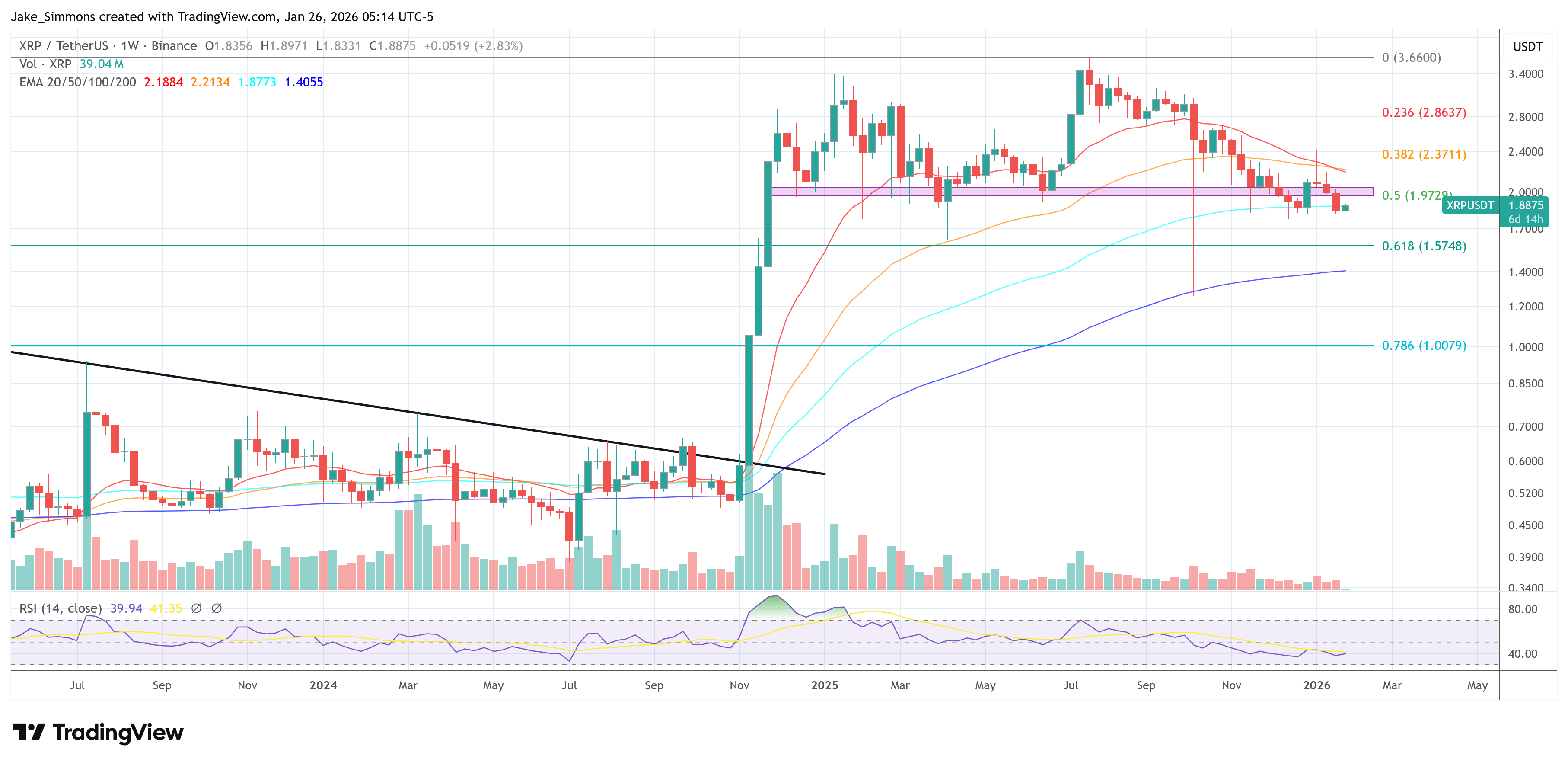
From this, his headline conclusion lands with a thud and a wink: under extreme global utility, we aren’t burning a few hundred tokens. We could be wiping a billion XRP out of existence every year, a kind of deflationary engine fed by demand and the stubbornness of people who trust a ledger to run when the world wants to run fast. At press time, XRP traded around $1.88.
Read More
- Top 20 Dinosaur Movies, Ranked
- 20 Movies Where the Black Villain Was Secretly the Most Popular Character
- Celebs Who Narrowly Escaped The 9/11 Attacks
- 25 “Woke” Films That Used Black Trauma to Humanize White Leads
- Spotting the Loops in Autonomous Systems
- The 10 Most Underrated Jim Carrey Movies, Ranked (From Least to Most Underrated)
- Gold Rate Forecast
- Transformers Under the Microscope: What Graph Neural Networks Reveal
- The Best Directors of 2025
- Every Notable ‘Star Trek: The Original Series’ Actor Who Died
2026-01-26 17:00