
Recent market dynamics have been characterized by a pronounced concentration of gains within U.S. large-capitalization equities, particularly those associated with the technology sector. This performance has been, in part, attributable to the substantial capital allocation towards artificial intelligence development and related technologies. However, a discernible shift in investor sentiment is emerging, prompting a reassessment of valuations and a potential rotation towards previously underrepresented asset classes.
Shifting Market Fundamentals
The prevailing narrative suggests a maturing of the AI-driven growth cycle. Investors are now scrutinizing the return on investment associated with these substantial expenditures, and questioning the sustainability of current valuation multiples. This is coinciding with a period of increased volatility, and a renewed focus on fundamental factors such as earnings quality and dividend yields.
Concurrently, small-capitalization equities are exhibiting signs of relative strength. While historically perceived as carrying a higher degree of risk, these securities have accumulated a considerable degree of intrinsic value, positioning them as potential beneficiaries of the evolving market landscape.
The Vanguard Extended Market ETF: A Strategic Consideration
The Vanguard Extended Market ETF (VXF +0.98%) warrants consideration as a potential avenue for capturing this emerging trend. This exchange-traded fund is designed to replicate the performance of the U.S. equity market, excluding the constituents of the S&P 500 index. Essentially, it functions as a broad-based exposure to mid- and small-capitalization stocks.
VXF offers diversification through access to over 3,300 individual holdings, coupled with a remarkably low expense ratio of 0.05%. This makes it a cost-effective instrument for gaining exposure to a segment of the market that has historically demonstrated potential for outperformance during periods of economic expansion.
Composition and Historical Performance
The fund’s allocation is not solely focused on small-cap stocks. A significant portion is dedicated to mid-capitalization companies, which often exhibit a balance between growth potential and relative stability. This blend may prove advantageous in an environment where investors are seeking opportunities beyond the large-cap sector, but remain cautious about excessive risk.
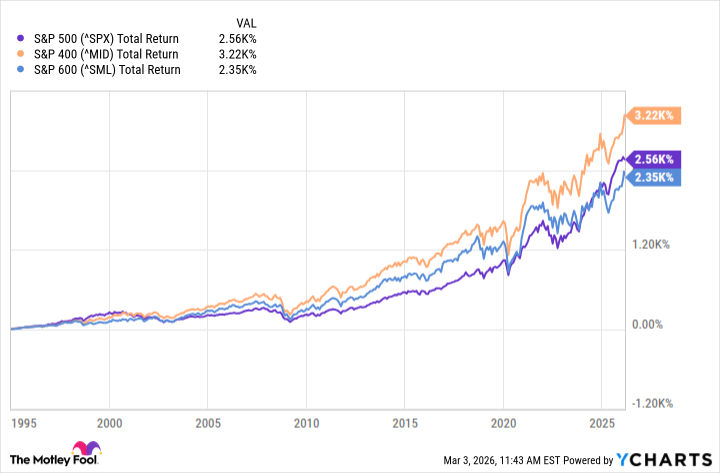
Historically, the S&P 400 Mid Cap index has demonstrated a capacity to outperform both the S&P 500 and the S&P 600 Small Cap index over extended periods. VXF, by incorporating exposure to both mid- and small-cap stocks, seeks to capture this potential upside.
Valuation and Earnings Outlook
As of the current reporting period, VXF exhibits a price-to-earnings (P/E) ratio of 20. While this metric is not inherently indicative of future performance, it suggests that the fund’s underlying holdings are currently trading at a reasonable valuation relative to broader market benchmarks.
The earnings outlook for 2026 suggests that technology companies will continue to drive a substantial portion of overall growth. However, a broadening of earnings momentum to other sectors is anticipated in 2027, potentially creating a more favorable environment for VXF’s underlying holdings.
While the potential for outperformance exists, it is contingent upon a sustained period of economic expansion and a continuation of the current market rotation. Investors should carefully consider their individual risk tolerance and investment objectives before allocating capital to VXF or any other exchange-traded fund.
Read More
- Top 20 Dinosaur Movies, Ranked
- 20 Movies Where the Black Villain Was Secretly the Most Popular Character
- Celebs Who Narrowly Escaped The 9/11 Attacks
- 25 “Woke” Films That Used Black Trauma to Humanize White Leads
- Spotting the Loops in Autonomous Systems
- Gold Rate Forecast
- The 10 Most Underrated Jim Carrey Movies, Ranked (From Least to Most Underrated)
- Transformers Under the Microscope: What Graph Neural Networks Reveal
- The Best Directors of 2025
- Every Notable ‘Star Trek: The Original Series’ Actor Who Died
2026-03-09 23:43