
Veeva Systems. It sounds like a futuristic cleaning product, doesn’t it? Or perhaps a villain in a particularly obscure science fiction film. In reality, it’s a company that, since its initial public offering in 2013, has been quietly posting rather impressive returns – a compound annual growth rate of 13.6%, which, if you’re keeping score, is rather a lot. But the question, as it always is in the world of investing, is whether this pleasant trajectory will continue. The cloud computing market, you see, is becoming something of a crowded space. And competition, as any seasoned observer of capitalism will tell you, is rarely polite.
Why Veeva Might Just Pull It Off
Veeva, it turns out, doesn’t sell cleaning products or menace the galaxy. It provides cloud-based solutions specifically for the life sciences industry. Which, when you think about it, is rather clever. Focusing on a niche. It’s a bit like deciding to sell only left-handed golf clubs – a smaller market, certainly, but one with potentially less… interference. The demand for new drugs and medical gadgets isn’t exactly going to diminish anytime soon, is it? Especially with a global population that seems determined to get older, and a corresponding increase in the need for, well, everything. Veeva, in effect, is selling shovels to the gold miners of the pharmaceutical world.
And they’re a leading shovel manufacturer. Fifteen of the top twenty biopharmaceutical companies apparently use their services. Which is a statistic that, while not exactly thrilling, does suggest they’re doing something right. They’ve also managed to create a situation where switching to a competitor is… inconvenient. These aren’t impulse purchases. We’re talking about storing and managing clinical trial data, protecting patient privacy, and navigating a regulatory landscape that would make a seasoned bureaucrat weep. It’s not something you change on a whim.
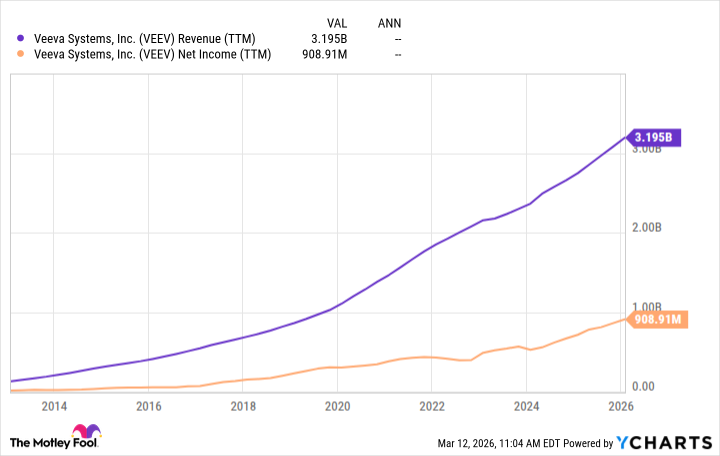
Now, growth has slowed a bit, as it inevitably does when a company gets, shall we say, established. But they estimate their total addressable market at around $20 billion. They’ve currently captured a little over 16% of that, which leaves a considerable amount of room for expansion. It’s a bit like discovering you’ve only explored a small corner of a vast and promising continent.
Don’t Bet the Farm (Or Your Retirement Account)
Let’s do a little math, shall we? To turn $70,000 into $2 million in thirty years requires a compound annual growth rate of 11.82%. Veeva has managed 13.6% over the past thirteen years. So, theoretically, it’s possible. But, as any sensible investor will tell you, past performance is no guarantee of future results. The stock market, after all, is less like a predictable machine and more like a particularly excitable weather system.
Veeva is expanding into new markets – cosmetics, consumer packaged goods, chemicals. It’s a sensible diversification strategy, although it will take time to meaningfully impact their bottom line. Think of it as planting a tree. You don’t get shade immediately. You have to wait. And hope it doesn’t get struck by lightning.
My view? Veeva Systems could be a useful addition to a well-diversified portfolio. It’s not a magic bullet, of course. There’s no such thing. But, with a little time and a disciplined approach, it might just help you reach your financial goals. Just don’t expect to be counting your millions overnight. Investing, like life, is a marathon, not a sprint.
Read More
- 20 Movies Where the Black Villain Was Secretly the Most Popular Character
- Transformers Under the Microscope: What Graph Neural Networks Reveal
- Celebs Who Narrowly Escaped The 9/11 Attacks
- Trading on Thin Air: AI Agents Conquer Crypto Volatility
- Silver Rate Forecast
- Gold Rate Forecast
- Invincible Season 4 Gender Swaps Tech Jacket As Fans Question Major Comic Change
- 22 Films Where the White Protagonist Is Canonically the Sidekick to a Black Lead
- Trading Smarter: AI-Powered Execution Schedules
- Every Notable ‘Star Trek: The Original Series’ Actor Who Died
2026-03-14 23:33