
Vanguard. The name itself feels…responsible. Like a headmaster, or a particularly sensible shoe brand. They’re everywhere, of course. Four trillion dollars worth of ‘everywhere,’ if you’re keeping track. Which I usually am, because my Aunt Mildred, bless her, decided to put her retirement into ETFs and now quizzes me relentlessly about ‘asset allocation’ and ‘beta coefficients.’ It’s exhausting. She keeps a spreadsheet, naturally. A color-coded spreadsheet.
They have a lot of these things, Vanguard. Over a hundred, which seems…excessive. Like a bakery with a hundred different types of sourdough. Eventually, some are going to get lost in the shuffle. Forgotten, left to stale on the shelf. And that, I suspect, is what’s happened with the Vanguard U.S. Minimum Volatility ETF. VFMV, they call it. Sounds like a particularly uninspired license plate.
A Better Mousetrap, Possibly
It’s been around for eight years, which in ETF years is…well, it’s not ancient, but it’s seen a few market cycles. It manages a respectable $340 million. Not exactly pocket change, but hardly the behemoth that is, say, the S&P 500 ETF. I’ve been looking at this fund for a while now, mostly because I’m trying to impress Aunt Mildred. She’s skeptical. She prefers funds with ‘brand recognition.’
The interesting thing is, this little fund has actually been outperforming some of its more famous siblings. Over the past five years, it’s quietly been doing its thing, while everyone else was chasing the latest meme stock or crypto fad. It’s almost…unseemly. Like a neighbor who wins the lottery and doesn’t brag about it.
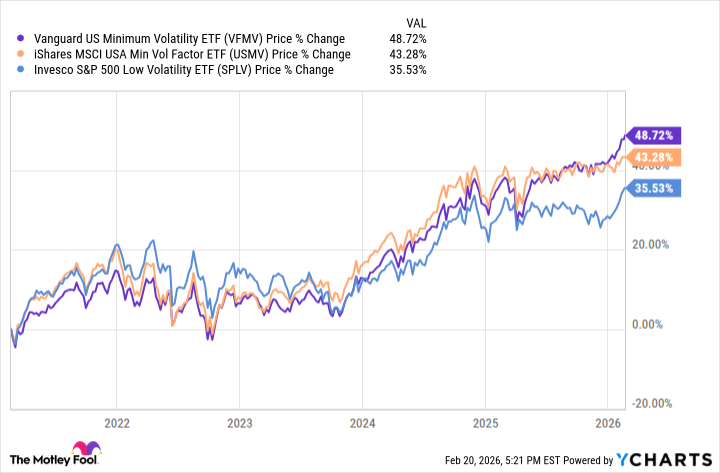
Apparently, it’s a bit of a hybrid. Vanguard, for all its indexing prowess, also dabbles in active management. Which always feels a little…dishonest, doesn’t it? Like a librarian who secretly enjoys reality television. They use a quantitative model, which means computers are involved, and I immediately distrust anything that requires a computer. It’s supposed to identify stocks with favorable volatility traits. In plain English, it picks stocks that don’t swing around quite as much.
And here’s the kicker: it’s not afraid of tech. Most “low volatility” funds are loaded up with consumer staples and utilities – the beige of the investment world. But this one actually has a significant chunk of its portfolio in tech stocks. It’s like a sensible accountant who secretly collects vintage motorcycles. And only 28% of its holdings overlap with the S&P 500 Low Volatility index, which suggests they’re doing something…different. Refreshing, even.
Long-Term Appeal, and a Low Fee
I used to think higher risk meant higher reward. It seemed logical. Then I met a retired neurosurgeon who lost a fortune betting on penny stocks. Turns out, lower-beta stocks – the ones that don’t jump around as much – have actually delivered better risk-adjusted returns over the long haul. It’s a counterintuitive truth, like discovering that your most annoying colleague is also the most competent.
And right now, these lower-beta stocks are actually trading at a discount. Investors seem to be obsessed with the next big thing, ignoring the steady, reliable performers. It’s a bit like a dating app – everyone’s swiping right on the flashy profiles, overlooking the genuinely kind and dependable people.
Oh, and the annual fee? A measly 0.13%. Thirteen dollars on a $10,000 investment. That’s practically a gift. Aunt Mildred would approve. Maybe. She’s still holding out for a fund that’s endorsed by a celebrity chef.
Read More
- Invincible Season 4 Gender Swaps Tech Jacket As Fans Question Major Comic Change
- Building Agents That Learn and Improve Themselves
- Gold Rate Forecast
- Silver Rate Forecast
- Games That Faced Bans in Countries Over Political Themes
- Superman Flops Financially: $350M Budget, Still No Profit (Scoop Confirmed)
- Trading Crypto with AI: A New Approach to Portfolio Management
- Unveiling the Schwab U.S. Dividend Equity ETF: A Portent of Financial Growth
- 22 Films Where the White Protagonist Is Canonically the Sidekick to a Black Lead
- 15 Films That Were Shot Entirely on Phones
2026-02-24 18:52