
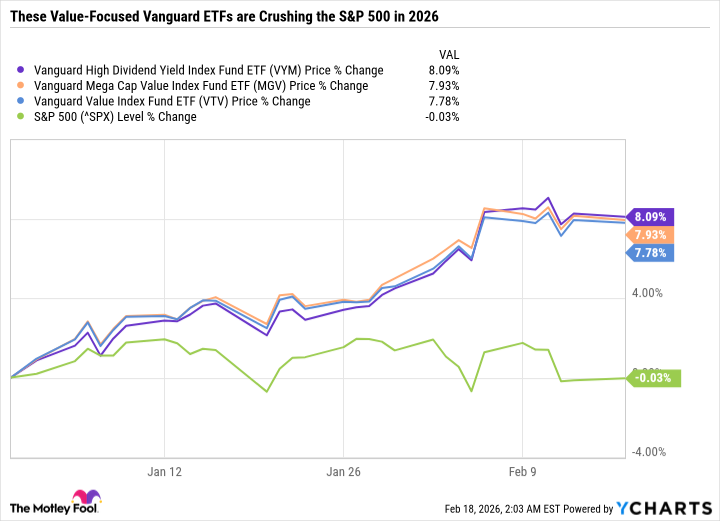
Recent market performance reveals a divergence beneath the surface of the broad indices. While the S&P 500 has exhibited limited year-to-date gains, this aggregate figure obscures a notable rotation. Sectors historically underrepresented in the capitalization-weighted index—consumer staples, energy, industrials, and materials—have demonstrated relative strength. Indeed, an equal-weighted S&P 500 has outperformed its market-cap counterpart, a phenomenon warranting closer inspection. This report examines three exchange-traded funds offered by Vanguard, each employing a value-oriented investment strategy, and assesses their relative merits for long-term capital allocation.
1. Vanguard Value ETF (VTV)
The Vanguard Value ETF (VTV), with approximately $227 billion in assets under management, represents a substantial presence within the value ETF landscape. Its scale permits a remarkably low expense ratio of 0.03%, a cost advantage accruing to investors. However, size alone does not guarantee performance. The fund’s composition diverges significantly from the growth-dominated profiles of benchmark indices. Financials, industrials, and healthcare constitute a majority (53.1%) of its holdings, reflecting a deliberate underweighting of technology and other high-growth sectors.
Core holdings include established entities such as JPMorgan Chase, Berkshire Hathaway, ExxonMobil, Johnson & Johnson, and Walmart. These companies, while lacking the speculative allure of certain growth stocks, possess established cash flows and a history of shareholder returns. The fund’s dividend yield of 2%, exceeding that of the S&P 500 (1.2%), provides a modest income stream. Currently, VTV trades at a price-to-earnings ratio of 21.7, a discount to the Vanguard S&P 500 ETF (27.5), suggesting a relative valuation advantage.
2. Vanguard Mega Cap Value ETF (MGV)
The Vanguard Mega Cap Value ETF (MGV) represents a more concentrated iteration of the core value strategy. With a slightly elevated expense ratio of 0.05%, MGV focuses on a smaller universe of 123 holdings, compared to VTV’s 312. While the constituent holdings exhibit considerable overlap, MGV allocates a greater weighting to the largest companies. For instance, the top five holdings (JPMorgan Chase, Berkshire Hathaway, ExxonMobil, Johnson & Johnson, and Walmart) account for 16.1% of the portfolio, compared to 13.1% in VTV.
Over the past five years, MGV has marginally outperformed VTV (89.1% total return versus 85.5%). This incremental outperformance, however, is not statistically significant. The choice between these two ETFs should therefore be predicated on investor preference for concentration versus diversification. MGV offers a more focused exposure to industry-leading value stocks, while VTV provides broader market participation.
3. Vanguard High Dividend Yield ETF (VYM)
The Vanguard High Dividend Yield ETF (VYM) has demonstrated the strongest year-to-date performance of the three ETFs examined, up 8.1%. With 562 holdings and an expense ratio of 0.04%, VYM prioritizes companies with a track record of consistent dividend payments. However, the fund’s definition of “high yield” warrants scrutiny.
Broadcom, a significant holding, has experienced substantial growth driven by its semiconductor business, a development seemingly at odds with a traditional value mandate. Similarly, Walmart’s consistent dividend increases are offset by its elevated share price, resulting in a relatively modest yield of 0.7%. The fund’s approach—maintaining positions in companies that have demonstrated shareholder returns—is, however, consistent with a long-term investment horizon. VYM’s dividend yield of 2.3% is comparable to VTV and MGV, while its valuation metrics remain broadly aligned.
Comparative Assessment
The Vanguard Value ETF, Mega Cap Value ETF, and High Dividend Yield ETF exhibit considerable similarities. For the majority of investors, the selection of a preferred fund will likely depend on subtle nuances in portfolio construction and risk tolerance. VTV offers the broadest diversification, while MGV provides a more concentrated exposure to leading value stocks. VYM, while exhibiting a slightly higher yield, incorporates elements of growth, potentially increasing its volatility.
Prior to making an investment decision, a thorough assessment of individual financial goals and risk parameters is essential. The historical performance of these ETFs should not be construed as indicative of future results. Furthermore, investors should be cognizant of the inherent risks associated with equity investing, including market fluctuations and company-specific events.
Read More
- Invincible Season 4 Gender Swaps Tech Jacket As Fans Question Major Comic Change
- Building Agents That Learn and Improve Themselves
- Gold Rate Forecast
- Games That Faced Bans in Countries Over Political Themes
- Silver Rate Forecast
- Superman Flops Financially: $350M Budget, Still No Profit (Scoop Confirmed)
- Trading Crypto with AI: A New Approach to Portfolio Management
- 15 Films That Were Shot Entirely on Phones
- 22 Films Where the White Protagonist Is Canonically the Sidekick to a Black Lead
- Unveiling the Schwab U.S. Dividend Equity ETF: A Portent of Financial Growth
2026-02-23 20:46