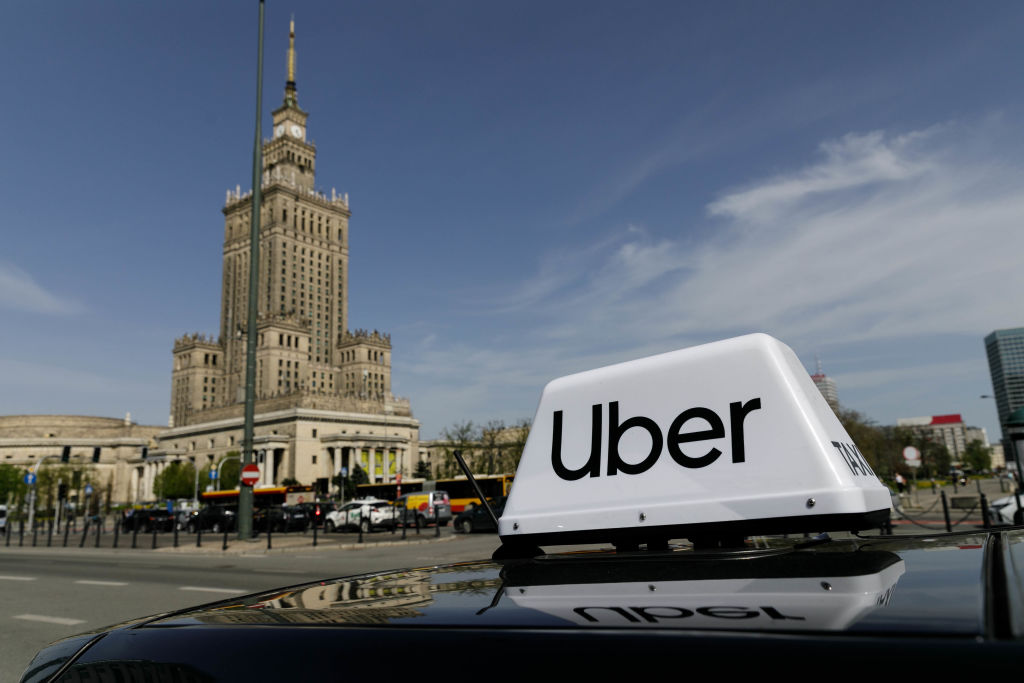
The universe, as anyone who’s accidentally glanced at a physics textbook knows, is a profoundly strange place. And within this strangeness, markets operate. Sometimes, they operate with a logic so baffling it would make a Boltzmann brain reconsider its existence. Which brings us to Uber. Yes, that Uber – the company that successfully monetized the human desire to avoid walking and occasionally, the fundamental laws of supply and demand.
One might assume, given the current obsession with a select group of tech behemoths (dubbed the “Magnificent Seven,” a moniker that sounds suspiciously like a 1970s superhero team), that the really interesting opportunities are already fully priced into those stocks. But Dara Khosrowshahi, Uber’s CEO since August 2017 (a period roughly equivalent to several geological epochs in internet time), suggests otherwise. He’s pointed to a multi-trillion-dollar opportunity lurking just around the corner. A corner, naturally, that’s probably curved and possibly guarded by a very polite but firm robot.
Navigating an Uncertain Journey (and the Robots Within It)
The biggest immediate risk for Uber isn’t, surprisingly, the existential dread of being a company in the 21st century. It’s the creeping realization that autonomous vehicles (AVs) could, theoretically, render its entire business model…redundant. Think of it: a world where you summon a vehicle with a thought, it arrives silently, and no one asks awkward questions about your destination. It’s a lovely thought, assuming you trust the algorithms. Leaders like Tesla and Alphabet’s Waymo are, naturally, also eyeing this potential future, which means a potentially fierce competition. The usual suspects, really. Costs, regulations, and the small matter of not crashing into things are, of course, all still being sorted out. (One suspects the paperwork alone will require a dedicated planet.)
However, Khosrowshahi seems remarkably unfazed. He believes AVs won’t destroy Uber, but rather unlock a truly colossal market. His reasoning? Global scale, a frighteningly dense network of demand (apparently, a lot of people want rides), sophisticated marketplace technology (which, let’s be honest, mostly involves matching people with cars), and decades of experience matching millions of trips in real-time. It’s a bit like being really good at herding cats…except the cats are humans and the herd is the entire planet.
Still a Long Way to Go (and a Lot of Code to Write)
Uber isn’t sitting around waiting for the robot apocalypse. It’s already dipping its toes into the AV waters. Through various partnerships, it’s currently facilitating AV rides in seven cities, with plans to expand to fifteen. More supply, the theory goes, will expand the market. (It’s a basic principle of economics, unless you happen to be selling slightly used planets.) This has already been observed in Atlanta and Austin, Texas, where the increased availability of AVs has… well, increased the availability of AVs. A truly remarkable cycle.
The long-term vision, naturally, involves a world where people don’t bother owning cars. Why bother with insurance, maintenance, and the sheer existential dread of parallel parking when you can simply summon a ride on demand? (It’s a compelling argument, assuming you’re not a dedicated petrolhead.) However, Khosrowshahi acknowledges that capturing this multi-trillion-dollar opportunity is…a work in progress. Currently, only 0.1% of ride-hailing trips worldwide are handled by AVs. (Which means 99.9% are still driven by actual humans. A comforting thought, perhaps?) There are, of course, issues related to weather, low-density population areas, and the occasional rogue squirrel.
Uber’s strength lies in its ability to aggregate demand – 202 million active users is a rather substantial pool of potential riders. This is supported by a powerful network effect. The company’s platform has evolved into a hybrid model of human drivers and AVs, capable of handling the extreme fluctuations in demand that occur throughout the day and week. For AV enterprises, maximizing revenue will be key. (A concept that, surprisingly, still eludes some companies.)
This should, theoretically, alleviate investor concerns about Uber’s biggest competitive risk. Uber, it seems, is staring at a remarkably long growth runway ahead. Whether it will actually reach the end of that runway, or simply get lost in the fog of technological disruption, remains to be seen. But it’s certainly a more interesting prospect than, say, counting grains of sand on a beach. Or, indeed, trying to understand the tax code.
Read More
- Invincible Season 4 Gender Swaps Tech Jacket As Fans Question Major Comic Change
- Silver Rate Forecast
- Gold Rate Forecast
- 22 Films Where the White Protagonist Is Canonically the Sidekick to a Black Lead
- Building Agents That Learn and Improve Themselves
- 15 Films That Were Shot Entirely on Phones
- 20 Movies Where the Black Villain Was Secretly the Most Popular Character
- Celebs Who Narrowly Escaped The 9/11 Attacks
- Trading Crypto with AI: A New Approach to Portfolio Management
- 18 TV Series Filming Rehearsals as Bonus Content
2026-02-21 12:04