Author: Denis Avetisyan
A new statistical framework reveals how narratives evolve within large collections of text over time.
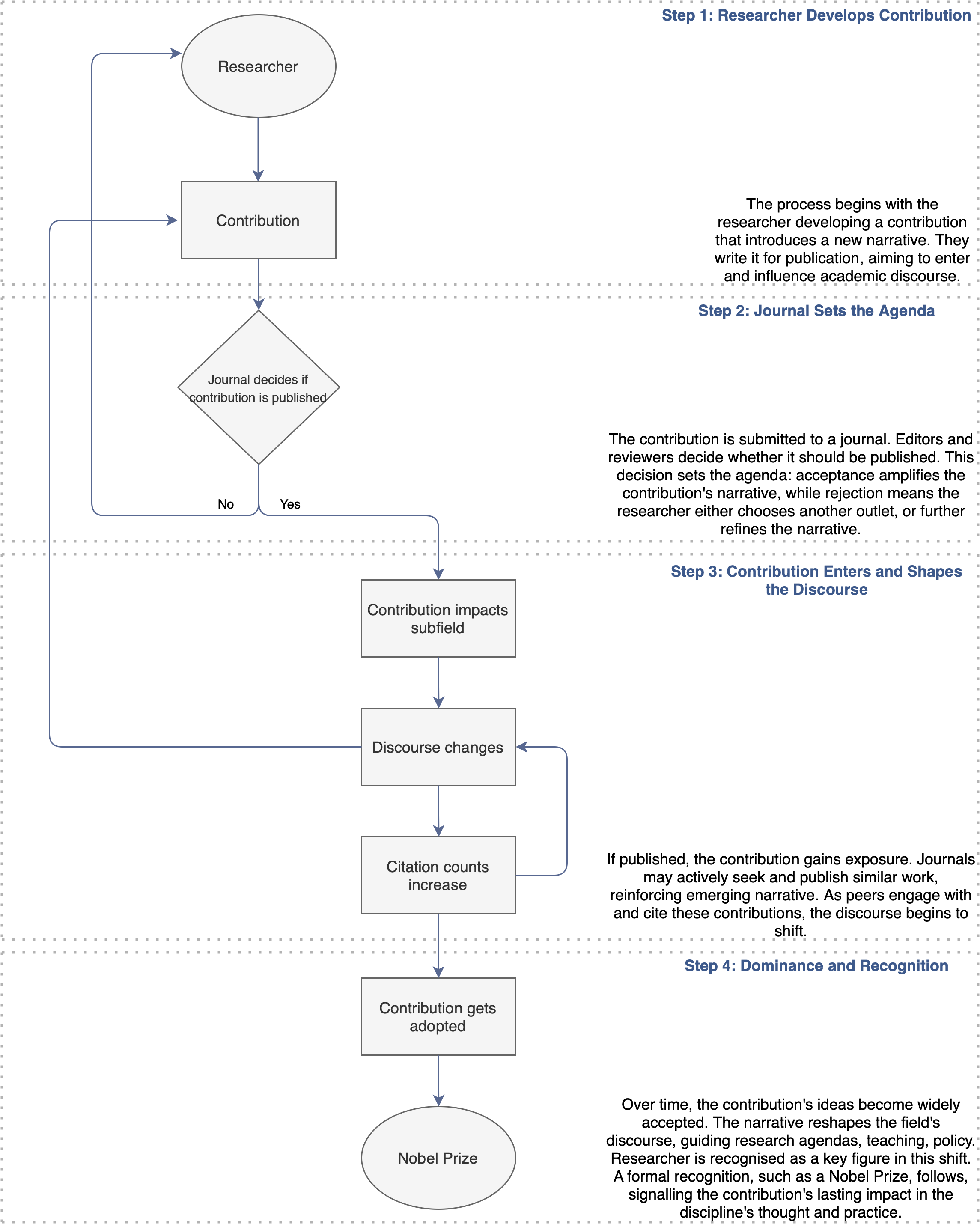
This work introduces a method leveraging Latent Dirichlet Allocation to identify and interpret emergent themes in longitudinal text corpora, demonstrating its utility in analyzing shifts in economic discourse and scholarly influence.
Identifying subtle shifts in dominant narratives within large textual datasets remains a significant challenge, despite their acknowledged influence on fields like economics and business. This is addressed in ‘A Statistical Framework for Detecting Emergent Narratives in Longitudinal Text Corpora’, which proposes a novel statistical approach leveraging Latent Dirichlet Allocation (LDA) to model and interpret the emergence of thematic prominence over time. The study demonstrates that sustained increases in topic prevalence, as estimated by the model, correlate with externally validated signals of influential narratives-specifically, Nobel Prize-recognised contributions in economics. Can this framework provide a robust, statistically grounded method for tracking evolving discourse and understanding the drivers of intellectual change across diverse longitudinal text corpora?
Mapping the Intellectual Landscape of Economics
The field of economics isn’t static; it’s a continuous conversation built upon decades of scholarly work, collectively known as ‘Economic Discourse’. Comprehending the discipline’s progression demands a systematic examination of this expansive body of research-journals, books, and working papers-to discern how central themes have transformed and novel concepts have gained traction. This analysis isn’t merely about tracking individual arguments, but about identifying the shifting priorities within the field – what questions economists choose to address, and how they frame those questions over time. By mapping these changes, researchers can begin to understand the forces driving intellectual evolution, revealing how economic thought responds to real-world events, internal debates, and the development of new methodologies. The ability to trace these themes is crucial for contextualizing contemporary economic debates and forecasting future research directions.
The sheer volume of published economic research presents a significant challenge to comprehensively understanding the field’s intellectual trajectory. Traditional literature reviews, while valuable, are often limited by their subjective nature and inability to scale with the exponentially growing body of work. Manual synthesis struggles to identify subtle shifts in emphasis or the emergence of genuinely novel ideas buried within countless publications. Consequently, pinpointing the precise moment a concept gains traction, or tracing its evolution through various theoretical frameworks, becomes increasingly difficult. This limitation hinders a full appreciation of how economic thought adapts to changing realities and impedes the identification of potentially transformative concepts before they become widely recognized, ultimately slowing the pace of progress within the discipline.
To truly understand the trajectory of economic thought, researchers are developing quantitative methods for tracking the rise and fall of specific topics within the vast body of economic literature. This involves moving beyond simple citation counts to analyze the context in which ideas appear, identifying shifts in emphasis and the emergence of novel themes. Sophisticated computational techniques, including natural language processing and topic modeling, are employed to map the ‘intellectual landscape’ over time, revealing how certain concepts gain prominence while others fade. By quantifying these shifts, scholars aim to uncover the underlying forces – such as real-world events, methodological innovations, or the influence of particular thinkers – that shape the evolution of economic discourse and ultimately, the field itself.
Uncovering Hidden Themes with Latent Dirichlet Allocation
Latent Dirichlet Allocation (LDA) is an unsupervised machine learning technique used for topic modeling, and in this research, it’s applied to the analysis of economic literature. LDA functions by probabilistically assigning each document to a mixture of topics and each topic to a distribution of words. Specifically, LDA identifies latent, or hidden, thematic structures within a corpus of text by analyzing word co-occurrence patterns. The algorithm assumes that each document is generated from a mixture of topics, and each topic is characterized by a distribution over a vocabulary of words. Through iterative statistical inference, LDA determines both the topic composition of each document and the word distribution of each topic, effectively revealing the underlying thematic landscape of the economic research being analyzed.
The Topic Proportion, as calculated by Latent Dirichlet Allocation (LDA), represents the probability distribution of topics within a given document. Specifically, it quantifies the percentage of a document’s content attributable to each identified topic. This is achieved through a statistical modeling process where LDA assigns each word in a document to a specific topic, and the Topic Proportion is derived from the aggregate word assignments. A document with a high Topic Proportion for a given topic indicates a strong thematic emphasis on that subject, providing a quantifiable measure of its content’s focus. These proportions, ranging from 0 to 1, sum to 1 for each document, ensuring a complete thematic representation.
The application of Latent Dirichlet Allocation (LDA) benefits significantly from the use of the JEL Classification system to construct focused research corpora. JEL codes, a standardized system for categorizing economic literature by subject matter, enable the creation of subfield-specific datasets. This curated approach ensures that LDA’s topic modeling operates on a body of research directly relevant to a particular area of economics, rather than a broad and potentially noisy collection. By isolating research based on JEL codes, we improve the coherence and interpretability of the resulting topic models, facilitating the identification of distinct themes within specific economic subfields.
Quantifying the Emergence of Narrative Shifts
To objectively identify ‘Narrative Emergence’, our methodology employs non-parametric statistical tests – the Mann-Kendall Test and Sen’s Slope Estimator – applied to the proportions of identified topics within the text corpus. The Mann-Kendall Test assesses the presence of a monotonic trend (consistent increasing or decreasing) in topic prevalence, without assuming data normality. Sen’s Slope Estimator then quantifies the magnitude and direction of this trend, providing an average change in topic proportion per unit of time. These tests are preferred due to their robustness against outliers and their lack of reliance on distributional assumptions, making them suitable for analyzing textual data where traditional parametric methods may be inappropriate.
The application of non-parametric statistical tests, specifically the Mann-Kendall Test and Sen’s Slope Estimator, moves beyond qualitative assessment of narrative emergence by providing quantifiable evidence of sustained thematic shifts. The Mann-Kendall test determines the presence of a monotonic trend – consistently increasing or decreasing topic proportions – while Sen’s Slope Estimator quantifies the magnitude and direction of that trend. This approach avoids subjective interpretation inherent in simple observation, offering statistically defensible conclusions regarding changes in thematic emphasis over time. The tests are particularly valuable as they do not require data to be normally distributed, a common characteristic of text data, and are robust to outliers, ensuring reliable detection of even subtle but consistent narrative developments.
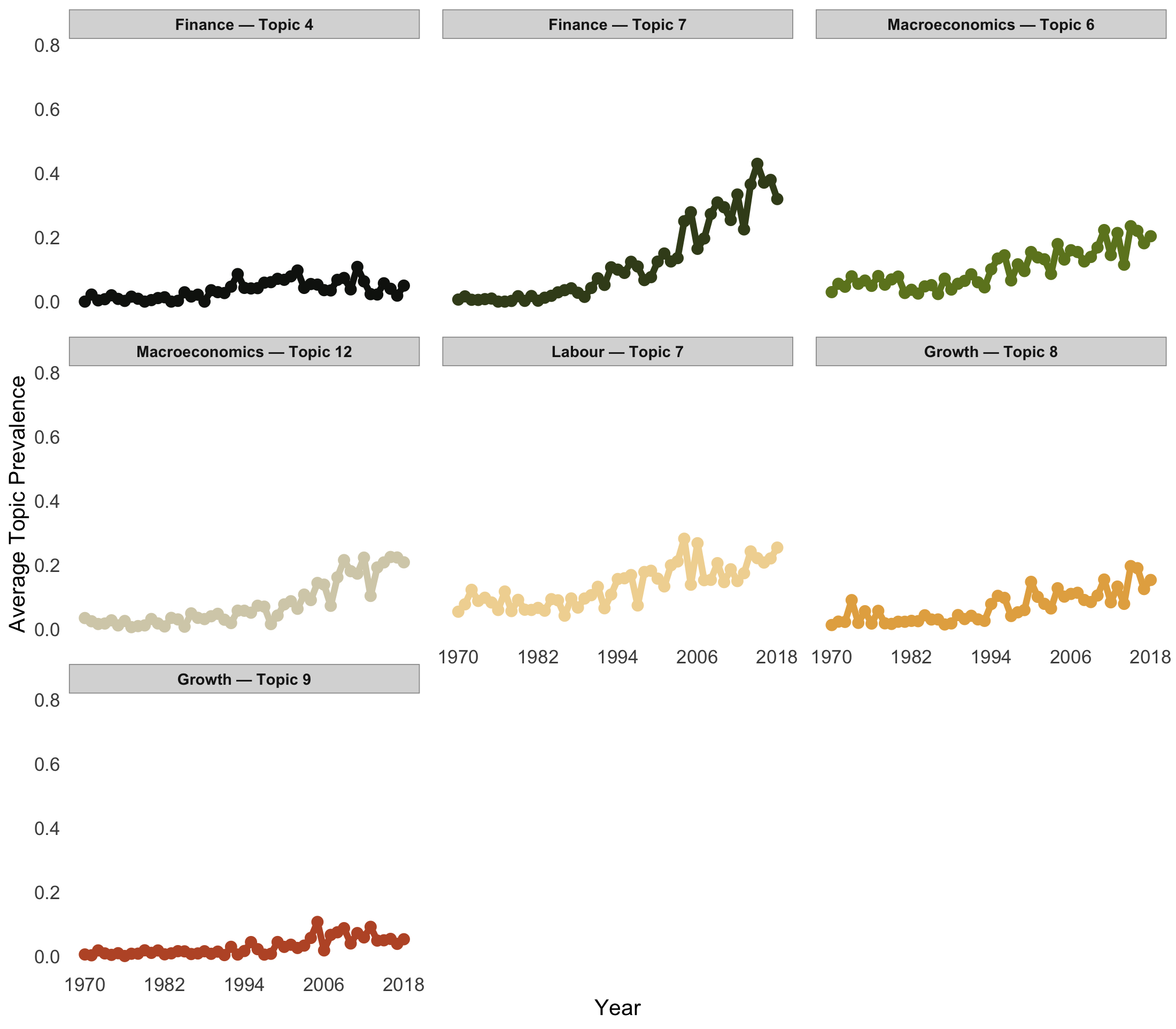
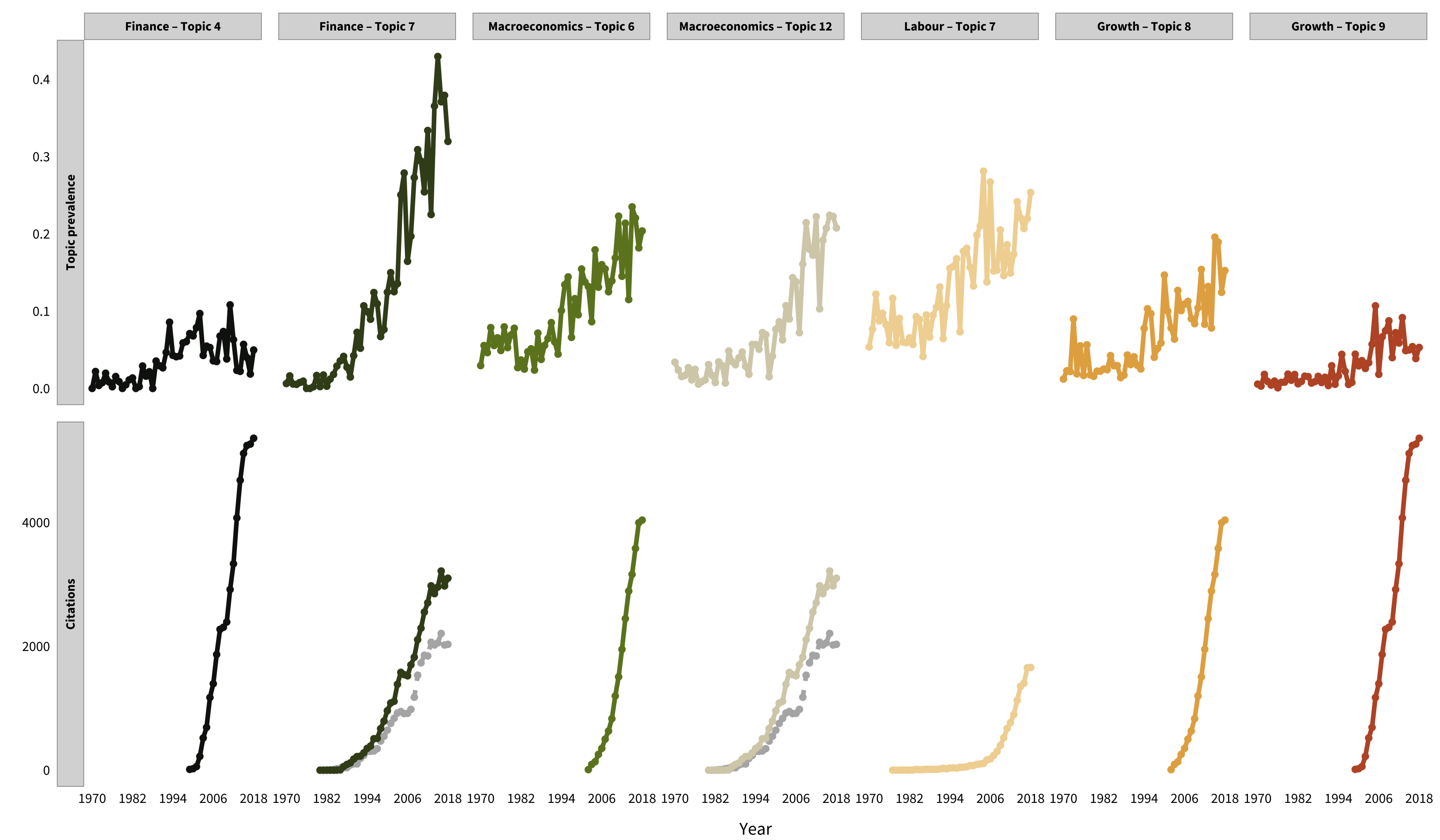
Statistical analysis of topic trajectories reveals significant positive trends, as measured by Kendall’s τ values ranging from 0.47 to 0.84. These values indicate a monotonic increase in the prominence of specific topics over the analyzed time period. A τ of 0.47 represents a moderate positive trend, while values approaching 0.84 signify a very strong, consistently increasing emphasis on the corresponding topic. The observed statistical significance supports the conclusion that these increases are not due to random fluctuation and represent a demonstrable shift in thematic focus.
Validating Insights and Recognizing Influential Narratives
The significance of newly identified research narratives gains further credence when considered alongside the recognition afforded to pioneering researchers through the Nobel Prize. Awards bestowed to individuals investigating specific themes serve as a retrospective validation of those areas’ importance and lasting impact on the field. This alignment between emergent trends, as revealed by computational analysis, and the accolades of the Nobel Prize suggests a robust and meaningful connection between current research directions and the most influential contributions to economic understanding. Examining Nobel laureates provides a historical benchmark, confirming that topics gaining prominence in recent discourse are not merely fleeting interests, but build upon a foundation of established and highly regarded scholarship.
The evolving landscape of economic thought is increasingly dominated by considerations of instability and interconnectedness, as evidenced by a significant surge in discourse surrounding ‘Financial Crises’ and ‘Systemic Risk’. Recent analyses demonstrate a clear upward trend in the prevalence of these topics within academic literature and professional discussions, indicating a growing recognition of their central importance to understanding modern economic systems. This heightened focus reflects a shift away from models prioritizing equilibrium and towards those acknowledging the inherent potential for disruption and cascading failures within complex financial networks. The growing prominence of these themes suggests a broader intellectual response to real-world events and a desire to develop more robust frameworks for anticipating and mitigating future economic shocks.
Analysis of topic prevalence reveals a consistent upward trend across several key areas of economic discourse. Employing Sen’s slope as a metric, researchers determined the annual rate of increase for identified topics ranged from 0.0038 to 0.0076, indicating growing attention within the field. Notably, the topic designated ‘Finance – Topic 7’ demonstrated the most significant surge in prevalence, registering an annual increase of 0.0076. This substantial growth suggests an evolving focus within financial research, potentially reflecting increased scrutiny of contemporary financial landscapes and a deepening understanding of related systemic challenges. The observed rates provide quantifiable evidence of shifting priorities and emerging themes driving academic investigation and, consequently, shaping the broader economic conversation.
Advancing Economic Methodology and Future Directions
A novel methodological toolkit, combining Latent Dirichlet Allocation (LDA), statistical trend analysis, and external validation, offers economists an unprecedented ability to chart the development of thought within the discipline. This approach moves beyond simple citation analysis by computationally identifying underlying thematic topics – such as behavioral economics or game theory – within a large corpus of economic literature. By then applying statistical methods to track the prevalence of these topics over time, researchers can discern evolving intellectual currents and pinpoint areas of growing or waning influence. Crucially, external validation – comparing the computationally derived trends with expert assessments and real-world economic events – strengthens the reliability of the findings and offers a robust means of understanding how economic ideas gain traction, mature, and ultimately shape the field.
The analytical framework-combining Latent Dirichlet Allocation, statistical trend analysis, and external validation-possesses considerable adaptability beyond its initial application. Researchers can readily apply this methodology to diverse subfields within economics, from behavioral finance to development economics, to chart the evolution of thought and pinpoint nascent research areas. Crucially, the proactive nature of this approach allows for the identification of emerging trends before widespread recognition, potentially enabling scholars and policymakers to anticipate future debates and focus resources on promising avenues of inquiry. This predictive capability extends beyond simply observing past shifts; it offers a means to navigate the complex landscape of economic research and proactively shape its future direction, fostering innovation and accelerating the pace of discovery.
Rigorous statistical analysis confirms the consistent evolution of identified economic topics over time. Specifically, each of the seven topic trajectories subjected to scrutiny exhibited statistically significant positive trends, with a p-value consistently below 0.01. This robust finding indicates that the observed shifts in economic thought aren’t attributable to random chance, but rather reflect genuine and measurable changes in the field’s focus. The consistent statistical significance across all tested topics strengthens the validity of the methodology employed, establishing it as a dependable tool for tracking intellectual development within economics and potentially other disciplines as well. This reliability allows for greater confidence in identifying not just past shifts, but also predicting future directions of economic research.
The pursuit of narrative emergence, as detailed within the statistical framework, demands a certain elegance in its interpretation. The paper’s application of Latent Dirichlet Allocation to longitudinal text reveals not merely what narratives arise, but how their thematic prominence shifts over time – a subtle dance of influence. This resonates with Paul Feyerabend’s assertion that “Anything goes.” While seemingly radical, this encourages a broad consideration of evidence, acknowledging that rigid adherence to a single methodology can obscure the nuanced emergence of meaning. The framework, by embracing statistical modeling, allows for a flexible exploration of topic prevalence, mirroring Feyerabend’s call for methodological pluralism in the pursuit of understanding complex phenomena.
What Lies Ahead?
The presented framework, while demonstrating a capacity to chart the rise and fall of thematic prominence within longitudinal text, merely scratches the surface of narrative detection. The elegance of Latent Dirichlet Allocation lies in its simplicity, yet this simplicity necessitates a degree of abstraction that obscures the nuanced interplay of rhetorical devices and contextual shifts truly defining a narrative’s lifecycle. Future iterations should grapple with incorporating sentiment analysis, not merely as an addendum, but as an integral component shaping topic weighting and temporal evolution.
A persistent challenge remains: discerning genuine narrative emergence from cyclical fluctuations inherent in any discursive field. The current approach relies heavily on statistical significance; however, significance does not equate to meaning. Each screen and interaction must be considered. A truly robust framework will require a theoretical foundation grounded in narrative theory, capable of differentiating between statistically anomalous shifts and those indicative of genuine conceptual innovation.
Ultimately, the goal is not simply to detect narratives, but to understand their persuasive power. The correlation observed between topic prevalence and scholarly influence hints at a deeper dynamic, suggesting narratives aren’t merely described by data; they shape it. Aesthetics humanize the system. Further research must address the question of agency: how do these emergent narratives, once identified, come to exert influence, and what are the implications for the evolution of knowledge itself?
Original article: https://arxiv.org/pdf/2602.20939.pdf
Contact the author: https://www.linkedin.com/in/avetisyan/
See also:
- Gold Rate Forecast
- Invincible Season 4 Gender Swaps Tech Jacket As Fans Question Major Comic Change
- Silver Rate Forecast
- 22 Films Where the White Protagonist Is Canonically the Sidekick to a Black Lead
- Unveiling the Schwab U.S. Dividend Equity ETF: A Portent of Financial Growth
- 14 Movies Where the Black Character Refuses to Save the White Protagonist
- The Best Former NFL Players Turned Actors, Ranked
- Why Won’t It Just *Do* What You Ask? Unpacking the Quirks of AI Language
- Superman Flops Financially: $350M Budget, Still No Profit (Scoop Confirmed)
- ONE PIECE Season 2 Confirms Sanji’s OTHER Backstory in the Live-Action
2026-02-25 06:09