
The current enthusiasm for artificial intelligence has, predictably, focused on the visible components: the processing units, the cloud infrastructure. These are the things that generate headlines. Less attention has been paid to the mundane necessities, the things that allow the spectacle to function. Specifically, memory. It is a quiet dependency, but a dependency nonetheless.
Sandisk, a manufacturer of flash memory, has recently experienced a surge in its share price. This is not, as some would have it, a testament to revolutionary innovation. It is, rather, a demonstration of how quickly capital will flow into any bottleneck in a rapidly expanding system. The market, as always, is not concerned with fundamentals, but with opportunity.
The Illusion of Progress
The narrative surrounding AI investment has been remarkably narrow. Nvidia and AMD, the purveyors of processing power, have been lauded as visionaries. Microsoft, Amazon, and Alphabet, the infrastructure providers, have been seen as the architects of the future. Those who supply the memory – the essential foundation – were long dismissed as purveyors of a commodity. This was a convenient oversight, allowing the more glamorous aspects of the AI boom to take center stage.
The truth is that high-performance computing requires more than just processing speed. As AI models grow in complexity, the ability to rapidly access vast quantities of data becomes paramount. This is where Sandisk, and its high-speed NAND flash storage, enters the equation. It is not a glamorous contribution, but it is a necessary one. And necessity, in the current climate, commands a premium.
The Limits of Growth
The NAND flash memory market is projected to grow at a modest rate – 5.3% annually. This is not the explosive growth that excites investors. However, a closer examination reveals a more nuanced picture. Currently, the vast majority of Sandisk’s revenue still comes from consumer electronics and mobile devices. The data center division, while growing rapidly, remains a relatively small part of the overall business.
This suggests that Sandisk is only beginning to tap into the potential of the AI market. The company’s ability to capture a larger share of this market will depend on its ability to scale production and maintain a competitive edge. This is not guaranteed. The memory market is dominated by a handful of players – Micron, SK Hynix, and Samsung – and competition is fierce.
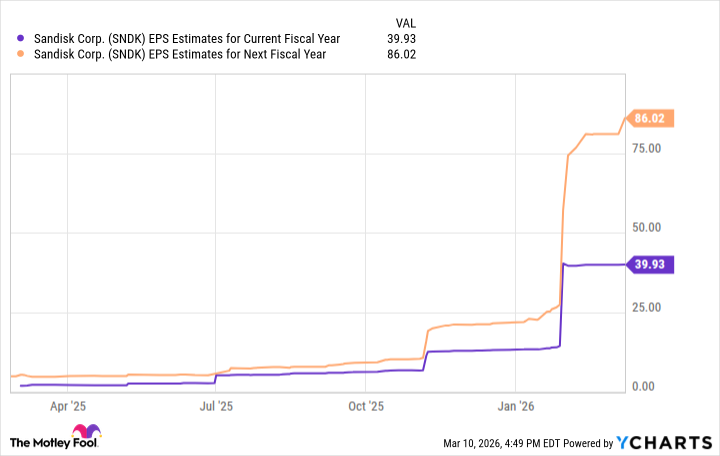
The Price of Perception
Sandisk is currently trading at a relatively low price-to-earnings multiple compared to other AI chip stocks. This is not necessarily an indication of undervaluation. It may simply reflect the market’s perception of memory as a less exciting, less innovative component of the AI ecosystem.
Comparing Sandisk to Nvidia or AMD is, to some extent, an apples-to-oranges comparison. Those companies are involved in the development of more versatile, general-purpose AI technologies. Sandisk’s expertise is more specialized. Its addressable market is smaller. However, this does not diminish its importance. A complex machine requires all of its parts to function properly.
A valuation in line with the Nasdaq-100 index would represent a significant increase in Sandisk’s share price. This is not an unreasonable expectation, given the company’s growth potential and the increasing demand for memory in the AI market. However, it is important to remember that market valuations are often driven by sentiment, not fundamentals.
Wall Street’s projections for capital expenditures by hyperscalers may be overly optimistic. If these projections prove to be inaccurate, Sandisk’s growth could be slower than expected. The company’s success will depend on its ability to navigate a complex and rapidly changing market.
The notion that Sandisk’s stock could double in 2026 is, frankly, speculative. It relies on a number of assumptions that may not hold true. However, in the current climate of irrational exuberance, anything is possible. The market, as always, is a fickle mistress.
Read More
- 20 Movies Where the Black Villain Was Secretly the Most Popular Character
- Celebs Who Narrowly Escaped The 9/11 Attacks
- Transformers Under the Microscope: What Graph Neural Networks Reveal
- Top 20 Dinosaur Movies, Ranked
- Silver Rate Forecast
- Trading on Thin Air: AI Agents Conquer Crypto Volatility
- Gold Rate Forecast
- 22 Films Where the White Protagonist Is Canonically the Sidekick to a Black Lead
- Every Notable ‘Star Trek: The Original Series’ Actor Who Died
- Games That Faced Bans in Countries Over Political Themes
2026-03-13 15:23