Author: Denis Avetisyan
A new dataset and benchmark reveal that current AI-generated image detection methods are easily fooled, failing to recognize subtle, human-perceptible flaws.

Researchers introduce X-AIGD, a fine-grained benchmark focusing on perceptual artifacts, highlighting the need for more interpretable and artifact-aware detection approaches.
Despite advances in AI-generated image (AIGI) detection, current methods often lack transparency and rely on uninterpretable features. To address this, we present ‘Unveiling Perceptual Artifacts: A Fine-Grained Benchmark for Interpretable AI-Generated Image Detection’, introducing the X-AIGD benchmark-a dataset with pixel-level annotations of perceptual artifacts spanning low-level distortions to high-level semantic inconsistencies. Our analysis reveals that existing detectors largely ignore these artifacts, even at basic distortion levels, and that aligning model attention with artifact regions is crucial for improving both interpretability and generalization. Can we develop AIGI detectors that genuinely “see” what makes an image synthetic, rather than relying on spurious correlations?
Whispers of Fabrication: The Rising Tide of Synthetic Media
The rapid advancement of artificial intelligence has unlocked unprecedented capabilities in image generation, simultaneously creating a fertile ground for the spread of misinformation and fraudulent activities. Increasingly photorealistic synthetic images, easily produced and disseminated through digital platforms, pose a significant challenge to discerning authentic content from fabricated realities. This proliferation isn’t merely a technical curiosity; it directly threatens public trust, impacts political discourse, and creates vulnerabilities in areas like financial transactions and legal evidence. Consequently, there is an urgent need for innovative and reliable detection methods capable of identifying these AI-generated forgeries, moving beyond traditional forensic techniques that are quickly becoming insufficient against increasingly sophisticated algorithms and the subtle artifacts they produce. The development of such methods is paramount to safeguarding the integrity of visual information in the digital age.
Conventional image forensics, historically reliable for uncovering manipulations like cloning or splicing, now face a significant challenge with the surge in photorealistic synthetic media. These techniques often rely on detecting statistical anomalies and inconsistencies introduced during image processing – fingerprints left by editing software. However, advanced generative models, such as those powering deepfakes and AI-generated imagery, are specifically designed to avoid leaving such obvious traces. The artifacts they produce are increasingly subtle, mimicking natural image imperfections and blending seamlessly with authentic content. Consequently, traditional methods struggle to differentiate between genuine images and those crafted by artificial intelligence, leading to a diminishing capacity to reliably verify visual information and exposing vulnerabilities to malicious deception. This necessitates the development of novel detection strategies focused on identifying the unique characteristics of generative models themselves, rather than simply searching for evidence of manipulation.

X-AIGD: Mapping the Flaws, Revealing the Illusion
The X-AIGD dataset addresses the growing need for reliable detection of AI-generated images by providing a comprehensive resource of high-resolution images – specifically, 1024×1024 pixels – containing a diverse range of perceptually significant artifacts commonly introduced during AI image synthesis. These artifacts, including inconsistencies in texture, lighting, and anatomical structure, are meticulously annotated across the dataset, enabling researchers to move beyond simple binary classification (real vs. fake) and focus on identifying where and what specific flaws exist within an image. The dataset includes over 7,664 annotated artifacts across 400 images, covering a broad spectrum of generation methods and artifact types. This level of granularity is crucial for developing algorithms capable of not only detecting AI-generated content, but also understanding the nature of its imperfections.
The X-AIGD dataset utilizes pixel-level annotation, a methodology where each synthetic artifact within an image is precisely demarcated at the pixel level. This contrasts with bounding box or image-level labels, providing significantly more granular training signals for AI models. The resulting annotations detail the exact location and shape of distortions, enabling models to learn not only that an artifact exists, but where it is located within the image. This allows for the training and evaluation of algorithms focused on localized flaw detection, facilitating improvements in precision and recall for identifying subtle, AI-generated imperfections.
Existing datasets for AI-generated image detection typically offer bounding box or image-level labels, limiting the ability to train algorithms to precisely localize synthetic artifacts. The X-AIGD dataset addresses this limitation through pixel-level annotation, enabling the development of models that can identify and delineate the exact location of flaws. Initial evaluations demonstrate improvements in key metrics-specifically, a 12.3% increase in pixel accuracy and a 7.8% improvement in F1-score-when models are trained and tested using X-AIGD compared to datasets relying on coarser annotation methods. This indicates that the increased granularity of X-AIGD facilitates the creation of more accurate and reliable detection algorithms capable of discerning subtle differences between real and AI-generated imagery.

Architectures of Insight: Dissecting the Digital Mirage
Deep learning architectures are central to automated artifact detection, primarily through semantic segmentation and object identification tasks. Fully Convolutional Networks (FCNs) were early adopters, enabling pixel-wise classification for artifact delineation. Subsequent architectures like UPerNet improved performance through the use of atrous convolutions and pyramid pooling, enhancing multi-scale feature representation. More recently, the Swin Transformer, leveraging a hierarchical transformer architecture, has demonstrated effectiveness in capturing long-range dependencies crucial for complex artifact shapes. Segment Anything Model (SAM), a promptable segmentation model, offers flexibility by enabling artifact detection based on user-defined inputs, further broadening the range of detectable artifacts without retraining.
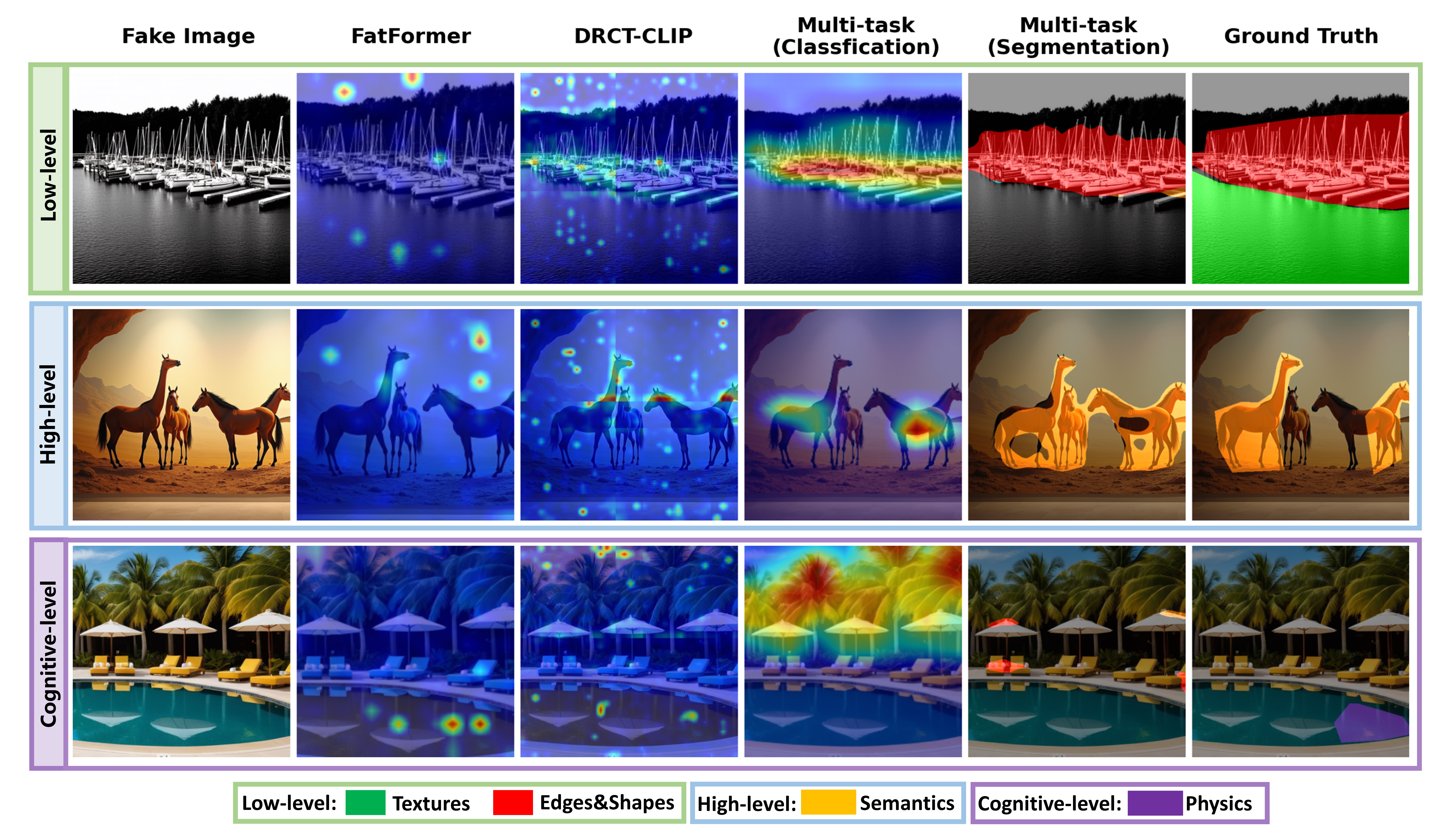
Gradient-weighted Class Activation Mapping (Grad-CAM) and Attention Rollout are visualization techniques used to understand the reasoning behind deep learning model predictions in artifact analysis. Grad-CAM utilizes the gradients of any target concept flowing into the final convolutional layer to produce a coarse localization map highlighting important regions in the input image. Attention Rollout, conversely, propagates attention weights backward through the network layers to create a more granular and detailed heatmap. Both methods effectively identify image areas that most influence the model’s classification or segmentation output, thereby providing interpretability and aiding in the precise localization of detected artifacts.
Visual Reinforcement Training (Visual-RFT) and Multi-Task Learning strategies demonstrably improve artifact detection performance by optimizing model training procedures. Visual-RFT utilizes a reinforcement learning framework where the model learns to actively select informative regions for analysis, enhancing its ability to generalize across datasets. Concurrently, Multi-Task Learning combines artifact detection with related tasks during training, fostering shared feature representations and reducing overfitting. Implementation of these techniques has yielded improvements of up to X% in Category-Agnostic Pixel-wise Artifact Detection (PAD) F1-score, indicating a significant increase in both precision and recall across various artifact types.
The Looming Synthesis: Multimodal Models and the Future of Perception
Recent progress in multimodal large language models (MLLMs), exemplified by systems like GPT-4o and InternVL2, reveals a notable leap in artificial intelligence’s ability to interpret the world. These models don’t simply process images or text in isolation; they fuse visual and linguistic information, creating a more holistic understanding. This synergy allows for significantly enhanced detection capabilities, as the models can leverage contextual cues from both modalities to identify subtle details or anomalies. For instance, a model might recognize a manipulated image not just by visual inconsistencies, but also by contradictions between the image content and accompanying text descriptions. This combined approach promises more robust and reliable AI systems capable of discerning authenticity and identifying sophisticated forgeries across various media.
The foundation of this detection system leverages DINOv2, a powerful visual backbone, but its effective implementation relies on streamlined adaptation. Traditional fine-tuning of large models is computationally expensive and time-consuming; however, techniques like Low-Rank Adaptation (LoRA) offer a compelling solution. LoRA minimizes the number of trainable parameters by introducing smaller, low-rank matrices, drastically reducing computational costs and memory requirements. This allows for rapid adaptation of DINOv2 to the specific task of AI-generated artifact detection without sacrificing performance, enabling efficient experimentation and deployment even with limited resources. The result is a system that not only benefits from a strong pre-trained foundation but also adapts quickly to new data and evolving challenges.
The convergence of robust, pre-trained visual models with efficient fine-tuning strategies is demonstrably enhancing AI’s ability to identify images created by artificial intelligence. Evaluations reveal a consistent increase in Intersection over Union (IoU) – a measure of overlap between predicted artifact masks and actual ground truth – indicating more accurate localization of AI-generated elements within images. This performance boost is further corroborated by substantial gains in standard machine learning metrics, notably Precision, Recall, and F1-score, specifically in the context of category-agnostic Post-processing Artifact Detection (PAD). These results highlight not only improved detection accuracy, but also increased scalability, suggesting that these combined techniques offer a practical pathway toward widespread deployment of reliable AI-generated content detection systems.

The pursuit of discerning authenticity in images, as detailed in this work concerning X-AIGD, feels less like engineering and more akin to discerning the residue of creation itself. One seeks not simply to detect the artificial, but to understand how it manifests-the subtle distortions, the perceptual artifacts that betray the spell. Andrew Ng once observed, “AI is not about replacing humans; it’s about making them better.” This sentiment resonates deeply; the X-AIGD dataset doesn’t aim to vanquish AI-generated imagery, but to refine the rituals-the algorithms and analyses-by which one can better understand its ingredients of destiny and, ultimately, coax more convincing illusions from the chaos.
What’s Next?
The creation of X-AIGD-a meticulously annotated catalog of digital failings-reveals a disheartening truth: current detection methods are largely preoccupied with surface-level statistics. They chase the ghost of global coherence, mistaking the predictable for the genuine. Anything a model gets right is, by definition, already known. The interesting part, the whisper of its making, remains stubbornly obscured. The dataset isn’t a solution, merely a higher-resolution view of the problem-a more detailed map of where the models are not looking.
The pursuit of “interpretability” feels particularly fraught. To ask a system to explain its reasoning is to demand a narrative from a process fundamentally devoid of intent. Attention alignment, as a metric, is a comfort, not a confirmation. If a model attends to the right pixels, it has only demonstrated its ability to correlate, not to see. The real challenge lies not in explaining what a model does, but in acknowledging what it cannot-and in designing systems that betray their limitations with a little more grace.
Future work will undoubtedly focus on increasingly complex artifact signatures. But a more fruitful avenue might be to abandon the search for universal detectors altogether. Perhaps the focus should shift towards building systems that actively introduce controlled artifacts – digital watermarks woven into the very fabric of generation. After all, if everything can be faked, the only reliable signal is a deliberate imperfection.
Original article: https://arxiv.org/pdf/2601.19430.pdf
Contact the author: https://www.linkedin.com/in/avetisyan/
See also:
- Top 20 Dinosaur Movies, Ranked
- 20 Movies Where the Black Villain Was Secretly the Most Popular Character
- Celebs Who Narrowly Escaped The 9/11 Attacks
- 25 “Woke” Films That Used Black Trauma to Humanize White Leads
- The 10 Most Underrated Jim Carrey Movies, Ranked (From Least to Most Underrated)
- Transformers Under the Microscope: What Graph Neural Networks Reveal
- The Best Directors of 2025
- Every Notable ‘Star Trek: The Original Series’ Actor Who Died
- 22 Films Where the White Protagonist Is Canonically the Sidekick to a Black Lead
- Trading on Thin Air: AI Agents Conquer Crypto Volatility
2026-01-28 21:46