
The prevailing economic narratives, much like cartographic projections, offer a comforting illusion of totality. We speak of ‘growth’ and ‘earnings’ as if these were immutable quantities, observed from a fixed point. Yet, the current conjuncture suggests a more unsettling geometry. The so-called ‘K-shaped recovery’ – a bifurcation of fortune – is not merely a statistical observation, but a symptom of a deeper, more recursive imbalance. The market ascends, driven by expenditure, but the foundations of that ascent are…peculiar.
For some time, I have been compiling a fragmentary treatise – tentatively titled ‘On the Topology of Debt’ – and the data accumulating is disconcerting. Personal spending, while superficially robust, exhibits a quality of borrowed time. It is as if a vast clockwork mechanism is maintained not by its inherent energy, but by the continual winding of a diminishing spring. The average monthly increase of 0.4%, a figure often cited with satisfaction, masks a reliance on credit that borders on the ontological.
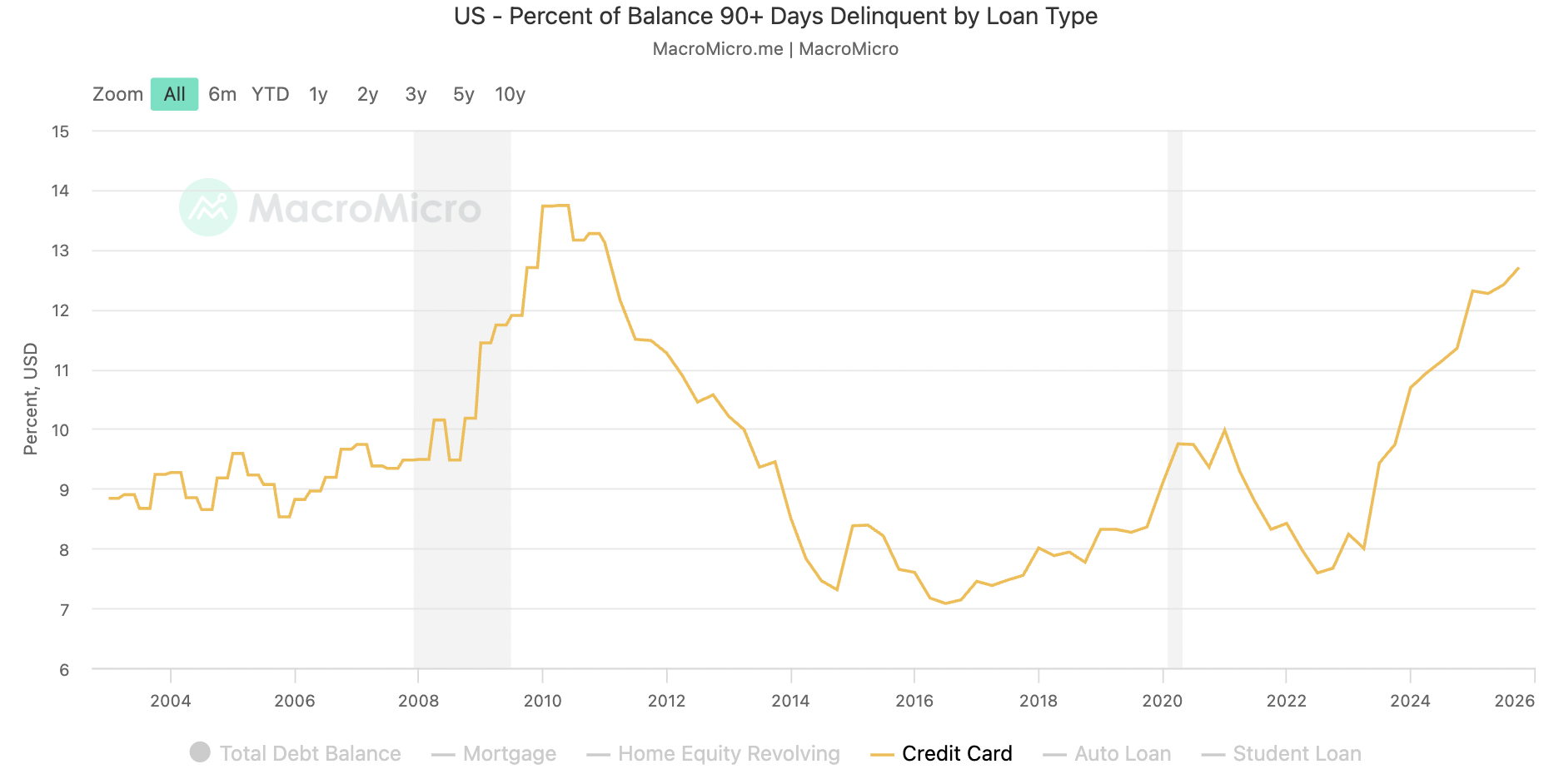
The current rate of delinquency on credit card debt – approaching 13% as of the last quarter – is not simply a number. It is a point of inflection, a node in a labyrinth of obligations. My research into the archives of the Banco Nacional suggests a similar pattern preceded the crisis of 2008, though the specific details, naturally, are lost in the inevitable bureaucratic erosion. The trajectory is alarming; a climb from approximately 8% to over 12% in a mere three years. One is tempted to postulate a fixed interval of instability, a recurring dream within the economic calendar.
The market, of course, remains largely indifferent to the source of this expenditure. It is a creature of momentum, a hall of mirrors reflecting only the illusion of prosperity. The calculations are elegant in their simplicity, but they lack the crucial element of context. They are, to borrow a phrase from the apocryphal scholar Alistair Finch, “blind to the shadows.”
One would expect, ideally, a correspondence between increased spending and increased incomes. Yet, wage growth, while nominally positive, has demonstrably lagged behind the escalating cost of goods. Inflation, hovering around 3%, erodes purchasing power with the relentless efficiency of a desert wind. The consequence, predictably, is a reliance on borrowed funds, a deferral of reckoning that can only be temporary. It is as if one attempts to build a tower on foundations of sand, bracing it with increasingly fragile supports.
The parallels to the late 2000s are… unsettling. The illusion of limitless credit, the gradual accumulation of risk, the inevitable moment of collapse. One might posit that these cycles are not accidental, but inherent to the structure of modern finance, a kind of economic karma. Any attempt by legislative bodies to intervene, I suspect, will prove futile, akin to rearranging the furniture on a sinking ship. The only plausible outcome, as far as I can discern, is a painful recalibration, a dismantling of the unsustainable edifice we have constructed.
The market, as always, will offer its own interpretation, a complex and ultimately unknowable equation. But the discerning observer, the student of patterns, can at least glimpse the shadows, and prepare for the inevitable descent. The labyrinth, after all, always has an exit – though it may not be the one we desire.
Read More
- Top 20 Dinosaur Movies, Ranked
- 20 Movies Where the Black Villain Was Secretly the Most Popular Character
- 25 “Woke” Films That Used Black Trauma to Humanize White Leads
- Silver Rate Forecast
- Gold Rate Forecast
- Spotting the Loops in Autonomous Systems
- From Bids to Best Policies: Smarter Auto-Bidding with Generative AI
- 22 Films Where the White Protagonist Is Canonically the Sidekick to a Black Lead
- Celebs Who Narrowly Escaped The 9/11 Attacks
- Can AI Lie with a Picture? Detecting Deception in Multimodal Models
2026-03-04 17:02