
For three years, the machines have ascended, their valuations mirroring a trajectory previously reserved for theological speculation. The S&P 500, a construct of numbers attempting to quantify the unquantifiable, experienced a surge, a temporary reprieve from the inherent meaninglessness. But the reprieve, as all things do, faltered. The benchmark now oscillates, a pendulum swinging between illusory gains and the inevitable descent, mirroring the anxieties of those who observe its movements. The concern, naturally, is not the numbers themselves, but the justification for them – a revenue stream predicated on an expectation of perpetual novelty, a demand that seems, upon closer inspection, to be built on air.
And yet, the apparatus continues. Investors, those diligent functionaries of capital, express a discernible unease. The ‘fear gauge,’ a curiously named instrument that attempts to measure the immeasurable, has spiked to 24. A number, of course, but also a symptom. It suggests a recognition, however fleeting, that the promised dividends of artificial intelligence may be less a certainty and more a bureaucratic process with no discernible endpoint. History, or what passes for it in these algorithmic times, offers a pattern. And the pattern is not reassuring.
The Illusion of Ascent
The ascent, as previously noted, was predicated on a belief in the transformative power of these new technologies. Nvidia, Palantir Technologies, Meta Platforms – these names, once mere designations, became totems of a new faith. Investors, driven by a compulsion to participate in the illusion, poured capital into these ventures, anticipating a return that, logically, could not be sustained. The logic, however, was never the point. The point was the participation itself, the adherence to a system that demanded constant growth, regardless of underlying value.
Billions were allocated, pledges made, infrastructure constructed – a labyrinthine network of servers and data centers, all dedicated to the pursuit of an intelligence that remains, stubbornly, elusive. The promise was efficiency, optimization, increased earnings. But the earnings, when scrutinized, appear to be less a result of genuine innovation and more a consequence of financial engineering, a shuffling of assets designed to maintain the illusion of prosperity. The capital expenditure, nearing $700 billion, feels less like investment and more like a ritualistic offering, a desperate attempt to appease the algorithmic gods.
And now, the unease. The question is not whether the demand exists – the demand, it seems, is insatiable – but whether the supply can justify the expenditure. The ongoing geopolitical disturbances, the arbitrary fluctuations of interest rates – these are merely distractions, symptoms of a deeper malaise. The true concern is the inherent fragility of the system, its reliance on a narrative that, upon closer inspection, begins to unravel.
The Measurement of Anxiety
The ‘fear gauge,’ formally known as the CBOE Volatility Index (VIX), is a curious instrument. It attempts to quantify the immeasurable, to assign a numerical value to the collective anxiety of the market. It is based on options on the S&P 500, a construct of numbers attempting to quantify the unquantifiable. When the VIX climbs, it suggests that investors expect volatility ahead; when it falls, it indicates expectations of a steady market environment. It is, in essence, a self-fulfilling prophecy, a feedback loop that amplifies the prevailing sentiment.
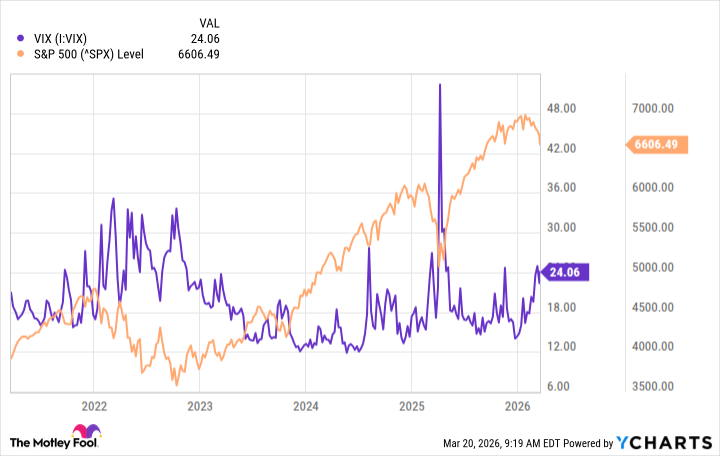
History, or what passes for it in these algorithmic times, offers a pattern. A peak in the VIX has consistently accompanied declines in the S&P 500. Therefore, it is logical to assume that AI stocks, heavily weighted within the benchmark, will continue to slip. The technology sector, the engine of this artificial ascent, will bear the brunt of the correction. But the correction, as all corrections do, will be temporary. The S&P 500, driven by forces beyond our comprehension, will rebound. And AI stocks, buoyed by the relentless flow of capital, will once again ascend.
However, a prudent investor does not rely on historical patterns or algorithmic predictions. A prudent investor recognizes the inherent absurdity of the system and seeks opportunities to acquire quality assets at discounted prices. The current dip in AI stocks represents such an opportunity. The long-term outlook remains bright, but the path will be fraught with volatility and uncertainty. The fear gauge, therefore, should not be interpreted as a signal to flee, but as an invitation to participate, to acquire a stake in the illusion, and to reap the rewards when the machine inevitably resumes its ascent.
Read More
- Gold Rate Forecast
- Games That Faced Bans in Countries Over Political Themes
- Silver Rate Forecast
- 22 Films Where the White Protagonist Is Canonically the Sidekick to a Black Lead
- Unveiling the Schwab U.S. Dividend Equity ETF: A Portent of Financial Growth
- How to Do Sculptor Without a Future in KCD2 – Get 3 Sculptor’s Things
- Celebs Who Narrowly Escaped The 9/11 Attacks
- 14 Movies Where the Black Character Refuses to Save the White Protagonist
- 20 Movies Where the Black Villain Was Secretly the Most Popular Character
- The Best Directors of 2025
2026-03-23 01:34