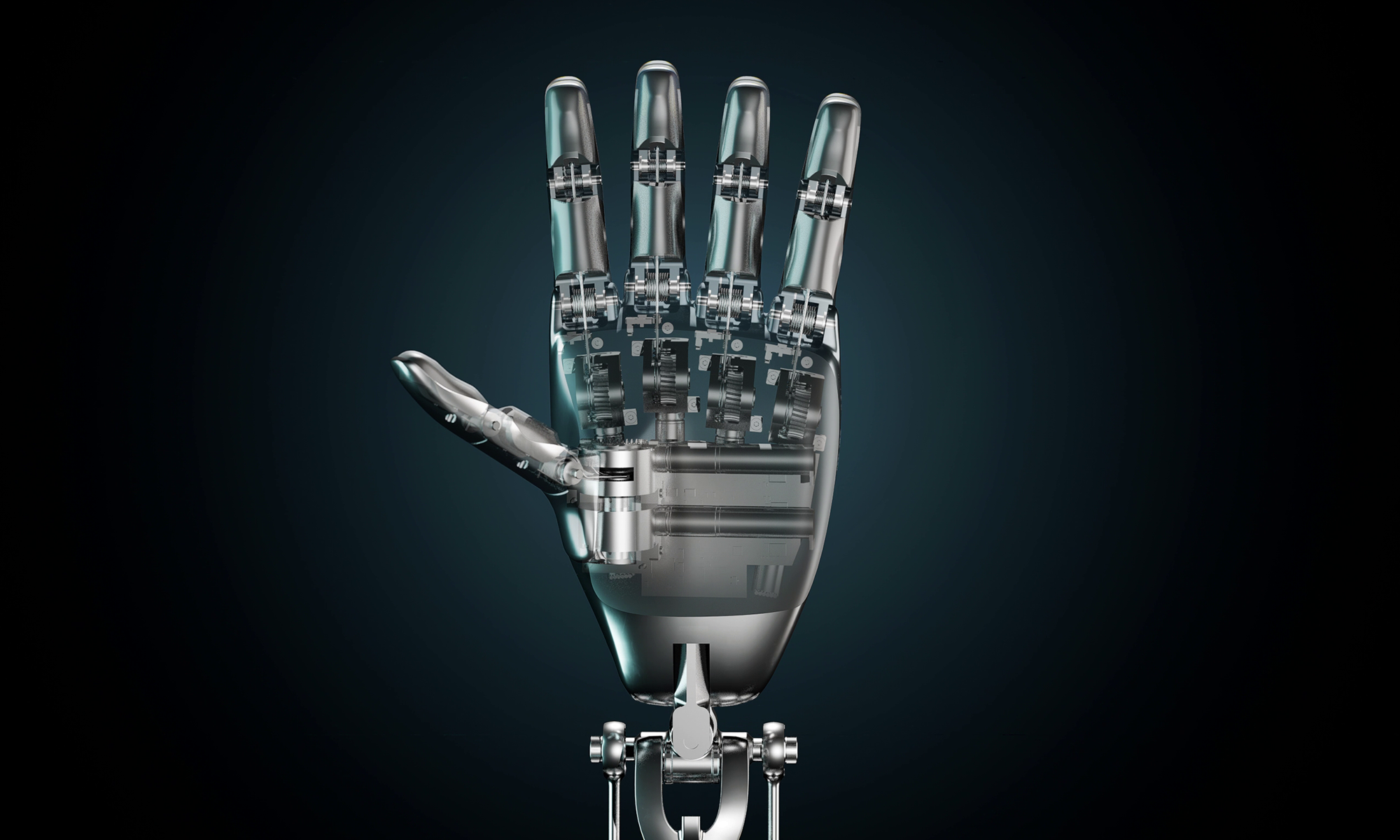
Jason Calacanis, a gentleman who appears to have stumbled into Silicon Valley from some forgotten provincial estate – though one brimming with shrewdness, mind you – has uttered a prophecy. A curious one, at that. He suggests that posterity will not recall Tesla for its conveyances, those electric carriages that currently command such attention, but for a metallic mimicry of man: the Optimus robot. A bold claim, indeed. One that, as a custodian of capital, compels a certain… scrutiny. It is a peculiar thing, this obsession with the future, isn’t it? As if the present, with its endless parade of minor calamities and mismanaged accounts, were not quite sufficient.
Calacanis, you see, is not a product of the polished academies, nor a scion of venture capital dynasties. He began, if memory serves, by scribbling opinions into the ether – a digital pamphleteer, if you will. AOL, in a moment of inexplicable generosity (or perhaps desperation), acquired his digital broadsheets for a sum that briefly startled the financial press. It was a transaction that proved, if nothing else, that even the most fleeting of digital fancies can command a price. Since then, he’s navigated the turbulent waters of innovation, backing ventures with a gambler’s intuition and a peculiar knack for identifying the genuinely disruptive from the merely fashionable. Uber and Robinhood, those emblems of the modern age, bear the imprint of his early confidence.
So, when Calacanis speaks of robots and billion-unit production runs, one is compelled to listen. Not because he possesses some arcane knowledge, but because he has demonstrated a talent for recognizing, shall we say, the trajectory of bubbles. He’s seen the froth accumulate, the valuations swell, and the inevitable… adjustments. He speaks, it is rumored, directly with the gentleman at the helm of Tesla, a figure whose pronouncements are often as baffling as they are ambitious. A direct line, you understand, is a rare and valuable commodity in this realm of carefully constructed narratives.
🦾”NO ONE IS GOING TO REMEMBER THAT @Tesla MADE A CAR, THEY WILL ONLY REMEMBER THE @Tesla_Optimus ROBOT AND @elonmusk IS GOING TO MAKE A BILLION OF THEM” @Jason 🦿
Jason Calacanis, who famously never name drops, reluctantly name drops that he visited the Optimus studio 2 Sundays… pic.twitter.com/Qv3HC73JAI
Matthew Donegan-Ryan (@MatthewDR) January 15, 2026
The Optimus, then, is not merely a metallic curiosity, but a potential pivot. A transformation from purveyor of electric carriages to architect of automated labor. The idea, of course, is not entirely new. Mankind has long dreamt of creating artificial servants, automatons to alleviate the burden of toil. But the execution, as always, is the difficulty. And the cost, naturally. One imagines armies of engineers, toiling in dimly lit workshops, wrestling with actuators and algorithms. A chaotic ballet of wires and microchips, all in pursuit of a vaguely defined ideal.
What is Tesla Optimus?
Optimus is, in essence, a humanoid machine, intended to complement human workers. It boasts the now-familiar suite of technologies – computer vision, neural networks, the usual incantations – designed to enable autonomous operation in the real world. The current iteration, one suspects, is still prone to stumbling and misinterpreting simple commands. But the ambition, one must concede, is considerable. Tesla, for the moment, remains tethered to the capricious demands of the automotive market, constrained by consumer preferences and regulatory hurdles. Optimus, however, offers a path beyond this terrestrial realm. A leap into the boundless possibilities of artificial intelligence and robotics.
Why are humanoid robots important for the evolution of AI?
Artificial intelligence, in its current form, is largely confined to the digital sphere. Large language models, those digital mimics of human conversation, have redefined information access and corporate workflows. But the true potential of AI lies in its integration into the physical world. Amazon and Alibaba, those titans of commerce, have long employed robotics in their warehouses, automating the mundane tasks of logistics and fulfillment. But these are merely heavy, industrial machines, lacking the dexterity and adaptability of a human worker. Optimus, in theory, represents the next step in this evolution. Through extensive training and investment, Tesla hopes to create a machine learning protocol that allows Optimus to perform a wide range of tasks in any environment. A vision, naturally, of robotic assistants in factories, retail stores, hospitals, and even our very homes. Assisting with chores, administrative tasks, and perhaps, eventually, offering unsolicited advice.
Is Tesla the best AI stock to buy?
The gentleman at the helm of Tesla has declared that Optimus could potentially be a $10 trillion business. A figure that, to a cautious investor, appears… optimistic. But if humanoid robots were to have a significant impact on the global labor force, the potential cost savings and efficiency gains would be substantial. The temptation to invest in Tesla, naturally, is strong. But one must proceed with caution. The vision of Optimus, as compelling as it may be, remains largely theoretical. There is no guarantee that Tesla will succeed. And even if the technology proves viable, it will take years, perhaps decades, to reach a critical scale of production. Moreover, the current valuation of Tesla stock appears… generous. The market, it seems, is already pricing in a future that has yet to materialize.
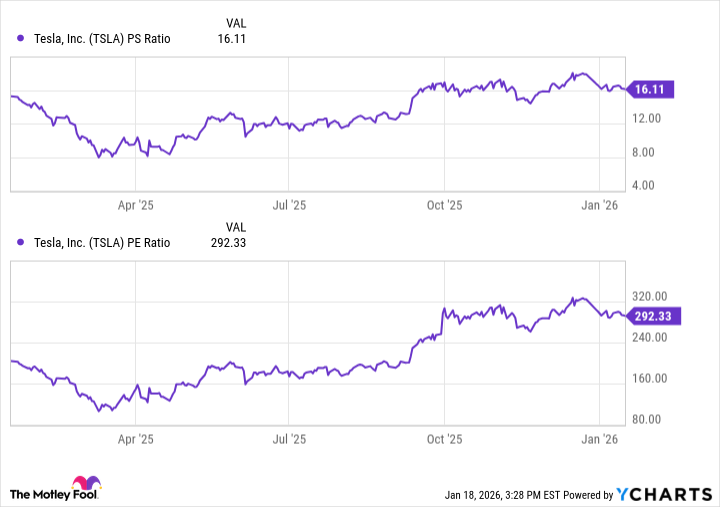
The chart, as is often the case, tells a story of exuberance. Tesla’s valuation has expanded significantly in recent months, even as sales of electric vehicles have begun to decline. The market, it appears, is overwhelmingly bullish on the potential of AI to transform the company. But as yet, Tesla has delivered little on this front. Optimus, in my estimation, remains a moonshot. A bold gamble with uncertain odds. While I find Calacanis’ rhetoric intriguing, I hesitate to endorse it as encouraging. There are too many unknowns, too many variables. For this reason, I do not see Tesla as the most compelling AI opportunity in the market at this time. There are, after all, other automatons in the workshop, and other engineers toiling away in the shadows. And the future, as always, remains a most unpredictable contraption.
Read More
- Top 20 Dinosaur Movies, Ranked
- 20 Movies Where the Black Villain Was Secretly the Most Popular Character
- 25 “Woke” Films That Used Black Trauma to Humanize White Leads
- Silver Rate Forecast
- Gold Rate Forecast
- Spotting the Loops in Autonomous Systems
- From Bids to Best Policies: Smarter Auto-Bidding with Generative AI
- Celebs Who Narrowly Escaped The 9/11 Attacks
- 22 Films Where the White Protagonist Is Canonically the Sidekick to a Black Lead
- Can AI Lie with a Picture? Detecting Deception in Multimodal Models
2026-01-22 13:03