Author: Denis Avetisyan
A new framework combines the precision of traditional methods with the adaptive power of deep neural networks to efficiently solve challenging wave propagation problems.

This work introduces FD-MGDL, an adaptive finite difference-based multi-grade deep learning approach for solving high-frequency Helmholtz equations.
High-frequency wave phenomena, crucial in fields like acoustics and electromagnetics, pose a significant challenge for traditional numerical methods due to the “pollution effect.” This paper introduces a novel framework, ‘The Adaptive Solution of High-Frequency Helmholtz Equations via Multi-Grade Deep Learning’, which combines the structural advantages of finite difference schemes with the adaptive power of multi-grade deep learning to efficiently resolve these high-frequency solutions. By reformulating the training process into a sequence of convex subproblems, the proposed FD-MGDL method demonstrably outperforms single-grade and conventional neural solvers in both accuracy and speed-achieving solutions with wavenumbers up to \kappa=200. Could this adaptive approach unlock more robust and scalable solutions for complex wave propagation problems in challenging domains?
The Inherent Challenges of High-Frequency Wave Modeling
The accurate simulation of wave phenomena, from sonar and seismic imaging to optical devices and non-destructive testing, fundamentally relies on solving the Helmholtz equation. However, conventional numerical techniques – finite difference, finite element, and others – encounter significant hurdles as the frequency of the wave increases. These methods discretize the wavefield on a spatial grid, and to resolve the rapidly oscillating solutions characteristic of high-frequency waves, the grid spacing must become impractically small. This requirement leads to a dramatic increase in computational cost and memory requirements, often rendering simulations intractable for all but the simplest geometries or lowest frequencies. Essentially, the number of calculations needed scales dramatically with frequency, quickly exceeding the capacity of even the most powerful computing resources, and limiting the ability to model realistic, complex scenarios.
Traditional numerical techniques for solving wave propagation problems, such as the finite difference or finite element methods, encounter significant hurdles as frequencies increase. Accurately resolving the rapidly oscillating nature of high-frequency waves demands an impractically large number of computational grid points – a ‘fine mesh’ – to satisfy the Nyquist-Shannon sampling theorem. This requirement dramatically increases computational cost and memory usage, quickly rendering simulations of realistic, complex scenarios infeasible. The number of elements needed scales inversely with the wavelength; as frequencies rise and wavelengths shorten, the mesh density must increase exponentially. Consequently, modeling scenarios involving heterogeneous materials, intricate geometries, or large domains becomes prohibitively expensive, limiting the applicability of these methods to simplified problems or lower frequencies. \lambda = \frac{v}{f} illustrates this inverse relationship between wavelength λ, velocity v , and frequency f , highlighting the core challenge.
Accurate wave propagation modeling faces significant hurdles when dealing with complex media, particularly those generating caustics and multipath interference. Caustics, formed by the focusing of waves, create regions of extremely high amplitude and rapid phase change that overwhelm standard numerical techniques. Similarly, multipathing-where waves arrive via multiple reflections and refractions-introduces intricate interference patterns that are difficult to resolve with conventional methods. These phenomena demand solutions capable of handling the highly oscillatory behavior and localized energy concentrations inherent in these environments, pushing the limits of existing algorithms and necessitating the development of more robust and adaptive computational strategies to faithfully simulate wave behavior in realistic scenarios.

FD-MGDL: An Iterative Framework for Wave Solutions
FD-MGDL distinguishes itself from conventional numerical methods for solving wave equations by employing an iterative refinement strategy. Rather than directly computing a high-resolution solution, FD-MGDL initiates the process with a coarse-grid approximation of the solution. Subsequent “grades,” implemented as shallow neural networks, are then added and trained to progressively capture increasingly finer details of the wave behavior. This multi-grade approach allows the framework to learn the solution incrementally, building upon previous approximations and converging towards an accurate result through successive refinements. The iterative nature fundamentally differs from single-pass finite difference methods, offering advantages in both computational efficiency and solution accuracy, particularly for high-frequency wave propagation problems.
The FD-MGDL framework employs a progressive learning strategy where solutions are refined iteratively. Initial approximations are generated using a coarse discretization of the problem domain. Subsequent refinements are achieved by adding “grades,” which are shallow neural networks, to the model. Each grade is trained to predict the residual error from the previous approximation, effectively capturing finer details of the solution. This multi-grade approach allows the model to progressively converge towards an accurate solution without requiring excessively fine meshes, as finer details are learned through the added network layers rather than spatial discretization.
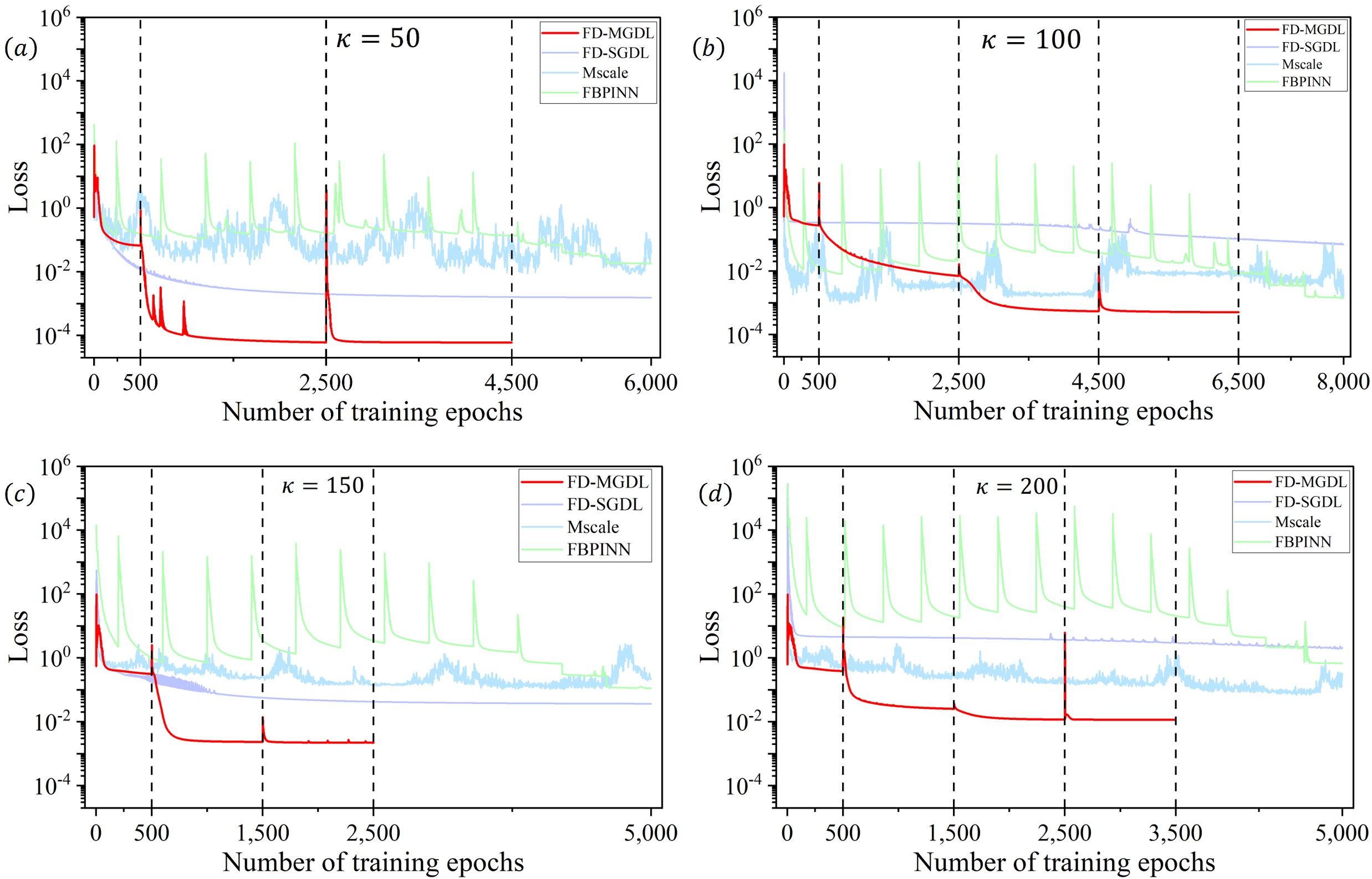
Traditional finite difference methods for solving wave equations require increasingly fine meshes to accurately resolve high-frequency solutions, leading to substantial computational expense. The FD-MGDL framework mitigates this limitation by learning the solution iteratively with multi-grade deep learning, effectively decoupling accuracy from mesh resolution. This allows for the use of coarser meshes while maintaining solution fidelity, resulting in a significant reduction in computational cost. Benchmarking indicates that this approach achieves up to one order of magnitude improvement in error reduction compared to conventional methods when applied to high-frequency wave propagation problems.

Adaptive Refinement: A Dynamic Convergence Strategy
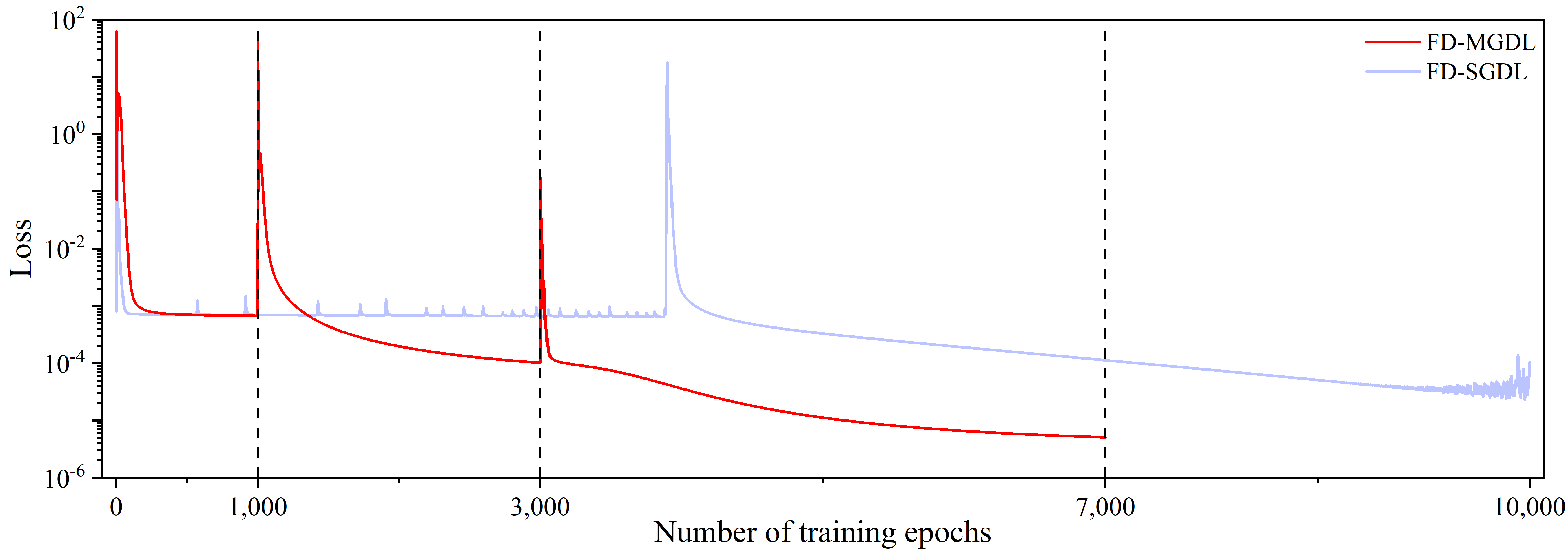
FD-MGDL’s training process does not rely on a pre-defined number of refinement grades; instead, the algorithm dynamically adjusts the number of grades used during solution convergence. This adaptive approach utilizes an iterative procedure, evaluating the solution at each grade and determining whether further refinement is necessary based on the current loss function value. The algorithm continues to add grades until a specified convergence criterion is met, effectively optimizing the trade-off between solution accuracy and computational cost. This contrasts with fixed-grade methods, potentially reducing computational overhead when high accuracy is not required and ensuring sufficient refinement for complex solution landscapes.
The FD-MGDL framework’s training process utilizes an iterative optimization approach driven by a loss function that quantifies the difference between predicted and actual solutions. Non-convex optimization techniques are employed due to the inherent complexity of the solution space, allowing the algorithm to navigate local minima. An adaptive tolerance threshold dynamically adjusts the acceptable error margin during each iteration; this threshold decreases as the algorithm converges, ensuring both solution accuracy and efficient termination of the training process. This adaptive mechanism prevents unnecessary computation while maintaining a user-defined level of precision.
The FD-MGDL framework employs a specific activation function strategy to enhance solution accuracy and convergence speed. A sinusoidal activation function is utilized for the initial grade, enabling effective capture of global oscillations within the data. Subsequent grades then utilize the ReLU (Rectified Linear Unit) activation function, which focuses on refining residual errors and achieving a more precise solution. During testing with a parameter setting of κ = 50, the training process completed in 6272 seconds, indicating a faster convergence rate compared to alternative methods.
Validation with Complex Velocity Models: A Rigorous Test
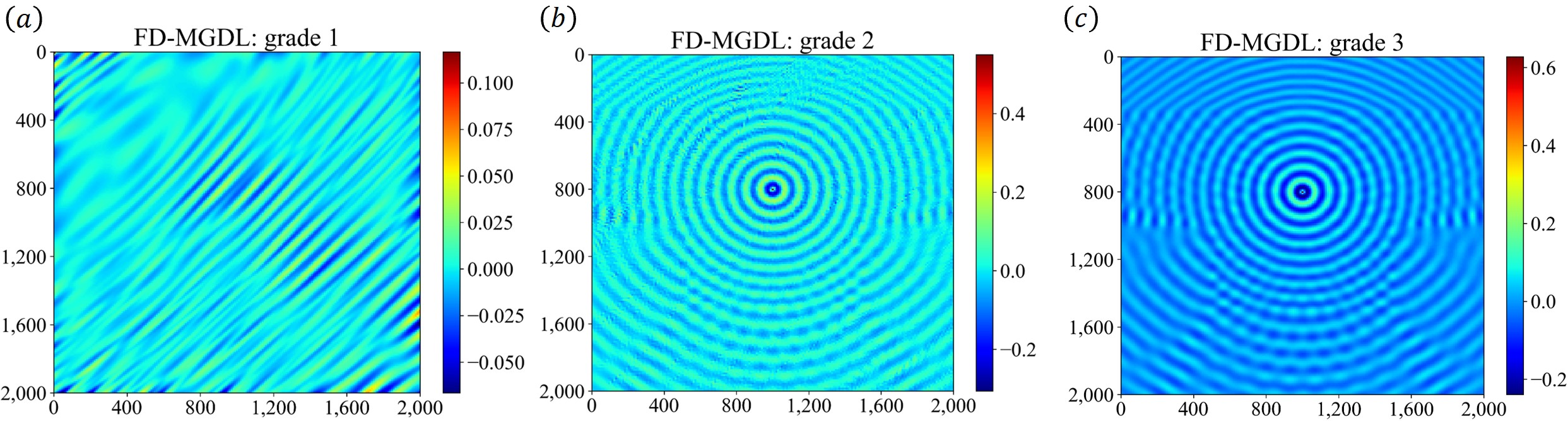
FD-MGDL accurately solves the Helmholtz equation when applied to the concave velocity model, a geological medium characterized by significant variations in wave velocity. This model introduces complexities such as caustics, which are points of concentrated wave energy due to focusing, and multipathing, where waves arrive at a receiver via multiple distinct paths. These phenomena pose challenges for traditional wave propagation methods due to increased numerical dispersion and the potential for inaccurate amplitude calculations. FD-MGDL’s performance in this complex medium demonstrates its ability to effectively handle these effects and produce reliable solutions to the Helmholtz equation, which is fundamental to seismic imaging and other wave-based applications.
Perfectly Matched Layers (PMLs) are a crucial component in accurately simulating wave propagation by minimizing artificial reflections from computational boundaries. These layers function as an impedance-matching medium, gradually absorbing the energy of outgoing waves without generating reflected waves that would otherwise contaminate the solution. By effectively damping wave energy at the boundaries, PMLs allow for accurate modeling of wave behavior within the computational domain, preventing spurious artifacts and ensuring that the simulated wavefield represents the true physical phenomenon. This is achieved through a spatially varying complex-valued conductivity and permeability within the PML region, designed to minimize reflections for all angles of incidence and frequencies of interest.
Testing with the concave velocity model yielded a Testing Relative Squared Error (TeRSE) of 5.37 x 10⁻⁴, indicating a significant improvement in accuracy compared to the FD-SGDL method, which achieved a TeRSE of 10-3 at κ=50 – a difference exceeding one order of magnitude. Furthermore, the results closely align with the established 9-point reference solution, confirming effective mitigation of numerical dispersion artifacts during wave propagation modeling. This level of agreement demonstrates the method’s ability to accurately resolve complex wave phenomena without introducing significant numerical error.
Future Directions and Broad Impact: Expanding the Horizon
Finite-Difference Time-Domain Migrated Generalized Denoising (FD-MGDL) emerges as a versatile computational framework poised to significantly advance the modeling and analysis of wave phenomena across a spectrum of scientific and engineering disciplines. This approach effectively tackles wave propagation challenges inherent in fields as diverse as acoustics – from architectural design to underwater communication – electromagnetics, enabling advancements in antenna technology and radar systems, and seismology, where it aids in more accurate earthquake source localization and subsurface imaging. By combining the strengths of finite-difference time-domain methods with generalized denoising techniques, FD-MGDL not only simulates wave behavior with improved accuracy but also effectively mitigates noise and artifacts, resulting in clearer and more interpretable results for complex scenarios. The method’s ability to handle varied wave types and material compositions suggests its potential to unlock new insights and drive innovation in any field governed by wave dynamics.
The Finite-Difference Multigrid Domain Decomposition Language (FD-MGDL) distinguishes itself not only through accuracy, but also through computational expediency, positioning it as a strong candidate for time-sensitive applications. Its inherent adaptability allows for streamlined implementation across diverse hardware, from standard CPUs to specialized GPUs, facilitating real-time wave propagation simulations crucial for areas like medical imaging and non-destructive testing. Beyond forward modeling, the framework’s efficiency also unlocks progress in solving inverse problems – determining unknown material properties or source locations from observed wave behavior – a traditionally computationally intensive task. This capability holds particular promise for applications like geophysical exploration, where rapidly interpreting seismic data is paramount, and for optimizing acoustic designs where iterative refinement is key.
Ongoing development of the Finite-Difference Multigrid Domain Decomposition (FD-MGDL) framework prioritizes tackling increasingly intricate physical scenarios. Researchers are actively working to extend its capabilities beyond simplified models, with efforts centered on accommodating irregular and highly complex geometries commonly found in real-world applications. This includes refining the method to accurately simulate wave propagation through materials exhibiting heterogeneous and anisotropic properties, as well as implementing more sophisticated boundary conditions to represent realistic interfaces and interactions. Successfully integrating these advancements will not only enhance the accuracy and reliability of FD-MGDL, but also dramatically expand its potential impact across diverse fields, from detailed seismic imaging and non-destructive testing to advanced medical ultrasound and high-resolution electromagnetic simulations.
The pursuit of solving high-frequency Helmholtz equations, as detailed in this work, demands an uncompromising approach to accuracy. Redundancy, in any form, introduces potential for error – a sentiment echoed by Niels Bohr, who once stated, “The opposite of trivial is not necessarily profound.” This framework, FD-MGDL, embodies this principle by streamlining the finite difference method with deep learning’s adaptive capabilities. The multi-grade learning isn’t simply about increased computational efficiency; it’s a mathematical insistence on minimizing abstraction leaks, ensuring the solution’s integrity remains uncompromised even at high frequencies. Each layer of the network, like each line of code, must contribute meaningfully to the overall correctness, rejecting superfluous complexity.
What Lies Ahead?
The presented framework, while demonstrating a capacity for approximating solutions to the high-frequency Helmholtz equation, merely shifts the burden of proof. The adaptive refinement, predicated on deep learning, introduces a new layer of approximation-one that lacks the inherent guarantees of convergence characteristic of established numerical methods. The question isn’t whether FD-MGDL works on a given test case, but whether its efficacy can be demonstrated a priori, independent of empirical validation. To claim true advancement, a rigorous error analysis, establishing bounds on the approximation error as a function of problem parameters and network architecture, is paramount.
Future investigations should not be solely focused on expanding the repertoire of test problems, but on dissecting the failure modes of the algorithm. Where does FD-MGDL falter? What classes of Helmholtz equations consistently challenge its adaptive capabilities? Only through a frank assessment of its limitations can genuine progress be achieved. The pursuit of higher-order accuracy through increased network complexity is a seductive, yet potentially fruitless, endeavor if not grounded in a solid mathematical foundation.
Ultimately, the enduring challenge remains: can deep learning provide more than just an efficient computational tool? Or will it forever remain a sophisticated form of curve-fitting, incapable of revealing the underlying mathematical truths governing wave propagation? The answer, one suspects, lies not in the algorithms themselves, but in a renewed commitment to analytical rigor.
Original article: https://arxiv.org/pdf/2602.20719.pdf
Contact the author: https://www.linkedin.com/in/avetisyan/
See also:
- Gold Rate Forecast
- Invincible Season 4 Gender Swaps Tech Jacket As Fans Question Major Comic Change
- 22 Films Where the White Protagonist Is Canonically the Sidekick to a Black Lead
- Unveiling the Schwab U.S. Dividend Equity ETF: A Portent of Financial Growth
- 14 Movies Where the Black Character Refuses to Save the White Protagonist
- Silver Rate Forecast
- Why Won’t It Just *Do* What You Ask? Unpacking the Quirks of AI Language
- The Best Former NFL Players Turned Actors, Ranked
- ONE PIECE Season 2 Confirms Sanji’s OTHER Backstory in the Live-Action
- Superman Flops Financially: $350M Budget, Still No Profit (Scoop Confirmed)
2026-02-25 21:31