Start your day informed with the US Crypto News Morning Briefing, providing you with a quick overview of the top crypto stories you need to know.
Get ready – stablecoins could significantly change the US bond market. According to a recent report from Standard Chartered, increased demand for Treasury bills from companies creating digital dollars might lead the US government to reconsider its debt financing strategies.
Crypto News of the Day: Stablecoin Demand Could Force Washington to Rethink US Debt Strategy
A recent report from Standard Chartered suggests that stablecoins could significantly change how the US Treasury market works, possibly leading to major changes in how the government issues debt.
By 2028, stablecoin companies could create an additional $800 billion to $1 trillion in demand for U.S. Treasury bills, according to bank estimates.
This growing demand, along with the Federal Reserve’s buying activity, could reach a total of $2.2 trillion for short-term Treasury bills.
The report suggests the Treasury Department might use increased demand for short-term Treasury bills as a reason to issue more of them, while decreasing the supply of long-term bonds. This could potentially lead to the US government pausing auctions of 30-year bonds for up to three years.
According to a recent report from Standard Chartered, Geoff Kendrick suggests the US Treasury might increase the supply of short-term debt (T-bills) due to strong demand. He notes that companies issuing stablecoins are becoming major purchasers of this type of US debt.
Most of the anticipated demand for Treasury bills will likely come from developing countries. Standard Chartered projects that roughly two-thirds of this new demand will originate in emerging markets. In contrast, stablecoins used in developed countries are mainly replacing money people already have invested, rather than creating entirely new investment.
This trend shows that digital assets are becoming increasingly important in how money moves around the world, and they’re starting to affect traditional bond markets.
Moving about $9 billion from long-term bonds to short-term Treasury bills could initially cause the difference in interest rates between long- and short-term Treasury securities to shrink.
Standard Chartered recently published an interesting report on stablecoins and U.S. Treasury bills. They predict the stablecoin market could reach $2 trillion by 2028 – a figure also used by the U.S. Treasury. The report suggests that most of the new demand for T-bills will come from emerging markets, while developed markets will primarily see stablecoins replacing existing assets.
— Googly 👀 (@0xG00gly) February 23, 2026
Yield Curve Risks Mount as Treasury Weighs Expanding T-Bill Share
Standard Chartered points out that investor reactions could change over time, potentially influenced by factors like long-term market expectations, government debt levels, and overall investor confidence.
The bank warns that bond yields might initially fall sharply, but longer-term yield movements could be influenced by underlying factors like the risk associated with holding bonds and the need to replace maturing ones.
Treasury Secretary Scott Bessent could use the current situation to issue more short-term Treasury bills and shift the balance of the nation’s debt.
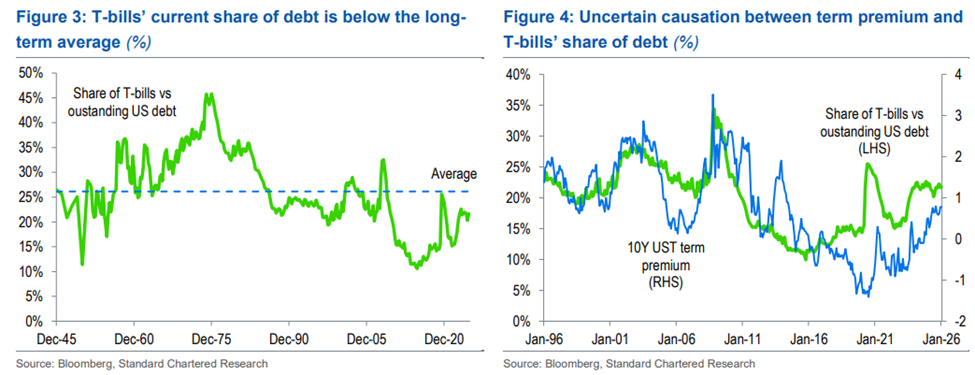
Increasing the proportion of Treasury bills by a small amount – 2.5% over three years – could create around $900 billion in new bills, which would balance out the expected high demand for them.
This might help with initial shortages while still allowing interest rates on long-term government bonds to stay at a reasonable level.
The report points out that Treasury bills have typically made up 26.1% of the government’s total debt. This is higher than the recommended level of 15–20% suggested by the Treasury Borrowing Advisory Committee, indicating there’s potential to issue more debt through Treasury bills.
Although the stablecoin market has recently experienced a slowdown, currently valued at about $304 billion, experts predict it will grow to $2 trillion by 2028. This recent pause in growth is likely due to challenges in the broader digital asset market and delays in new regulations, particularly following the US GENIUS Act.
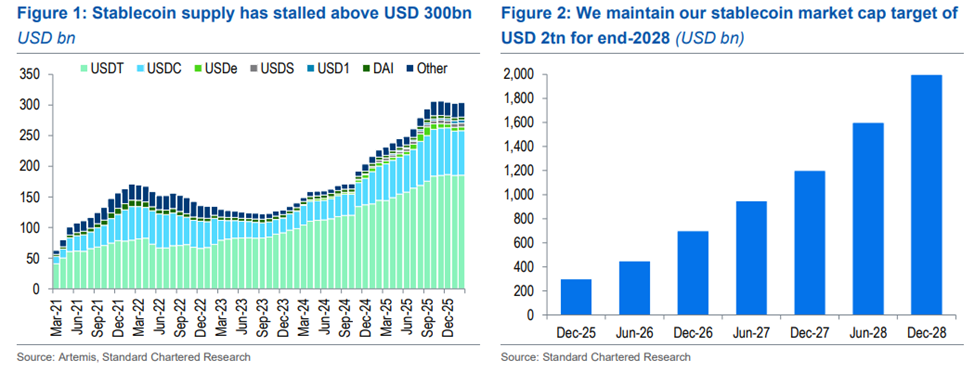
Standard Chartered believes these issues are temporary fluctuations, not permanent problems. Increased demand for stablecoins, along with the Federal Reserve’s continued bond purchases and replacements of maturing securities, could significantly change how short-term US debt markets operate.
In my research, I’ve found that pausing the auctions of 30-year bonds isn’t something the Treasury hasn’t done before – they actually stopped them for a few years between 2002 and 2006. However, the financial situation we’re facing now is quite different than it was back then, making a similar pause more complicated.
Chart of the Day
Byte-Sized Alpha
Read More
- Invincible Season 4 Gender Swaps Tech Jacket As Fans Question Major Comic Change
- Building Agents That Learn and Improve Themselves
- Gold Rate Forecast
- Games That Faced Bans in Countries Over Political Themes
- Silver Rate Forecast
- Trading Crypto with AI: A New Approach to Portfolio Management
- 15 Films That Were Shot Entirely on Phones
- Why Won’t It Just *Do* What You Ask? Unpacking the Quirks of AI Language
- Unveiling the Schwab U.S. Dividend Equity ETF: A Portent of Financial Growth
- Thinking Before Acting: A Self-Reflective AI for Safer Autonomous Driving
2026-02-23 20:23