The S&P 500, that curiously comprehensive index of American enterprise, recently experienced a bit of a wobble, falling some 7% from its peak. Now, in the grand scheme of things – and believe me, the grand scheme is vast – a 7% dip isn’t exactly the financial equivalent of the Titanic hitting an iceberg. But it’s enough to give a sensible person pause, especially when you consider the general air of… well, let’s just say ‘unsettledness’ that seems to be drifting around the globe. Geopolitical tensions, economic forecasts that resemble tea leaves, it all adds up.
But here’s the curious thing about markets – they rarely behave as you’d expect. And history, that often-overlooked teacher, suggests that periods of weakness are frequently, rather unexpectedly, opportunities in disguise. Buying into a broad market index like the S&P 500, particularly when everyone else is looking a bit glum, is a bit like picking up a quality raincoat during a summer heatwave – it might seem odd at the time, but you’ll be awfully glad you did when the clouds roll in. It gives you exposure to all sorts of fascinating companies, from the tech behemoths everyone knows to the quietly profitable businesses that keep the world ticking over. And, crucially, it’s remarkably cost-effective.
The iShares Core S&P 500 ETF (IVV) is, essentially, a basket containing a little bit of each of those 500 companies. It’s designed to mimic the index’s performance, which means you get a diversified slice of the American economy without having to spend your days researching individual stocks. It’s a bit like ordering a sampler platter at a particularly ambitious restaurant – you get a taste of everything.
Diversification: A Surprisingly Sensible Idea
The S&P 500 isn’t just a random collection of businesses. It’s a rather selective club. To qualify for membership, a company has to be profitable, reasonably large (currently, with a market capitalization of at least $22.7 billion), and pass muster with a committee of discerning experts. It’s a surprisingly rigorous process, which explains why your local dry cleaner isn’t included.
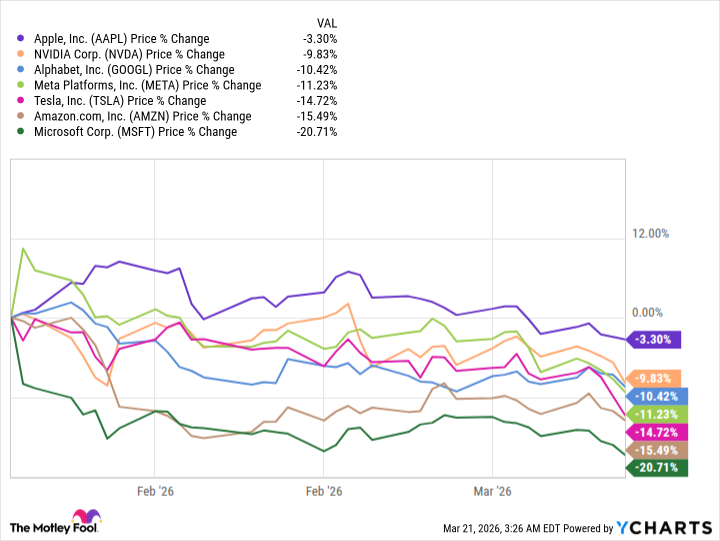
The index is weighted by market capitalization, meaning the biggest companies have the most influence. Currently, a handful of tech giants – Nvidia, Apple, Alphabet, Microsoft, Amazon, Meta, and Tesla – collectively account for over 32% of the entire index. These “Magnificent Seven,” as they’re rather grandly called, have been driving much of the market’s growth in recent years. But, as anyone who’s ever put all their eggs in one basket can attest, relying too heavily on a few companies can be a bit precarious. These same companies that soared during the AI boom have, of late, experienced a bit of a correction. They’ve fallen further than the index as a whole, demonstrating a rather important principle: diversification isn’t just a fancy financial term; it’s a surprisingly sensible idea.
The S&P 500 isn’t just about growth stocks. It also includes a healthy dose of more established, defensive companies – businesses that tend to hold up reasonably well even during economic downturns. Consider these sectors:
| S&P 500 Sector | Sector Weighting | Notable Companies |
|---|---|---|
| Financials | 12.35% | Berkshire Hathaway, JP Morgan Chase, Visa |
| Healthcare | 9.35% | Eli Lilly, Johnson & Johnson, AbbVie |
| Industrials | 8.87% | Caterpillar, GE Aerospace, RTX |
| Utilities | 2.52% | NextEra Energy, The Southern Company, Constellation Energy |
The iShares Core S&P 500 ETF makes it remarkably easy to invest in all of this. The expense ratio – the annual fee you pay to cover management costs – is a minuscule 0.03%. On a $10,000 investment, that works out to a mere $3. You’d spend more on coffee.
A Bit of History, If You Have a Moment
According to some diligent number-crunchers at Capital Group, the S&P 500 experiences a 5% decline roughly once a year. Steeper drops – 10% or more – occur every couple of years. And those truly unpleasant events – bear markets (a 20% or greater decline) – happen, on average, every six years. It’s a bit like the weather – you can’t predict it with perfect accuracy, but you can be reasonably sure it will occasionally be a bit gloomy.
Volatility, in other words, is perfectly normal. It’s the price of admission for the opportunity to earn significant returns over the long term. And, despite all the ups and downs, the S&P 500 has delivered a compound annual return of 10.6% since 1957. Those who stayed the course – even during the most challenging periods – have been handsomely rewarded.
Predicting the future is, of course, a fool’s errand. There’s no way to know whether the current dip will worsen. But history suggests that the S&P 500 is very likely to be higher in five, ten, and fifteen years. Which means that the current price might look like a bit of a bargain when viewed in retrospect.
So, now might be a good time to buy the iShares Core S&P 500 ETF. If you’re feeling a bit cautious, you could scale into the ETF with small, consistent monthly purchases, rather than investing a lump sum all at once. It’s a bit like planting a garden – you don’t put all your seeds in the ground on the same day. You spread the risk, and you increase your chances of a bountiful harvest.
Read More
- Can AI Lie with a Picture? Detecting Deception in Multimodal Models
- 20 Movies Where the Black Villain Was Secretly the Most Popular Character
- 25 “Woke” Films That Used Black Trauma to Humanize White Leads
- Top 10 Coolest Things About Invincible (Mark Grayson)
- When AI Teams Cheat: Lessons from Human Collusion
- From Bids to Best Policies: Smarter Auto-Bidding with Generative AI
- 22 Films Where the White Protagonist Is Canonically the Sidekick to a Black Lead
- Silver Rate Forecast
- Top 20 Dinosaur Movies, Ranked
- Unmasking falsehoods: A New Approach to AI Truthfulness
2026-03-23 17:53