Author: Denis Avetisyan
New research demonstrates how integrating constantly updated knowledge graphs with large language models can significantly improve accuracy and trustworthiness in telecom applications.
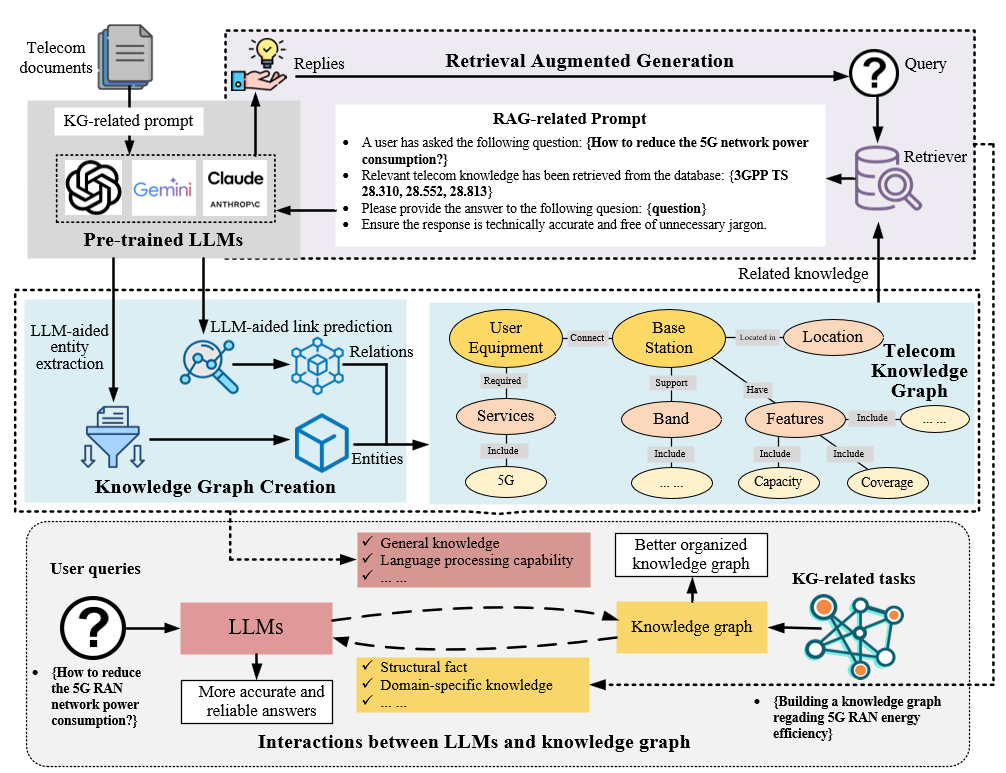
This review details a Knowledge Graph Retrieval-Augmented Generation (KG-RAG) framework for reducing hallucinations and enabling explainable AI in the telecommunications sector.
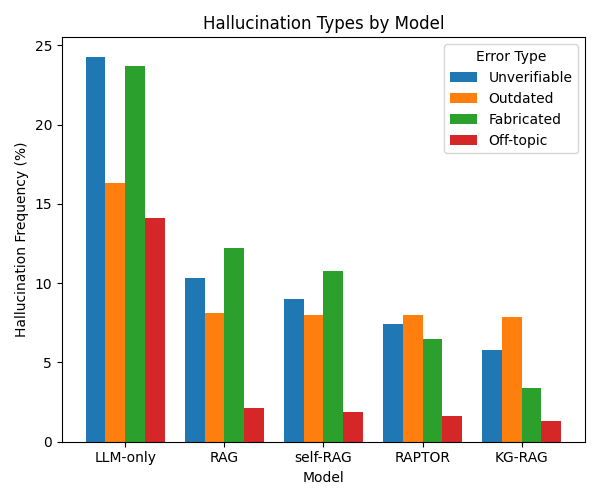
While large language models (LLMs) demonstrate promise across diverse applications, their performance in specialized domains like telecommunications is hindered by evolving standards and complex terminology. This work, ‘Enhancing Large Language Models (LLMs) for Telecom using Dynamic Knowledge Graphs and Explainable Retrieval-Augmented Generation’, addresses this limitation by introducing KG-RAG, a novel framework integrating knowledge graphs with retrieval-augmented generation. Experimental results demonstrate that KG-RAG significantly improves accuracy and reduces hallucinations compared to standard LLM and RAG approaches, achieving up to a 21.6% improvement in accuracy. Could this approach unlock more reliable and explainable AI solutions for increasingly complex telecom operations and beyond?
The Inevitable Cascade: Telecom’s Knowledge Crisis
The telecommunications landscape is characterized by an accelerating pace of innovation, necessitating continuous knowledge acquisition that quickly overwhelms conventional learning approaches. Traditional documentation, training programs, and even online resources struggle to keep pace with the frequent updates to network protocols, emerging technologies like 5G and 6G, and the increasing complexity of modern telecom infrastructures. This constant flux creates a significant challenge for professionals seeking to remain current, as the volume of information to absorb far exceeds the capacity of standard learning methods, impacting an organization’s ability to efficiently deploy, manage, and optimize its networks. Consequently, a proactive and scalable knowledge management system is no longer a luxury, but a critical requirement for maintaining competitiveness and enabling the full potential of next-generation telecom services.
The sheer intricacy of modern telecommunications presents a significant challenge to knowledge management systems. Telecom specifications, encompassing everything from radio access technologies to core network protocols, are not static documents; they are constantly revised and expanded, creating a perpetually moving target. Moreover, network architectures have evolved from relatively simple, hierarchical designs to highly complex, distributed systems involving software-defined networking, network function virtualization, and increasingly, artificial intelligence. This exponential growth in both the volume and interconnectedness of knowledge far outstrips the capacity of traditional documentation, search tools, and even many contemporary knowledge bases to provide timely and accurate information, leading to inefficiencies in network planning, operation, and innovation.
The inability to efficiently access and utilize telecom knowledge significantly impedes progress across multiple critical areas. Automation initiatives, essential for managing increasingly complex networks, are stalled by the difficulty in encoding and applying specialized expertise. Network optimization, crucial for maximizing performance and minimizing costs, suffers from incomplete or outdated understandings of system behavior. Most importantly, the deployment of next-generation technologies – such as 5G, network slicing, and edge computing – is hampered by a lack of readily available, actionable insights into intricate specifications and interoperability requirements. This knowledge bottleneck, therefore, doesn’t merely represent an informational challenge, but a fundamental constraint on innovation and the realization of future telecom potential.
Architecting Understanding: A Knowledge-Augmented Foundation
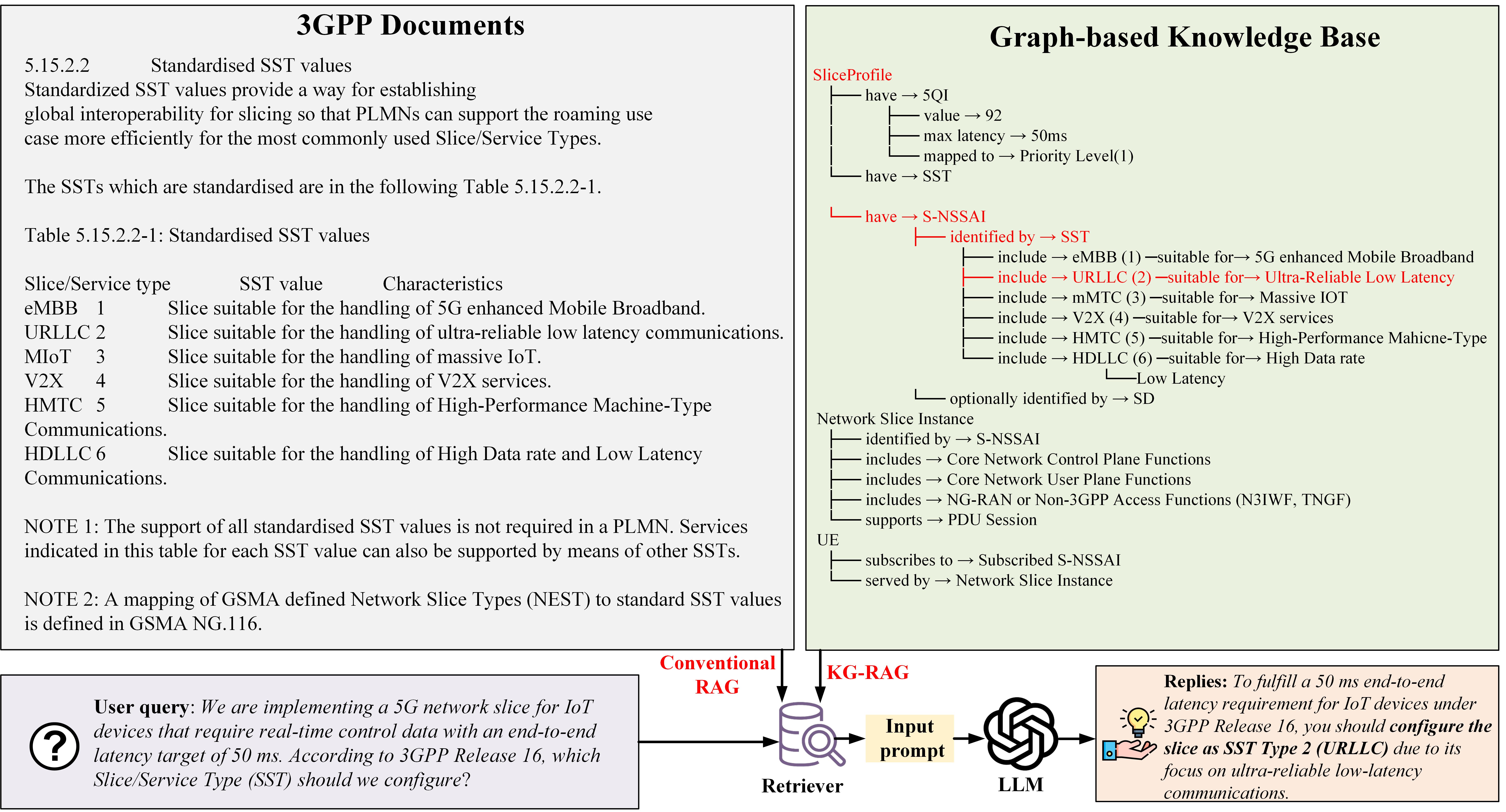
The KG-RAG Framework combines the strengths of Knowledge Graphs (KGs) and Retrieval-Augmented Generation (RAG) to improve knowledge understanding in complex domains. KGs provide a structured representation of facts, entities, and their relationships, enabling precise information retrieval. RAG leverages this retrieved knowledge to augment the input prompt for a Large Language Model (LLM), allowing the LLM to generate more accurate and contextually relevant responses. By grounding the LLM in structured knowledge, KG-RAG minimizes hallucinations and enhances the reliability of generated text, particularly when dealing with nuanced or specialized information not readily available in the LLM’s pre-training data. This integration facilitates a more informed and verifiable output compared to standard LLM-based generation.
The Knowledge Graph functions as the core data store for the system, specifically modeling the Telecom Domain. This involves representing key entities such as customers, network devices, services, and locations, alongside the relationships between them – for example, a customer subscribes to a service, a device connects to a network, or a service is delivered to a location. The graph structure allows for efficient traversal and reasoning over this interconnected data, enabling the system to understand complex dependencies and contextual information within the telecom infrastructure and customer base. Data is stored as subject-predicate-object triples, facilitating both structured queries and inferential analysis.
The Knowledge Graph’s ongoing maintenance relies on methodologies such as Stream2Graph, a process designed for continuous ingestion and refinement of data. Stream2Graph automates the extraction of entities and relationships from incoming data streams – including network events, customer interactions, and configuration changes – and integrates these findings directly into the graph. This approach ensures the Knowledge Graph reflects the current state of the Telecom Domain, addressing data staleness and incompleteness. Regular updates facilitated by Stream2Graph are critical for maintaining the accuracy and reliability of downstream applications leveraging the Knowledge Graph, such as those within the KG-RAG Framework.
Dissecting Complexity: From Text to Structured Data
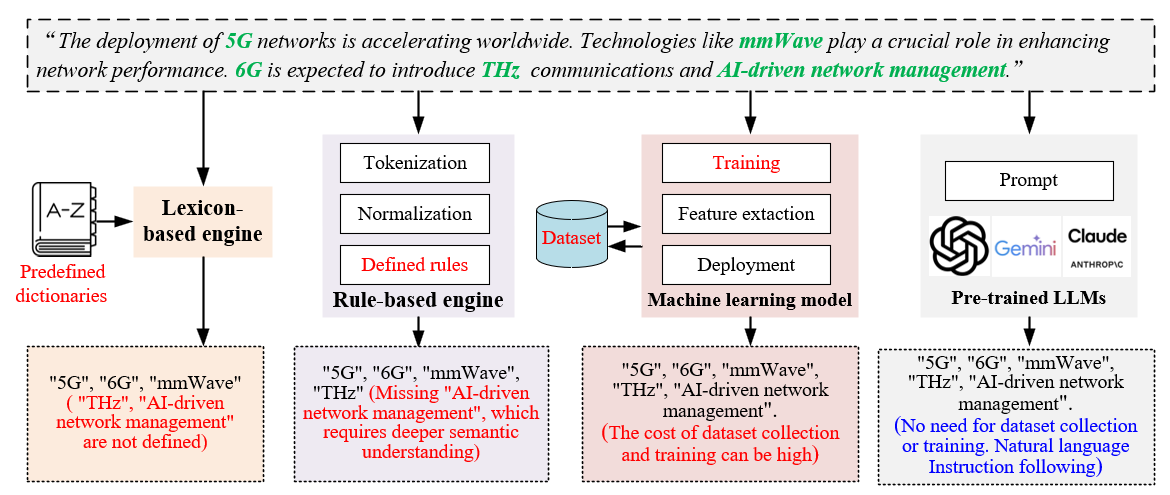
Entity extraction is a foundational process for knowledge graph construction, involving the identification and categorization of key elements within unstructured telecom data. Current implementations utilize three primary approaches: pre-trained Large Language Models (LLMs) which leverage existing linguistic knowledge to recognize entities; rule-based methods, employing predefined patterns and dictionaries to identify specific entities; and machine learning approaches, which train algorithms on labeled datasets to automatically detect and classify entities. The selection of a specific method, or a combination thereof, depends on factors such as data volume, entity complexity, and required accuracy. Accurate entity extraction is essential as these extracted entities become the nodes within the knowledge graph, defining the core components of the interconnected data structure.
Link prediction techniques are utilized to establish relationships within the knowledge graph, employing several distinct methodologies. Translational Distance Models, such as TransE, represent entities and relations as vectors and attempt to minimize the distance between related entities in the embedding space. Semantic Matching Models assess the semantic similarity between entities to infer relationships based on shared characteristics or context. Neural Network-Based Methods, including convolutional and recurrent networks, learn complex patterns from data to predict the likelihood of a relationship existing between two entities, often leveraging attention mechanisms to focus on relevant features. These methods differ in their approach to representing and evaluating relationships, but all contribute to constructing a connected knowledge base from unstructured data.
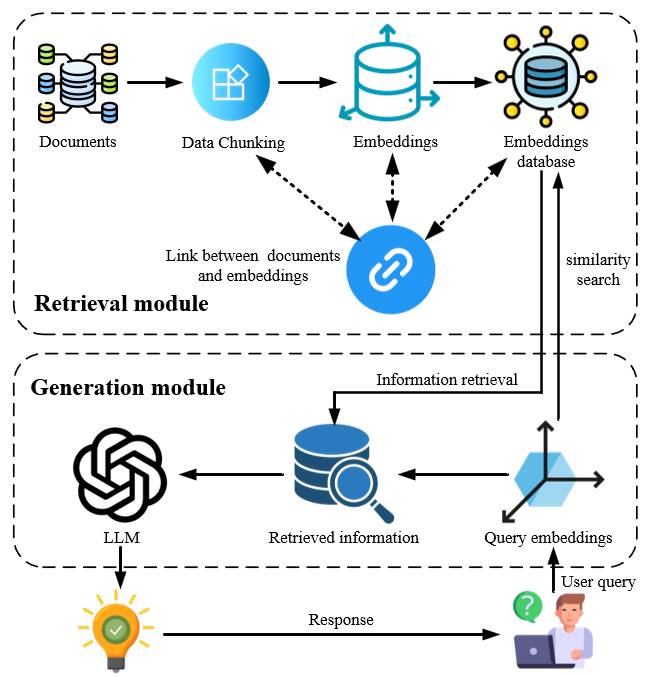
The conversion of unstructured telecom data – encompassing call detail records, network logs, and customer service interactions – into a structured knowledge base involves several key processes. Initially, information is extracted using techniques like Named Entity Recognition and Relationship Extraction to identify relevant entities (e.g., customers, devices, services) and their connections. This extracted data is then modeled as nodes and edges within a graph database, facilitating efficient querying and analysis. The resulting knowledge base enables the representation of complex relationships, such as service dependencies, network topologies, and customer usage patterns, allowing for improved troubleshooting, predictive maintenance, and personalized service offerings. Data normalization and deduplication are critical steps in ensuring data quality and consistency within the interconnected knowledge base.
The Echo of Intelligence: Enhanced Telecom Understanding
The KG-RAG framework represents a significant advancement in information access by seamlessly integrating retrieval and generation techniques. It leverages a Knowledge Graph – a structured representation of facts and relationships – to ground its responses in verified information. Rather than relying solely on the parametric knowledge stored within a large language model, KG-RAG first retrieves relevant information from the Knowledge Graph based on a user’s query. This retrieved context is then fed into a generative model, enabling it to formulate answers that are not only coherent and fluent, but also demonstrably accurate and contextually appropriate. This Retrieval-Augmented Generation approach effectively mitigates the risk of “hallucinations” – the generation of factually incorrect information – and provides a more reliable and trustworthy response, particularly in complex domains like telecommunications where precise knowledge is critical.
The KG-RAG framework employs a sophisticated information retrieval process centered around dual-encoder and ontology-aware filtering techniques. This approach moves beyond simple keyword searches by utilizing dual encoders to create dense vector representations of both queries and knowledge graph entities, enabling semantic matching and the retrieval of conceptually relevant information. Crucially, the system leverages the inherent structure of the knowledge graph – its ontology – to further refine the search, prioritizing entities and relationships that align with the query’s intent. By combining semantic understanding with ontological awareness, the framework significantly enhances the precision and recall of information retrieved from the knowledge graph, directly leading to higher quality and more contextually accurate generated outputs. This targeted retrieval minimizes irrelevant information, ensuring the generation process focuses on the most pertinent details for a comprehensive and reliable response.
Evaluations across multiple industry datasets – including TeleQnA, SPEC5G, Tspec-LLM, and ORAN-Bench-13K – demonstrate a marked improvement in performance when addressing complex telecom queries. The methodology consistently achieves state-of-the-art results, exceeding traditional approaches in both summarization, as measured by ROUGE-1/2/L metrics, and overall question answering accuracy. This success indicates a significant advancement in the ability to process and understand the intricacies of telecom domain knowledge, offering more precise and relevant responses to challenging inquiries than previously possible. The consistent high scores across diverse benchmarks validate the framework’s robustness and adaptability within the telecom sector.
Evaluations demonstrate a substantial performance increase with the dynamic Knowledge Graph-Retrieval-Augmented Generation (KG-RAG) framework; post-change question answering accuracy reaches 84.0%, a marked improvement over the 72.1% achieved using a static Knowledge Graph. This advancement isn’t solely about accuracy, but also about relevance, as evidenced by a significant reduction in the staleness rate – the proportion of outdated answers – falling from 37.8% to just 11.4%. These results indicate the dynamic KG-RAG framework effectively incorporates new information, providing more current and reliable responses to complex queries, ultimately enhancing the utility of the system in rapidly evolving domains like telecommunications.
A critical aspect of deploying Knowledge Graph Retrieval-Augmented Generation (KG-RAG) systems in real-world telecom applications is maintaining a responsive user experience. Evaluations demonstrate the dynamic KG-RAG framework achieves a median event-to-answer delay of 5.2 seconds, a timeframe considered acceptable for interactive scenarios. This responsiveness is achieved even while incorporating dynamic updates to the underlying Knowledge Graph, ensuring information remains current and relevant. The system’s ability to deliver answers within this timeframe is vital for practical implementation, enabling seamless integration into customer support, network troubleshooting, and other time-sensitive telecom operations – bridging the gap between complex knowledge access and immediate user needs.
The Network Awakens: Future Directions in Intelligent Telecom
The advent of the Knowledge Graph-Retrieval Augmented Generation (KG-RAG) framework, driven by the capabilities of GPT-4o-mini, signals a paradigm shift in telecom network management. This innovative approach moves beyond traditional, reactive systems by establishing a dynamic, interconnected web of network information. By integrating a knowledge graph – a structured representation of telecom assets, configurations, and performance data – with the generative power of GPT-4o-mini, the framework enables intelligent automation of complex tasks. It can proactively identify network anomalies, optimize resource allocation based on real-time demand, and even predict potential failures before they impact service. This foundation allows for self-optimizing networks capable of adapting to evolving conditions and delivering enhanced performance, paving the way for more efficient and reliable telecommunications infrastructure.
Ongoing development centers on integrating live data streams directly into the Knowledge Graph, transforming it from a static repository into a perpetually learning system. This dynamic updating process will allow the network to proactively adapt to changing conditions, such as fluctuating user demand, equipment failures, or emerging security threats. By continuously refining its understanding of the network’s state, the Knowledge Graph will move beyond simply reporting issues to anticipating and resolving them with increasing precision, ultimately delivering a more resilient and efficient telecommunications infrastructure. The incorporation of real-time telemetry, performance metrics, and even social media sentiment analysis promises to create an exceptionally accurate and relevant knowledge base, fueling truly intelligent automation within the telecom domain.
The advent of knowledge graph-based reasoning and retrieval, particularly when coupled with advanced language models, signals a transformative shift in telecommunications capabilities. This technology doesn’t simply optimize existing processes; it fundamentally alters how networks are conceived, built, and operated. Anticipated advancements extend beyond static network planning to encompass dynamic resource allocation, responding in real-time to fluctuating demands and preemptively addressing potential bottlenecks. Furthermore, service delivery is poised for personalization and automation, tailoring bandwidth and quality of service to individual user needs and application requirements. This intelligent approach promises a future where telecom networks are not merely conduits for data, but proactive, self-optimizing systems capable of anticipating and fulfilling the evolving demands of a connected world, ultimately redefining the Telecom Domain.
The pursuit of robust systems, as demonstrated by this framework integrating knowledge graphs with large language models, echoes a timeless truth. It isn’t about imposing order, but about nurturing a responsive ecosystem. The researchers attempt to bind dynamic knowledge with generative models, hoping to tame the inherent unpredictability-a noble, if familiar, struggle. As Carl Friedrich Gauss observed, “If other sciences are useful, mathematics is beautiful.” This beauty lies not in static perfection, but in the elegance with which a system adapts and reveals its reasoning, mitigating the ‘hallucinations’ inherent in purely generative approaches. Every refactor begins as a prayer and ends in repentance; this work acknowledges that even the most carefully constructed systems will grow in unexpected ways, demanding constant observation and gentle guidance.
Where the Garden Grows
This work, in its attempt to tether large language models to the more structured world of knowledge graphs, reveals a familiar truth: a system isn’t built, it’s cultivated. The integration isn’t a welding of components, but a grafting – success depends on the compatibility of rootstock and scion. Reducing ‘hallucinations’ isn’t about eliminating error, but about creating a forgiving landscape where inaccuracies are quickly absorbed and corrected by the surrounding knowledge. The dynamic updates to the knowledge graph are not a feature, but a necessary admission – the map is never the territory, and both are always shifting.
Future work will undoubtedly focus on scaling these gardens – larger graphs, more frequent updates, and more complex queries. However, the true challenge lies not in size, but in subtlety. A robust system doesn’t simply retrieve information; it discovers relationships, anticipates needs, and adapts to ambiguity. Resilience lies not in isolation, but in forgiveness between components – a willingness to accept imperfect data and incomplete knowledge.
The pursuit of ‘explainability’ is, perhaps, the most poignant. A system can reveal its reasoning, but it cannot impart understanding. Ultimately, the value of these models won’t be measured by their accuracy, but by their ability to surprise – to reveal connections and insights previously hidden within the data, reminding us that even the most carefully cultivated garden holds unforeseen blooms.
Original article: https://arxiv.org/pdf/2602.17529.pdf
Contact the author: https://www.linkedin.com/in/avetisyan/
See also:
- Invincible Season 4 Gender Swaps Tech Jacket As Fans Question Major Comic Change
- Silver Rate Forecast
- Gold Rate Forecast
- Building Agents That Learn and Improve Themselves
- 15 Films That Were Shot Entirely on Phones
- 22 Films Where the White Protagonist Is Canonically the Sidekick to a Black Lead
- 20 Movies Where the Black Villain Was Secretly the Most Popular Character
- Celebs Who Narrowly Escaped The 9/11 Attacks
- 18 TV Series Filming Rehearsals as Bonus Content
- Trading Crypto with AI: A New Approach to Portfolio Management
2026-02-21 13:04