Author: Denis Avetisyan
A new framework uses adversarial question generation to push the limits of smaller language models in complex, domain-specific tasks.
This paper details an adversarial learning approach to improve the interpretive reasoning capabilities of language models through synthetic data generation and targeted question design.
Despite extensive pre-training, large language models often struggle to generalize to specialized domains due to limited task-relevant data. This work, ‘Agentic Adversarial QA for Improving Domain-Specific LLMs’, introduces an adversarial question-generation framework designed to enhance domain-specific reasoning by proactively identifying and addressing comprehension gaps in smaller language models. The method generates a compact set of challenging questions through iterative comparison of model outputs with a robust expert, improving performance with substantially fewer synthetic samples. Could this approach unlock more efficient domain adaptation for LLMs, enabling robust performance even in data-scarce environments?
The Illusion of Understanding: LLMs and the Boundaries of Expertise
Large Language Models, while capable of generating remarkably coherent text and possessing a broad understanding of many topics, frequently falter when confronted with the subtleties of specialized knowledge. These models excel at identifying patterns in vast datasets, allowing them to mimic human language and even synthesize information, but this strength doesn’t translate to genuine comprehension within complex domains. Essentially, LLMs demonstrate knowing about things rather than understanding them, struggling with the nuanced reasoning and contextual awareness required for fields like medicine, law, or engineering. This limitation isn’t a matter of processing power, but rather a fundamental challenge in translating statistical correlations – the basis of LLM function – into the deep, inferential understanding characteristic of human expertise. Consequently, performance benchmarks consistently reveal a performance gap when LLMs are applied to tasks requiring specialized domain-specific knowledge, even when presented with seemingly straightforward problems.
While increasing the size of Large Language Models (LLMs) has yielded improvements in many areas, research indicates that simply scaling parameters reaches a point of diminishing returns when it comes to truly mastering complex, specialized knowledge. The core issue isn’t a lack of data encountered during training, but rather the challenge of efficiently incorporating sparse, relevant information – facts and relationships that are infrequent but crucial for accurate reasoning. LLMs often struggle to distinguish between common associations and nuanced, domain-specific truths, leading to errors in fields requiring precision. Innovative methods, therefore, are needed to move beyond brute-force scaling and enable LLMs to effectively access, validate, and utilize the pockets of critical information that define expertise – techniques like knowledge graph integration, retrieval-augmented generation, and targeted fine-tuning represent promising avenues for bridging this gap and unlocking the full potential of these powerful models.
The practical limitations of Large Language Models become strikingly apparent when applied to fields demanding precise, specialized knowledge, such as legal reasoning. Benchmarks like LegalBench consistently reveal a substantial performance gap between current LLMs and human experts, demonstrating a failure to reliably navigate the complexities of case law and statutory interpretation. This isn’t simply a matter of needing more data; it underscores a fundamental challenge in how these models acquire and utilize knowledge. While proficient at identifying patterns in vast datasets, LLMs struggle with the sparse, nuanced information characteristic of specialized domains, necessitating research into methods that go beyond scale and focus on effectively integrating and reasoning with targeted, domain-specific expertise.
Constructing Knowledge: Synthetic Data as a Foundation for Expertise
Synthetic data augmentation addresses limitations in training data quantity and diversity by programmatically generating artificial datasets. This technique is particularly valuable when real-world data is scarce, expensive to acquire, or contains privacy concerns. By creating synthetic examples, models can be exposed to a wider range of scenarios and edge cases, leading to improved generalization performance and robustness. The generated data aims to statistically resemble the real data distribution, allowing the model to learn relevant patterns without relying solely on limited observed instances. This approach is applicable across various machine learning tasks, including image recognition, natural language processing, and tabular data analysis, and can significantly enhance model accuracy and reliability.
Knowledge-Instruct and EntiGraph represent advanced techniques for enriching synthetic data generation. Knowledge-Instruct transforms extracted factual statements into instruction-response pairs, effectively creating question-answer datasets suitable for training and fine-tuning language models. This process enables models to learn from structured knowledge and improve their ability to follow instructions. EntiGraph, conversely, focuses on expanding entity-centric knowledge graphs. By adding new entities, relationships, and attributes, EntiGraph increases the breadth and depth of knowledge available for data synthesis. Both methods contribute to more comprehensive and nuanced synthetic datasets, ultimately leading to improved model performance in knowledge-intensive tasks.
Paraphrase-based augmentation increases the diversity of training datasets by algorithmically generating variations of existing text. This technique typically employs methods like back-translation, synonym replacement, or contextual word embeddings to create new examples that express the same meaning as the original data, but with differing phrasing and sentence structure. By exposing models to these reformulated instances, paraphrase augmentation improves their ability to generalize to unseen data and reduces sensitivity to specific wording, ultimately leading to more robust and versatile performance across a range of inputs and tasks. The effectiveness of this approach is predicated on maintaining semantic equivalence between the original and paraphrased text.
Honing Precision: Optimizing Training for Robust Performance
Fine-tuning, a core component of transfer learning, addresses the limitations of pre-trained Large Language Models (LLMs) when applied to specialized tasks or domains. LLMs are initially trained on massive, general datasets, acquiring broad language understanding but lacking expertise in specific areas. Fine-tuning involves taking a pre-trained model and further training it on a smaller, task-specific dataset. This process adjusts the model’s weights to optimize performance on the target task, significantly reducing the amount of data and computational resources required compared to training a model from scratch. The technique effectively transfers the knowledge gained during pre-training, allowing the model to generalize more effectively with limited task-specific data, and achieve higher accuracy and relevance in the desired domain.
Instruction tuning is a refinement of fine-tuning large language models (LLMs) that utilizes a dataset comprised of explicit instructions paired with desired responses. This training methodology moves beyond simple input-output examples by directly optimizing the model’s ability to interpret and execute complex, nuanced commands. The process involves presenting the LLM with instructions formatted as natural language prompts, and then training it to generate responses that accurately fulfill those instructions. By exposing the model to a diverse range of instructions and corresponding outputs, instruction tuning significantly improves performance on tasks requiring reasoning, multi-step problem solving, and adherence to specific formatting or stylistic guidelines, resulting in enhanced generalization to unseen instructions.
Differentiable Prompting offers a method for optimizing prompts by treating them as trainable parameters, allowing gradient-based optimization to directly improve performance on downstream tasks. Tools such as TextGrad facilitate this process by enabling the calculation of gradients with respect to prompt embeddings. Complementary to this, Question Generation techniques automatically create synthetic training data by generating diverse questions from existing text, effectively augmenting the training set and improving model generalization. These approaches move beyond manual prompt engineering and data curation, offering automated strategies to enhance both prompt quality and training data diversity, ultimately leading to improved model performance and robustness.
Adversarial Learning and Distributionally Robust Optimization (DRO) are techniques used to improve the resilience of Large Language Models (LLMs) against unexpected or perturbed inputs. Adversarial Learning involves training models on intentionally crafted, subtly modified inputs designed to induce errors, thereby exposing vulnerabilities and improving generalization. DRO, conversely, focuses on optimizing model performance not just for the average case, but specifically for the worst-case scenario within a defined data distribution. This is achieved by minimizing the loss function under the assumption of the most unfavorable data variation, resulting in a model less susceptible to performance degradation when encountering out-of-distribution or noisy data. Both methods contribute to enhanced robustness and reliability in real-world deployments by proactively addressing potential failure points.
Towards Efficient and Adaptable AI Systems: A Convergence of Techniques
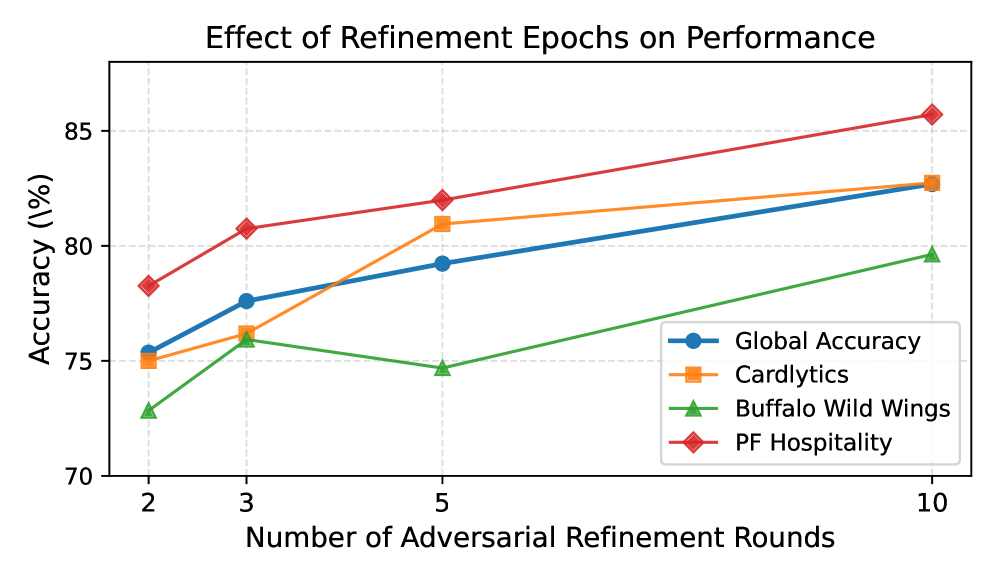
Large language model performance sees substantial gains when synthetic data augmentation is paired with refined training techniques like fine-tuning and instruction tuning, especially when applied to specialized fields. A novel adversarial question generation framework demonstrates this principle by proactively creating challenging data examples, effectively boosting model robustness and accuracy. Results indicate an 18.99% improvement in accuracy compared to the original, unaugmented model, suggesting that strategically crafted synthetic data can significantly enhance a language model’s capacity to understand and respond accurately, even in complex, domain-specific scenarios. This approach represents a key advancement in tailoring AI to address nuanced challenges within particular areas of expertise.
Model distillation offers a powerful technique for deploying large language models in resource-constrained environments. This process involves training a smaller, more efficient “student” model to mimic the behavior of a larger, more complex “teacher” model. By transferring knowledge from the expansive teacher network to a compact student, significant reductions in computational cost and memory footprint are achieved without substantial performance degradation. The student model learns to replicate the teacher’s outputs – not just the correct answers, but also the probabilities associated with each potential response – effectively capturing the nuanced understanding of the larger model. This allows for faster inference speeds and broader applicability, particularly on edge devices or in real-time applications where efficiency is paramount, all while maintaining a high degree of accuracy comparable to its larger counterpart.
Active learning represents a paradigm shift in training artificial intelligence models, prioritizing data efficiency through strategic selection. Instead of requiring exhaustive labeling of datasets, this methodology intelligently identifies the most informative data points – those that, when annotated, yield the greatest improvement in model performance. By focusing annotation efforts on these crucial instances, active learning significantly reduces the burden of manual labeling, a traditionally time-consuming and expensive process. This targeted approach not only accelerates model development but also enables effective training with substantially smaller datasets, making sophisticated AI applications more accessible and sustainable, particularly in resource-constrained environments or domains where labeled data is scarce.
The convergence of synthetic data augmentation, optimized training, model distillation, and active learning strategies culminates in AI systems distinguished by their adaptability, efficiency, and robustness when confronted with intricate, domain-specific challenges. This integrated approach not only elevates performance but also dramatically reduces computational demands; recent evaluations demonstrate a 3.89% performance advantage over the EntiGraph competitor, achieved while requiring approximately 70 times fewer training tokens. This substantial reduction in data dependency promises to accelerate development cycles and broaden accessibility to advanced AI capabilities, particularly in resource-constrained environments, fostering innovation across a diverse range of specialized fields.
The pursuit of robust domain-specific language models, as detailed in this work, echoes a fundamental tenet of mathematical rigor. The paper’s adversarial approach, generating challenging questions to expose interpretive weaknesses, aligns with the need for provable correctness rather than merely functional performance. This is not simply about achieving high scores on benchmarks; it’s about ensuring the model understands and can reliably reason within a given domain. As David Hilbert famously stated, “One must be able to say whether a mathematical assertion is true or false.” This principle translates directly to the evaluation of LLMs; the adversarial framework serves as a method to definitively reveal the limits of a model’s reasoning and drive improvements towards demonstrably correct interpretations, moving beyond superficial success.
What Remains to be Proven?
The pursuit of domain adaptation via adversarial question generation, as demonstrated, offers a superficially elegant approach. Yet, the underlying premise – that synthetic challenges effectively map onto genuine interpretive weakness – warrants further scrutiny. The current methodology treats symptom, not cause. A truly robust solution demands a formal verification of the model’s logical capabilities, not merely iterative refinement against contrived examples. The performance gains, while encouraging, remain empirical; a mathematical guarantee of improved reasoning remains elusive.
A critical limitation lies in the generation process itself. The adversarial questions are, at root, products of another imperfect system. The potential for the synthetic data to reflect, and therefore reinforce, existing biases within the generative model has not been adequately addressed. Minimizing redundancy in both question and answer sets is paramount; each byte of superfluous information introduces a new vector for error propagation.
Future work must prioritize the development of formal methods for assessing and correcting logical fallacies within language models. The field should move beyond performance metrics and towards provable correctness. Only then can the ambition of genuinely intelligent domain adaptation be realized, divorced from the vagaries of empirical testing.
Original article: https://arxiv.org/pdf/2602.18137.pdf
Contact the author: https://www.linkedin.com/in/avetisyan/
See also:
- Invincible Season 4 Gender Swaps Tech Jacket As Fans Question Major Comic Change
- Building Agents That Learn and Improve Themselves
- Gold Rate Forecast
- Games That Faced Bans in Countries Over Political Themes
- Silver Rate Forecast
- Trading Crypto with AI: A New Approach to Portfolio Management
- Superman Flops Financially: $350M Budget, Still No Profit (Scoop Confirmed)
- 22 Films Where the White Protagonist Is Canonically the Sidekick to a Black Lead
- Unveiling the Schwab U.S. Dividend Equity ETF: A Portent of Financial Growth
- 15 Films That Were Shot Entirely on Phones
2026-02-23 20:39