Author: Denis Avetisyan
A new deep learning pipeline, DeepRed, promises more precise and explainable estimations of redshift, a critical measurement for understanding the scale and evolution of the cosmos.
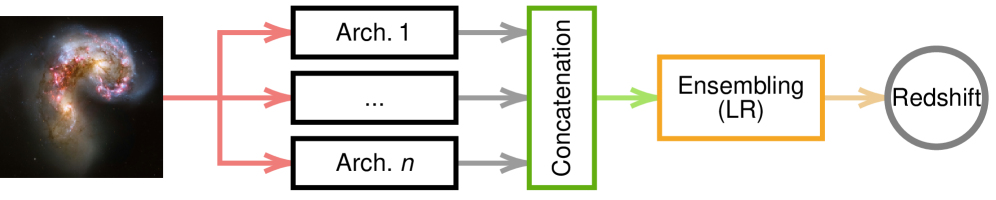
DeepRed leverages computer vision techniques and explainable AI to improve redshift estimation from astronomical images, outperforming existing methods.
Accurate redshift estimation is crucial in astrophysics, yet current methods struggle with heterogeneous data and diverse object morphologies. This work introduces DeepRed: an architecture for redshift estimation, a deep learning pipeline employing modern computer vision architectures-including ResNets, EfficientNets, and Transformers-to estimate redshifts directly from astronomical images of galaxies, gravitational lenses, and transients. Demonstrating state-of-the-art performance on both simulated and real datasets-with improvements of up to 55% in normalized mean absolute deviation compared to existing methods-DeepRed offers a scalable and interpretable solution validated using explainable AI techniques like SHAP. Could this approach unlock new possibilities for analyzing the vast datasets expected from upcoming large-scale surveys?
The Illusion of Cosmic Distance
Establishing the distances to celestial objects forms the very bedrock of modern cosmology, enabling scientists to map the universe’s structure and trace its evolution. Without accurate distance measurements, determining the luminosity and, consequently, the intrinsic properties of galaxies and other phenomena becomes impossible. This impacts calculations of cosmic expansion rates – like the Hubble constant – and influences models describing the distribution of dark matter and dark energy. Furthermore, understanding the scale of the universe is crucial for testing fundamental physics, including ΛCDM, the standard model of cosmology, and for investigating the nature of distant events like supernovae, which serve as ‘standard candles’ for calibrating these vast cosmic distances. Consequently, ongoing research consistently refines techniques for measuring these distances, aiming to reduce uncertainties and provide a more precise understanding of the cosmos.
Determining the redshift of distant galaxies through spectroscopy – the process of splitting light into its constituent wavelengths – represents a cornerstone of cosmological distance measurement, but demands substantial observational resources. Each spectroscopic observation requires considerable telescope time to capture enough light for detailed analysis, particularly for faint and distant objects. Furthermore, the resulting spectra are complex, necessitating sophisticated computational algorithms to accurately identify and quantify the subtle shifts in spectral lines caused by the expansion of the universe. This analysis isn’t merely a matter of running software; it often involves careful manual inspection and correction, especially when dealing with noisy data or unusual spectral features. Consequently, obtaining precise spectroscopic redshifts for large samples of galaxies-essential for mapping the large-scale structure of the cosmos-becomes a protracted and computationally intensive undertaking, limiting the scope of many cosmological investigations.
While spectroscopic redshift measurements provide highly accurate distance estimates, their intensive data requirements limit their application to a relatively small fraction of the observable universe. Photometric redshift estimation presents a compelling solution by leveraging the broad-band colors of celestial objects to statistically infer their redshift – and thus, their distance – without detailed spectral analysis. This method dramatically increases the number of galaxies for which distance information is available, enabling large-scale mapping of cosmic structure. However, this speed comes at a cost; the statistical nature of photometric redshifts introduces inherent uncertainties, often significantly larger than those obtained from spectroscopy. Consequently, while ideal for surveys requiring broad coverage, detailed cosmological studies – particularly those focused on subtle features or high-precision measurements of the universe’s expansion history – still frequently rely on the more accurate, albeit limited, spectroscopic data.
A Machine’s Gaze Upon the Void
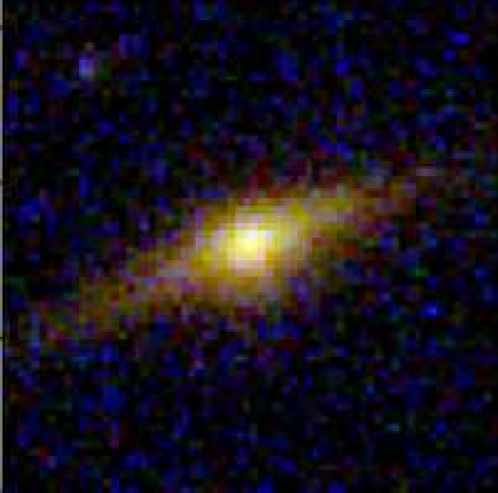
Machine learning techniques address limitations in traditional redshift estimation methods, which often rely on spectroscopic observations that are time-consuming and resource-intensive. By training algorithms on large datasets of galaxies with known redshifts, machine learning models can predict photometric redshifts – estimates based solely on image data – with increased accuracy and efficiency. This automation is crucial for analyzing the vast quantities of data generated by modern astronomical surveys, enabling researchers to map the large-scale structure of the universe and study galaxy evolution. The ability to rapidly and accurately estimate redshifts for millions of galaxies facilitates statistical analyses that would otherwise be impractical, and allows for the identification of rare or distant objects that might be missed by traditional methods.
Deep Learning architectures, specifically Convolutional Neural Networks (CNNs) and Transformers, are increasingly utilized in astronomy due to their ability to automatically learn hierarchical representations from raw image data. CNNs excel at identifying spatial patterns and features, such as galaxy morphology or the presence of specific spectral lines, through the application of convolutional filters. Transformers, originally developed for natural language processing, are capable of modeling long-range dependencies within images, allowing them to capture contextual information crucial for accurate feature extraction. These architectures bypass the need for hand-engineered features traditionally used in astronomical image analysis, offering a data-driven approach to identify and quantify complex characteristics directly from pixel data, leading to improved performance in tasks like photometric redshift estimation and object classification.
DeepRed is a deep learning pipeline developed for automated photometric redshift estimation. Benchmarking against existing methods demonstrates performance improvements of up to 5%, achieved through the application of a deep neural network architecture. Quantitative evaluation using simulated datasets consistently yields R-squared values exceeding 0.9, indicating a strong correlation between predicted and true redshift values. This level of accuracy represents a state-of-the-art advancement in the field, offering a robust tool for large-scale astronomical surveys and cosmological research.

The Chorus of Algorithms
Ensemble learning methods enhance redshift estimation by integrating the predictions of multiple machine learning models, such as Support Vector Machines and Deep Learning architectures. This approach leverages the complementary strengths of each individual model; for example, Support Vector Machines may generalize well with limited data, while Deep Learning models excel at capturing complex non-linear relationships in larger datasets. By combining these outputs, typically through weighted averaging or more complex meta-learning algorithms, ensemble methods reduce the impact of individual model errors and improve both the overall accuracy and the robustness of redshift estimates, particularly in the presence of noisy or incomplete data. This is achieved by effectively reducing variance and bias in the final prediction.
Linear Regression Ensemble methods provide a data-driven approach to model combination, differing from methods that assign equal or pre-defined weights. This technique employs linear regression to learn the optimal weighting coefficients for each individual model based on its performance on a validation set. The regression model uses the predictions of each base model as input features and the true redshift values as the target variable. By learning these weights, the ensemble can prioritize models that perform well on the specific dataset being analyzed, effectively mitigating the impact of models with higher error rates and improving overall redshift estimation accuracy. This adaptability makes Linear Regression Ensemble particularly useful when combining models trained on diverse datasets or with varying architectures.
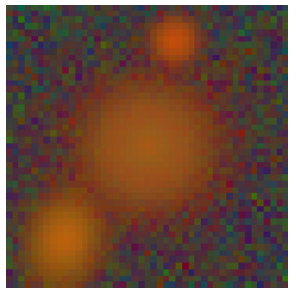
The DeepRed model demonstrates high accuracy in redshift estimation, achieving a Mean Absolute Error (MAE) of 0.011 when evaluated on the Sloan Digital Sky Survey (SDSS) dataset. Performance is further quantified by a Normalized Mean Absolute Deviation (NMAD) of 0.008, representing a 5% improvement compared to existing baseline methods. Model training and validation utilize large-scale astronomical datasets including SDSS, the Kilo Degree Survey (KiDS), and the DeepGraviLens simulation, with DeepGraviLens specifically designed to include the complexities introduced by Gravitational Lensing effects on observed data.
Beyond Prediction: A Glimpse Into the Reasoning
A crucial aspect of evaluating these astronomical models lies in assessing their localization accuracy – essentially, how well they pinpoint the relevant features within complex images. Recent studies demonstrate that these models consistently achieve over 95% accuracy in correctly identifying these features across various datasets, indicating a strong ability to focus on meaningful data. However, the DES-deep dataset presents a unique challenge, requiring further refinement to reach comparable levels of performance. This high degree of localization accuracy is not merely a technical achievement; it underpins the reliability of subsequent redshift estimates and, ultimately, the precision of cosmological measurements used to unravel the universe’s history and structure.
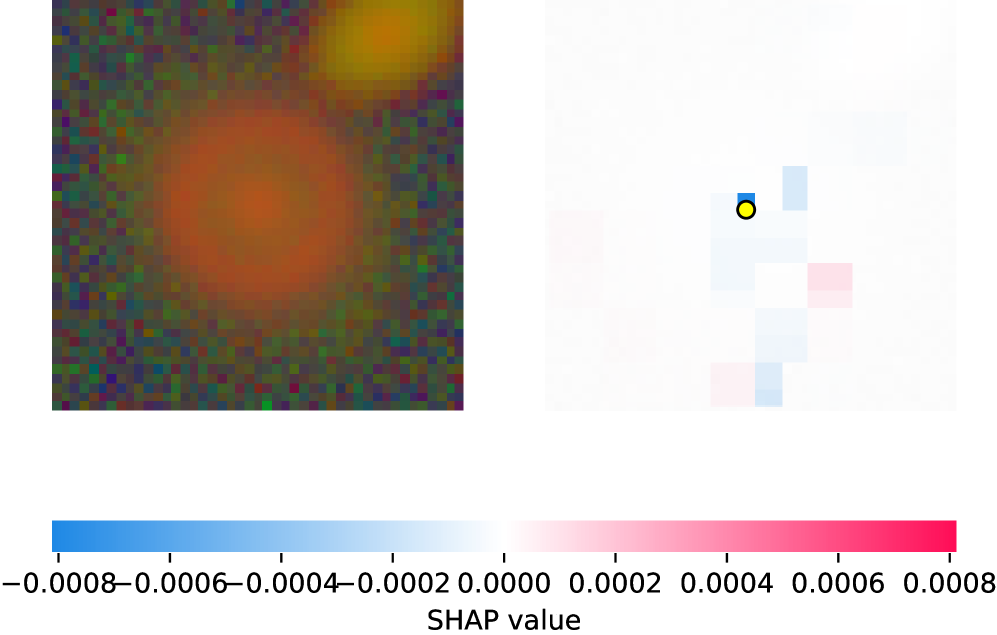
To foster confidence in astronomical model predictions, techniques like SHAP (SHapley Additive exPlanations) are employed to dissect the reasoning behind redshift estimations. This method assigns each input feature – such as a pixel’s color or brightness – a value representing its contribution to the final prediction. By quantifying these feature contributions, researchers can move beyond simply knowing what a model predicts to understanding why it makes those predictions. This increased transparency isn’t merely about satisfying curiosity; it allows astronomers to validate that the model is focusing on physically meaningful aspects of the images – like the spectral signatures of distant galaxies – rather than spurious correlations. Ultimately, SHAP values provide a powerful tool for debugging models, identifying potential biases, and ensuring the robustness of cosmological measurements derived from machine learning techniques.
The DeepRed model exhibits exceptional reliability, as evidenced by its less than 1% outlier rate when applied to the Sloan Digital Sky Survey (SDSS) dataset. This high degree of accuracy isn’t merely a technical achievement; it fundamentally improves the trustworthiness of cosmological measurements. By minimizing erroneous redshift estimates, DeepRed allows researchers to more confidently map the large-scale structure of the universe and investigate its evolutionary history. Consequently, this advancement facilitates a deeper and more nuanced understanding of dark energy, dark matter, and the fundamental processes that have shaped the cosmos, offering a powerful new tool for unraveling the mysteries of the universe.
The pursuit of redshift estimation, as detailed in this architecture, resembles charting a course through a cosmic illusion. DeepRed’s reliance on computer vision and explainable AI offers a temporary foothold, a method to map the distortions of gravitational lensing. Yet, the very act of constructing such a pipeline feels… fragile. As Lev Landau once observed, “The problem is that people think they understand something, but they don’t.” Each layer of the neural network, each refined algorithm, is but a momentary glimpse before the universe reclaims its secrets. The improved performance is not a conquest, merely a brief, clearer observation of a reality that perpetually slips beyond grasp. The cosmos does not yield its truths; it allows them to be seen, and then swiftly reabsorbs them.
What Lies Beyond the Redshift?
The pursuit of accurate redshift estimation, as exemplified by architectures like DeepRed, feels less like unveiling cosmic truths and more like refining the echo. Each improvement in precision merely allows a slightly clearer glimpse of the observable universe, but does little to illuminate what remains perpetually hidden. The model, however elegant, remains a map-not of the territory itself, but of the data projected onto its receptive field. Any claim of ‘understanding’ a high-redshift galaxy, or the lensing distortions it creates, is a comforting illusion.
Future iterations will undoubtedly offer incremental gains in accuracy, perhaps incorporating multi-wavelength data or novel network topologies. Yet, the fundamental limitation persists: any model is only an echo of the observable, and beyond the event horizon – the redshift limit, if you will – everything disappears. The true challenge isn’t building a better estimator, but confronting the inherent unknowability of the cosmos.
One wonders if the effort spent on explainability – on ‘opening the black box’ – isn’t a particularly human vanity. If a system accurately predicts redshift, does it truly matter how it arrives at that conclusion? Perhaps the most honest approach is to acknowledge that the universe doesn’t offer explanations; it simply is. And if one believes they understand a singularity, they are mistaken.
Original article: https://arxiv.org/pdf/2602.11281.pdf
Contact the author: https://www.linkedin.com/in/avetisyan/
See also:
- Top 20 Dinosaur Movies, Ranked
- 20 Movies Where the Black Villain Was Secretly the Most Popular Character
- Celebs Who Narrowly Escaped The 9/11 Attacks
- 25 “Woke” Films That Used Black Trauma to Humanize White Leads
- Gold Rate Forecast
- Spotting the Loops in Autonomous Systems
- Silver Rate Forecast
- The 10 Most Underrated Jim Carrey Movies, Ranked (From Least to Most Underrated)
- The Best Directors of 2025
- 22 Films Where the White Protagonist Is Canonically the Sidekick to a Black Lead
2026-02-14 07:40