Author: Denis Avetisyan
Researchers have developed a new AI system that combines visual data with language processing to better identify and understand anomalies in complex industrial environments.
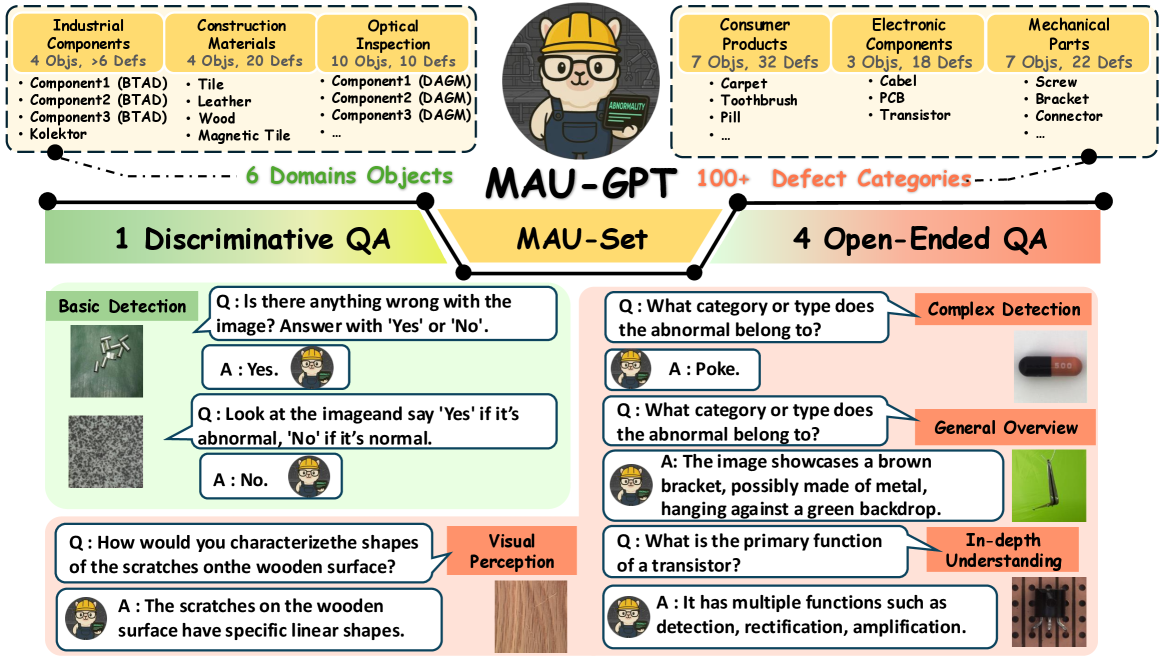
This work introduces MAU-GPT, a multimodal large language model and the MAU-Set dataset to enhance industrial anomaly detection through anomaly-aware learning and expert adaptation.
Despite advances in automated quality control, scaling robust industrial anomaly detection remains challenging due to limited data diversity and poor generalization across defect types. To address this, we present ‘MAU-GPT: Enhancing Multi-type Industrial Anomaly Understanding via Anomaly-aware and Generalist Experts Adaptation’, introducing both the MAU-Set dataset – a comprehensive resource for multi-type anomaly understanding – and MAU-GPT, a novel multimodal large language model. Leveraging a Mixture-of-Experts architecture with an anomaly-aware LoRA adaptation mechanism, MAU-GPT demonstrably outperforms existing state-of-the-art methods across multiple industrial domains. Could this approach pave the way for fully automated, scalable industrial inspection systems capable of handling increasingly complex manufacturing processes?
Unveiling Hidden Patterns: The Challenge of Industrial Anomaly Detection
Historically, industrial quality control has relied heavily on manual inspection or rule-based systems designed to identify pre-defined defects. These approaches are fundamentally reactive – problems are detected only after they manifest as faulty products, leading to wasted materials, rework, and potential recalls. However, modern manufacturing processes are increasingly complex, involving intricate interactions between numerous variables. This complexity results in anomalies that are no longer simple deviations from norms, but rather subtle, multi-faceted issues – a slight variation in temperature coupled with a minor vibration, for example – that traditional methods struggle to recognize. The limitations of these reactive systems highlight the urgent need for intelligent, proactive solutions capable of discerning nuanced defects before they escalate into significant production failures.
Contemporary manufacturing environments, characterized by intricate processes and highly automated systems, present a significant challenge to traditional quality control methods. These facilities now routinely integrate diverse components, employ advanced materials, and operate with minimal human oversight, resulting in anomalies far beyond the scope of simple, pre-defined defect categories. Consequently, a shift towards proactive, intelligent systems is essential. These systems must move beyond merely detecting deviations from established norms and instead demonstrate a nuanced understanding of potential defects – recognizing subtle indicators, contextualizing anomalies within the broader production process, and even predicting failures before they occur. Such capabilities necessitate the integration of advanced technologies like machine learning and artificial intelligence, allowing for continuous adaptation, real-time analysis, and a far more comprehensive approach to maintaining product quality and operational efficiency.
Traditional industrial anomaly detection systems often falter when confronted with the dynamic realities of modern manufacturing. These systems, frequently reliant on pre-programmed thresholds or rigid statistical models, struggle to generalize beyond the specific defects they were designed to identify. As production processes become more intricate and product lines diversify, the range of potential anomalies expands dramatically, quickly overwhelming the capabilities of static detection methods. Consequently, these approaches exhibit limited adaptability, requiring frequent recalibration or complete overhauls whenever new product variants are introduced or process parameters shift. This lack of flexibility not only increases operational costs but also introduces delays in identifying emerging defects, potentially leading to significant quality control lapses and impacting overall production efficiency.
MAU-GPT: A Multimodal Reasoning Engine for Complex Systems
MAU-GPT utilizes Large Language Models (LLMs) to establish a knowledge base concerning industrial operations and the specific traits of anomalies within those processes. This is achieved by pre-training the LLM on extensive datasets detailing normal operating procedures, equipment specifications, and historical anomaly data, including both root causes and observable symptoms. The LLM then functions as a contextual reasoning engine, capable of interpreting sensor readings, maintenance logs, and operator reports to build a comprehensive understanding of the system’s state and identify deviations from expected behavior. This foundational understanding enables more accurate and efficient anomaly detection and diagnosis compared to traditional rule-based or statistical methods.
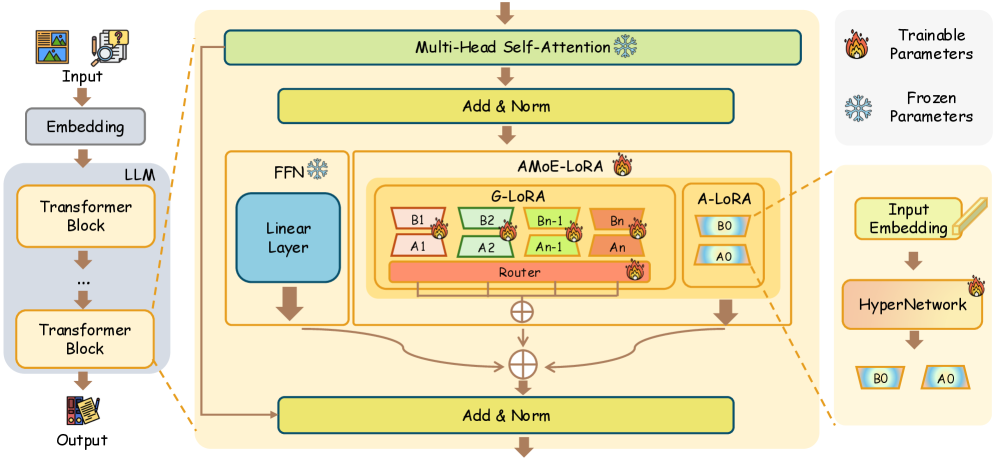
The AMoE-LoRA mechanism within MAU-GPT facilitates efficient adaptation to diverse anomaly types by employing a parameter-efficient fine-tuning strategy. AMoE, or Adaptive Mixture of Experts, dynamically selects and combines multiple expert networks, each specializing in a subset of anomaly characteristics. LoRA, or Low-Rank Adaptation, then introduces a small number of trainable parameters to the pre-trained Large Language Model, allowing for specialized reasoning without requiring updates to the entire model weight set. This approach minimizes computational cost and data requirements compared to full fine-tuning, while enabling MAU-GPT to effectively differentiate and analyze various industrial anomalies based on their specific attributes.
MAU-GPT integrates a Vision Encoder to directly process image and video data, supplementing textual inputs. This allows the system to analyze visual cues indicative of anomalies – such as deviations in color, shape, or texture – that may not be explicitly described in accompanying text reports. The Vision Encoder transforms visual data into a vector representation, which is then fused with textual embeddings before being processed by the Large Language Model. This multimodal approach extends MAU-GPT’s analytical scope beyond text-based descriptions, enabling the detection of anomalies observable through visual inspection of industrial processes and equipment.
Adaptive Expertise: Unlocking the Power of AMoE-LoRA
Low-Rank Adaptation (LoRA) is employed within AMoE-LoRA as a parameter-efficient fine-tuning technique. Rather than updating all model parameters during adaptation, LoRA introduces trainable low-rank matrices that are added to existing weights. This significantly reduces the number of trainable parameters – often by over 90% – compared to full fine-tuning, resulting in lower computational costs and memory requirements. The reduced parameter count also translates to a decreased need for large datasets, enabling effective adaptation with limited labeled anomaly data. LoRA achieves comparable performance to full fine-tuning by focusing adaptation on a smaller, carefully selected subset of parameters, preserving the knowledge encoded in the pre-trained model while specializing it for anomaly detection tasks.
MAU-GPT employs a dynamic Mixture of Experts (MoE) architecture to improve anomaly detection accuracy. This system comprises multiple ‘expert’ neural networks, each specializing in recognizing particular anomaly types. During analysis, a gating network routes input data to a subset of these experts – typically only one or a few – based on the characteristics of the anomaly being investigated. This selective activation reduces computational load and allows each expert to focus its parameters on a narrower range of anomalies, leading to improved performance compared to a single, monolithic model. The dynamic nature of the MoE ensures that the most relevant experts are engaged for each specific anomaly, optimizing both accuracy and efficiency.
The Hypernetwork within AMoE-LoRA functions as a parameter generator for the Low-Rank Adaptation (LoRA) modules. Instead of directly fine-tuning all model weights, LoRA introduces trainable rank decomposition matrices. The Hypernetwork takes the anomaly category as input and uses this information to dynamically generate the weights for these LoRA matrices. This conditional generation process allows the model to adapt its learning process specifically to the characteristics of each anomaly type, enabling targeted learning and improving performance on diverse anomaly detection tasks without requiring separate fine-tuned models for each category.
Demonstrating Impact: Rigorous Evaluation and Performance Metrics
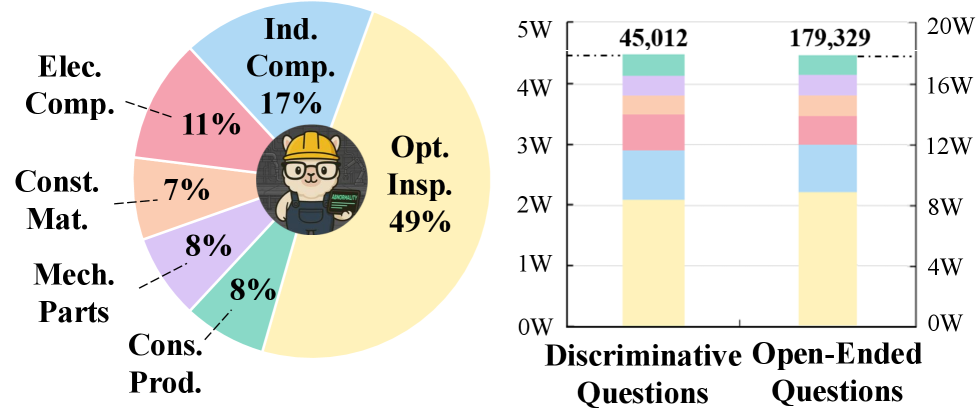
The evaluation of MAU-GPT relied on the MAU-Set dataset, a resource specifically designed to rigorously test anomaly detection and understanding capabilities. This dataset distinguishes itself through a hierarchical question answering structure, demanding that the model not only identify anomalies but also reason about their relationships and implications at multiple levels of detail. Furthermore, MAU-Set provides broad anomaly coverage, encompassing a diverse range of defects and irregularities – crucial for ensuring that any successful model demonstrates robust and generalizable performance, rather than excelling on a limited set of scenarios. This comprehensive approach to dataset construction allowed for a nuanced assessment of MAU-GPT’s ability to navigate complex anomaly-related inquiries and provide insightful, contextually relevant responses.
The evaluation of MAU-GPT’s capabilities extended beyond simple identification to encompass a spectrum of question answering challenges, specifically utilizing both discriminative and open-ended question answering tasks. Discriminative QA framed inquiries as binary classifications – determining whether an anomaly exists or not – while open-ended QA demanded more complex reasoning and detailed explanations. This dual approach ensured a comprehensive assessment of the model’s abilities, testing not only its capacity to detect anomalies but also to understand and articulate the nature of those defects. By evaluating performance across these distinct task types, researchers gained a nuanced understanding of MAU-GPT’s strengths and limitations in handling various anomaly detection scenarios, ultimately showcasing its robust and versatile capabilities.
To rigorously assess the reliability of its outputs, MAU-GPT employed GPT-4o as an independent evaluator. This process moved beyond traditional metric-based assessments by leveraging the advanced reasoning capabilities of a state-of-the-art large language model to judge the quality and factual correctness of MAU-GPT’s responses. Specifically, GPT-4o analyzed generated answers for coherence, relevance, and accuracy, providing a nuanced validation that complements quantitative scores. This approach ensures a high degree of confidence in the model’s performance, as it confirms that MAU-GPT not only produces statistically strong results, but also delivers outputs that align with human expectations for clarity and correctness, ultimately bolstering the trustworthiness of the anomaly detection system.
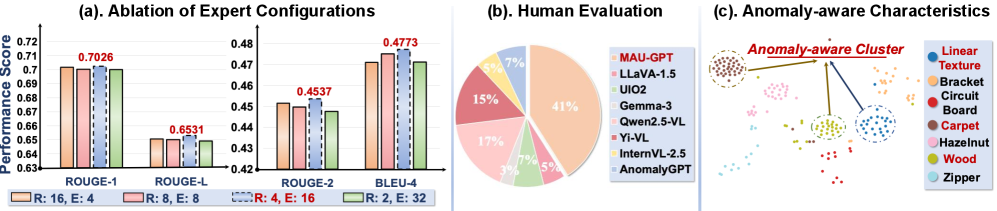
Evaluations using the MMAD Benchmark reveal that MAU-GPT exhibits leading capabilities in identifying anomalies and comprehending defects within complex data. The model consistently achieved the highest reported ROUGE-L and BLEU scores – key metrics for evaluating text generation quality – when compared against a suite of established vision-language models including LLaVA-1.5-7B, UIO2-Xl-3B, Gemma-3, Yi-VL, InternVL-2.5, and AnomalyGPT. This performance suggests that MAU-GPT not only accurately detects irregularities but also effectively describes the nature of these defects, offering a significant advancement in automated anomaly understanding and analysis.
Human expert evaluations consistently demonstrate that MAU-GPT produces responses preferred over those generated by competing anomaly detection models. These evaluations, conducted with knowledgeable reviewers, assessed the clarity, relevance, and overall quality of the answers provided by each system. The results reveal a significant endorsement rate for MAU-GPT, indicating a clear preference for its outputs in understanding and explaining anomalies. This strong performance, validated by human judgment, underscores the model’s ability to not only identify defects but also to articulate them in a manner readily understood and accepted by experts in the field, establishing a new benchmark for both accuracy and interpretability.
Evaluations on the MMAD Benchmark reveal that MAU-GPT achieves performance levels remarkably close to those of considerably larger 34 billion parameter models, despite its relatively compact size. This suggests a highly efficient architecture and training methodology, enabling it to capture complex relationships within anomaly detection data with fewer resources. The model’s ability to approach the accuracy of these larger counterparts signifies a substantial advancement in balancing performance and computational cost, potentially broadening the accessibility and deployment of sophisticated anomaly understanding systems in resource-constrained environments. This efficiency not only reduces the demands on hardware but also lowers energy consumption, contributing to more sustainable AI practices.
The pursuit of robust anomaly detection, as demonstrated by MAU-GPT, echoes a fundamental principle of pattern recognition. Every image, every sensor reading, presents a challenge to understanding, not just a model input. Geoffrey Hinton aptly stated, “What we’re trying to do is create systems that can learn in a very robust way, and that means they have to be able to generalize from a small amount of data.” This generalization, central to the MAU-GPT’s Mixture of Experts approach and the newly constructed MAU-Set dataset, allows the model to adapt to unseen anomalies. The system doesn’t merely identify deviations; it strives to comprehend the underlying reasons, mirroring the need for rigorous logic and creative hypothesis in interpreting complex industrial data.
Beyond the Horizon
The construction of MAU-Set, and the subsequent architecture of MAU-GPT, represent a focused attempt to bridge the gap between large language model capabilities and the nuanced demands of industrial anomaly detection. However, the very act of defining ‘anomaly’ remains a curiously subjective endeavor. The dataset, however comprehensive, reflects the biases inherent in its creation; the anomalies known are not necessarily the anomalies that will be. Future work must grapple with the inherent uncertainty – the ‘unknown unknowns’ – that define real-world industrial processes.
The Mixture of Experts approach, while demonstrating promising results, also hints at a fundamental limitation. Specialization, even within a generalized model, necessitates a careful balance between focused expertise and broad contextual understanding. One anticipates a future iteration will explore dynamic expert allocation – a system that learns when to prioritize specific knowledge domains, rather than relying on a fixed architecture. The question isn’t merely detecting the aberrant signal, but interpreting its significance within the complex web of interconnected processes.
Ultimately, the true test lies not in benchmark performance, but in deployment. The transition from controlled laboratory settings to the messy, unpredictable reality of the factory floor will inevitably reveal unforeseen challenges. A truly robust system will not simply flag deviations, but offer reasoned explanations, facilitating human-machine collaboration and driving genuine insight. The pursuit of anomaly detection, it seems, is less about finding the exceptional, and more about understanding the rule.
Original article: https://arxiv.org/pdf/2602.07011.pdf
Contact the author: https://www.linkedin.com/in/avetisyan/
See also:
- 20 Movies Where the Black Villain Was Secretly the Most Popular Character
- Top 20 Dinosaur Movies, Ranked
- 25 “Woke” Films That Used Black Trauma to Humanize White Leads
- Gold Rate Forecast
- Spotting the Loops in Autonomous Systems
- Silver Rate Forecast
- 22 Films Where the White Protagonist Is Canonically the Sidekick to a Black Lead
- Top 10 Coolest Things About Invincible (Mark Grayson)
- Can AI Lie with a Picture? Detecting Deception in Multimodal Models
- Celebs Who Narrowly Escaped The 9/11 Attacks
2026-02-10 21:09