Author: Denis Avetisyan
A new deep learning approach, DeepPM, uses graph neural networks to identify the most profitable users to engage in social networks, boosting influence and returns.
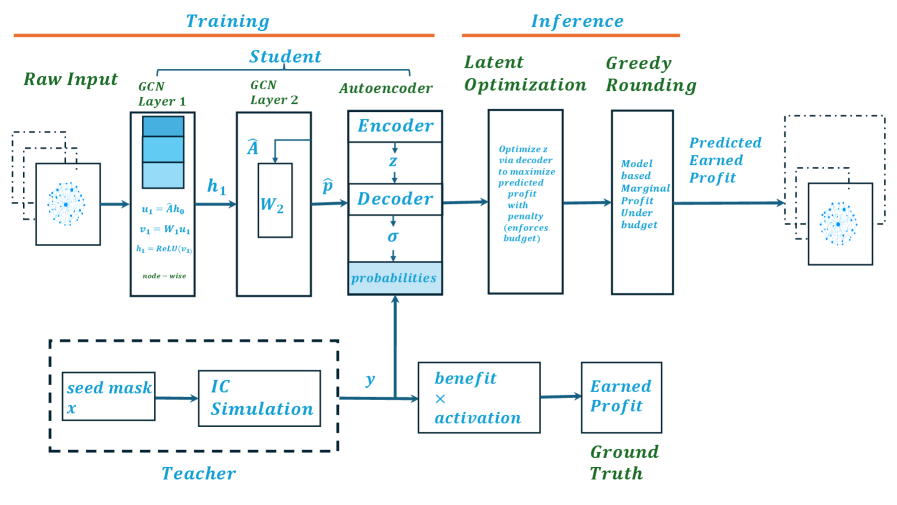
This review details DeepPM, a model leveraging graph neural networks for profit maximization through strategic seed user selection in social networks, demonstrating superior performance to existing influence maximization methods.
Maximizing profit within complex social networks remains challenging due to the difficulty of accurately modeling real-world information diffusion. This paper introduces ‘DeepPM: A Deep Learning-based Profit Maximization Approach in Social Networks’, a novel deep learning framework leveraging graph neural networks to identify influential seed users and optimize profit. Experimental results demonstrate that DeepPM outperforms existing methods on real-world datasets by learning diversified diffusion patterns without relying on predefined diffusion models. Could this approach unlock more effective viral marketing strategies and fundamentally change how influence is harnessed in online social systems?
The Inevitable Cascade: Pinpointing Influence in Complex Systems
The capacity to pinpoint influential users within a social network is paramount to effectively disseminating information and achieving specific goals, ranging from marketing product adoption to public health interventions and even political mobilization. These individuals, often possessing extensive networks and high connectivity, act as crucial nodes in the spread of ideas and behaviors; a carefully selected group can trigger a cascade of influence, reaching a far greater audience than would be possible through broadcast methods. Research demonstrates that influence isn’t solely determined by the sheer number of connections, but also by factors like network position, engagement rates, and the credibility of the influencer within their community. Consequently, identifying these key individuals requires sophisticated analytical techniques, moving beyond simple metrics like follower count to understand the complex dynamics of social contagion and maximize the impact of any given message or campaign.
The pursuit of influence maximization, while conceptually straightforward, presents significant computational hurdles when applied to networks mirroring real-world scale and intricacy. Traditional optimization techniques, designed for smaller, more manageable systems, falter under the weight of billions of nodes and trillions of connections characteristic of social networks like Twitter or Facebook. These methods often rely on exhaustive or near-exhaustive searches of the solution space – a process that becomes exponentially more expensive as network size increases. Furthermore, accurately modeling the cascading effects of information spread – accounting for user behavior, network topology, and potential delays – introduces a level of complexity that strains even the most powerful computing resources. Consequently, finding the truly optimal seed set – the small group of users whose activation maximizes information diffusion – becomes an intractable problem, necessitating the development of heuristic algorithms that prioritize efficiency over absolute optimality.
The pursuit of influence maximization frequently encounters limitations when employing straightforward algorithms. Methods like Random Selection, which simply chooses nodes at random, and Simple Greedy, which iteratively selects the node with the highest degree, often fall short of optimal performance in complex networks. These approaches struggle to account for the cascading effects of information spread, failing to recognize how a node’s influence is amplified – or diminished – by its connections and the connections of others. Consequently, they may identify individuals with high immediate reach but overlook those strategically positioned to trigger wider, more sustained propagation. This oversight results in suboptimal seed sets, limiting the overall impact of any influence campaign and highlighting the need for algorithms that more accurately model the intricate dynamics of social networks.
The practical application of influence maximization isn’t simply about finding influential users, but doing so within budgetary constraints. Incentivizing individuals to act as initial spreaders of information – the ‘seed’ users – often requires substantial investment, be it through financial rewards, exclusive access, or other forms of compensation. This cost dramatically complicates the seed set selection process; algorithms must now balance the potential reach of an influencer with the price of securing their participation. Consequently, efficient algorithms aren’t merely seeking the most connected individuals, but rather the most cost-effective set of influencers capable of triggering a cascade of information across the network. Failing to account for these incentivization costs can lead to theoretically optimal seed sets that are financially unsustainable, rendering the entire maximization effort impractical.

Learning the Cascade: A Systemic Response to Complexity
DeepPM addresses the Profit Maximization Problem not through traditional optimization algorithms, but by reformulating it as a supervised learning task. This approach allows the system to learn from historical data and generalize to new network instances, a capability often lacking in deterministic methods. Instead of directly calculating the optimal seed set, DeepPM trains a model to predict the expected profit generated by different seed set configurations. This learning-based paradigm enables DeepPM to adapt to complex network structures and dynamic influence propagation patterns without requiring explicit modeling of these factors, offering a scalable and flexible solution to the problem.
DeepPM utilizes a Teacher-Student framework to address the Profit Maximization Problem. The teacher model is trained to forecast the influence spread resulting from various seed sets, specifically employing the Independent Cascade (IC) Model for simulating information diffusion. The IC Model operates by iteratively activating nodes in a network based on the probability of influence from their activated neighbors. The teacher model learns to predict the expected number of activated nodes – and thus, the potential profit – given a seed set and the network topology. This learned predictive capability is then transferred to a student model, allowing for efficient seed set selection without repeatedly running computationally expensive IC simulations.
The teacher model within DeepPM utilizes a Graph Convolutional Network (GCN) to generate node representations that encode network structure and feature information. GCNs operate by aggregating feature vectors from a node’s immediate neighbors, effectively capturing relational dependencies within the graph. This aggregation process is iteratively applied, allowing information to propagate across multiple hops and create embeddings that reflect a node’s position and influence within the network. The resulting node representations are learned in an end-to-end fashion, enabling the model to capture complex, non-linear relationships between nodes and their features, thereby improving the accuracy of predicting influence spread for seed set selection.
DeepPM utilizes a student model trained to replicate the seed set selection process of a pre-trained teacher model, resulting in substantial gains in efficiency. This approach allows for faster prediction of profitable seed sets compared to directly optimizing for profit, as the student model has already learned to approximate the impact of various seed sets via the teacher. Empirical evaluation demonstrates that DeepPM consistently achieves up to 60% higher profit than state-of-the-art methods when selecting seed sets for influence maximization, indicating a significant improvement in solution quality and computational performance.
Empirical Confirmation: Observing the Cascade in Action
DeepPM’s performance was assessed using three established benchmark datasets: Wiki-Vote, Ego-Facebook, and Email-Eu-Core. The Wiki-Vote dataset represents a voting network, allowing for evaluation of influence maximization strategies in a deliberative context. The Ego-Facebook dataset is derived from Facebook social network data, providing a realistic evaluation environment for diffusion processes. Finally, the Email-Eu-Core dataset, based on email communication networks, offers a different structural setting for analyzing information spread. These datasets were selected to ensure a comprehensive evaluation across diverse network topologies and scales, facilitating robust comparisons against baseline algorithms.
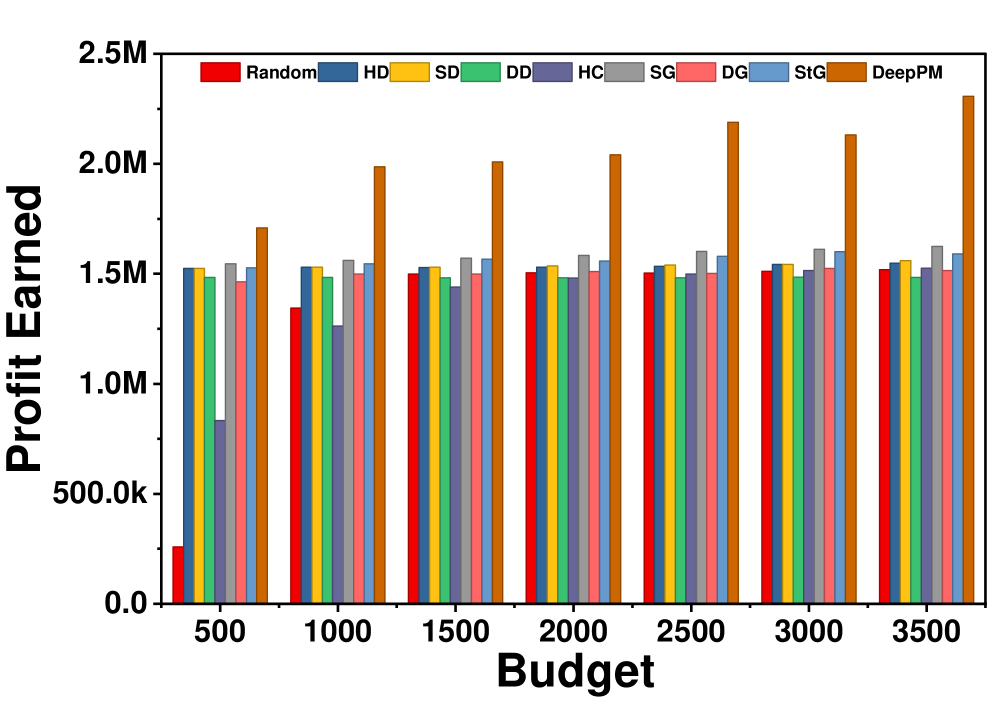
Comparative analysis on benchmark datasets – including Wiki-Vote, Ego-Facebook, and Email-Eu-Core – indicates that the DeepPM framework consistently achieves superior performance when contrasted with established baseline algorithms. Specifically, DeepPM outperformed Stochastic Greedy, Double Greedy, and Degree Discount across multiple experimental runs and varying network configurations. This consistent outperformance is evidenced by quantifiable profit improvements, ranging from 10% to 58% depending on the dataset and algorithm used for comparison, and demonstrates the effectiveness of DeepPM’s approach to influence maximization.
Evaluations conducted on the Euemail and Facebook datasets demonstrate that DeepPM consistently generates a profit improvement ranging from 19% to 58% when compared against both Random and Double Greedy algorithms. This performance was observed across a variety of budget allocations, indicating DeepPM’s ability to optimize information diffusion strategies effectively under differing resource constraints. The measured profit improvement represents the quantifiable benefit of DeepPM’s learning-based approach to seed selection, exceeding the performance of the baseline algorithms in maximizing influence spread within the network structures of these datasets.
Evaluations conducted on the Facebook dataset, utilizing a uniform probability setting for node activation, demonstrate that DeepPM consistently generates a profit improvement ranging from 18% to 40% when compared to several baseline algorithms. This performance metric was calculated by comparing the total profit derived from seed node selections made by DeepPM against those made by the competing methods. The observed profit gains indicate a substantial advantage for DeepPM in maximizing influence spread within the Facebook network structure under the specified probabilistic model.
Evaluations using the Wiki-Vote dataset, under a uniform probability setting, indicate that the DeepPM framework achieves a profit improvement ranging from 10% to 42% when compared against the Stochastic Greedy algorithm. This performance gain was consistently observed across varying budget allocations within the dataset, demonstrating DeepPM’s ability to more effectively identify and influence nodes for maximizing information diffusion profit in the Wiki-Vote network structure.
Evaluations of the DeepPM framework were conducted using network configurations defined by both Uniform and Trivalency settings to assess its adaptability. The Uniform Setting characterizes networks where each node possesses an equal probability of influencing others, while the Trivalency Setting constrains node degrees to a maximum of three connections. Performance consistency across these distinct network topologies-representing variations in network density and influence spread-demonstrates the framework’s robustness and generalizability beyond specific network characteristics. This indicates DeepPM’s ability to effectively model information diffusion regardless of underlying network structure, a critical attribute for real-world applicability.
Empirical validation across the Wiki-Vote, Ego-Facebook, and Email-Eu-Core datasets demonstrates DeepPM’s capacity to model complex information diffusion processes within social networks. Performance gains of 10-58% over benchmark algorithms – including Stochastic Greedy, Double Greedy, and Degree Discount – indicate that the learning-based approach effectively captures the non-linear relationships governing influence propagation. This capability is maintained across varying network topologies, as evidenced by robust results under both Uniform and Trivalency settings, suggesting DeepPM’s adaptability to diverse social structures and diffusion dynamics.
Beyond Prediction: The Inevitable Trajectory of Influence
The core principles underpinning DeepPM extend significantly beyond initial applications, offering a versatile framework for optimizing seed set selection across diverse fields. Efficiently identifying influential nodes becomes crucial not only in maximizing marketing reach, but also in strategically intervening in the spread of information – or misinformation. Public health initiatives, for instance, can leverage these techniques to pinpoint key individuals for vaccination campaigns or to disseminate critical health information during outbreaks, effectively controlling disease propagation. Similarly, the ability to identify and target the sources of false narratives presents a powerful tool for rumor suppression and the mitigation of social instability, highlighting the broad applicability of DeepPM’s approach to complex network challenges.
The true potential of DeepPM lies in its capacity to move beyond static influence maximization and embrace the dynamic nature of social networks. By integrating the model with real-time network data – tracking evolving connections, shifting user behaviors, and emergent trends – DeepPM facilitates adaptive strategies. This allows for continuous recalibration of seed sets, ensuring that influence campaigns remain effective even as the network landscape changes. Instead of relying on pre-computed rankings, the system can respond to immediate shifts in connectivity and engagement, prioritizing nodes that are currently most receptive or strategically positioned for propagation. This responsiveness is particularly crucial in contexts like viral marketing or disease control, where timing and adaptability are paramount, ultimately offering a more robust and nuanced approach to harnessing social influence.
Continued development of DeepPM will likely involve experimentation with more sophisticated deep learning architectures, such as transformers or graph neural networks, to capture nuanced relationships within complex networks and improve predictive accuracy. Beyond structural analysis, future iterations of the model could incorporate user-specific attributes – including demographics, interests, and past behaviors – to personalize influence maximization strategies and identify highly receptive individuals. This shift towards attribute-aware influence maximization promises to move beyond generalized seed set selection, enabling targeted interventions with greater efficacy and relevance, and ultimately unlocking a more granular understanding of how information propagates through social systems.
DeepPM represents a significant advancement in the capacity to both analyze and leverage social influence within the intricate structures of complex networks. This framework moves beyond traditional influence maximization techniques by employing deep learning to predict the spread of information and identify optimal seed sets with unprecedented accuracy. Consequently, it furnishes researchers and practitioners with a robust methodology for not only deciphering the mechanisms driving collective behavior, but also for strategically intervening to achieve desired outcomes – whether that involves promoting beneficial health initiatives, mitigating the propagation of misinformation, or simply optimizing marketing campaigns. The power of DeepPM lies in its ability to model nuanced relationships and adapt to the constantly shifting dynamics inherent in real-world social systems, ultimately providing a pathway to harness the potent forces of connection and persuasion.
The pursuit of profit maximization within the complex ecosystems of social networks, as demonstrated by DeepPM’s graph neural network approach, echoes a fundamental truth about all systems. Each carefully selected ‘seed user’-a point of initial influence-is a prediction, a prophecy of diffusion. However, the model’s success isn’t guaranteed perpetuity; influence, like order, is merely a temporary cache against the inevitable entropy of network dynamics. As Grace Hopper observed, “It’s easier to ask forgiveness than it is to get permission.” DeepPM, in its algorithmic boldness, seems to embody this spirit – a willingness to act, to grow influence, and adapt to the consequences rather than seeking absolute pre-optimization. The architecture promises enhanced returns, but inevitably demands continuous monitoring and adjustment, a testament to the inherent fragility of even the most sophisticated designs.
What Lies Ahead?
The pursuit of “profit maximization” within social networks, as exemplified by DeepPM, feels less like engineering and more like a formalized observation of inherent instability. The model accurately predicts diffusion-a transient phenomenon. It optimizes for a peak, unaware that every peak inevitably decays, and the network reconfigures itself according to its own chaotic logic. Success isn’t a fixed state; it’s a temporary alignment with emergent properties. A guarantee of sustained profit is merely a contract with probability, and one quickly discovers that the most robust architectures are those that anticipate their own obsolescence.
Future iterations will undoubtedly focus on dynamic adaptation-modeling not just how influence spreads, but why it shifts. The current paradigm treats the network as a static graph, overlooking the constant renegotiation of connections and the evolving definitions of “influence” itself. True progress lies in embracing the inherent unpredictability-recognizing that chaos isn’t failure, it’s nature’s syntax. The question isn’t how to control the network, but how to listen to it.
Ultimately, stability is merely an illusion that caches well. The field will likely move beyond optimizing for a single metric-profit-and toward understanding the complex interplay of factors that govern network behavior. The most valuable models won’t be those that predict the future with certainty, but those that gracefully navigate its inevitable surprises.
Original article: https://arxiv.org/pdf/2602.01351.pdf
Contact the author: https://www.linkedin.com/in/avetisyan/
See also:
- Invincible Season 4 Gender Swaps Tech Jacket As Fans Question Major Comic Change
- Building Agents That Learn and Improve Themselves
- Gold Rate Forecast
- Games That Faced Bans in Countries Over Political Themes
- Silver Rate Forecast
- Trading Crypto with AI: A New Approach to Portfolio Management
- Superman Flops Financially: $350M Budget, Still No Profit (Scoop Confirmed)
- 22 Films Where the White Protagonist Is Canonically the Sidekick to a Black Lead
- Unveiling the Schwab U.S. Dividend Equity ETF: A Portent of Financial Growth
- 15 Films That Were Shot Entirely on Phones
2026-02-04 00:07