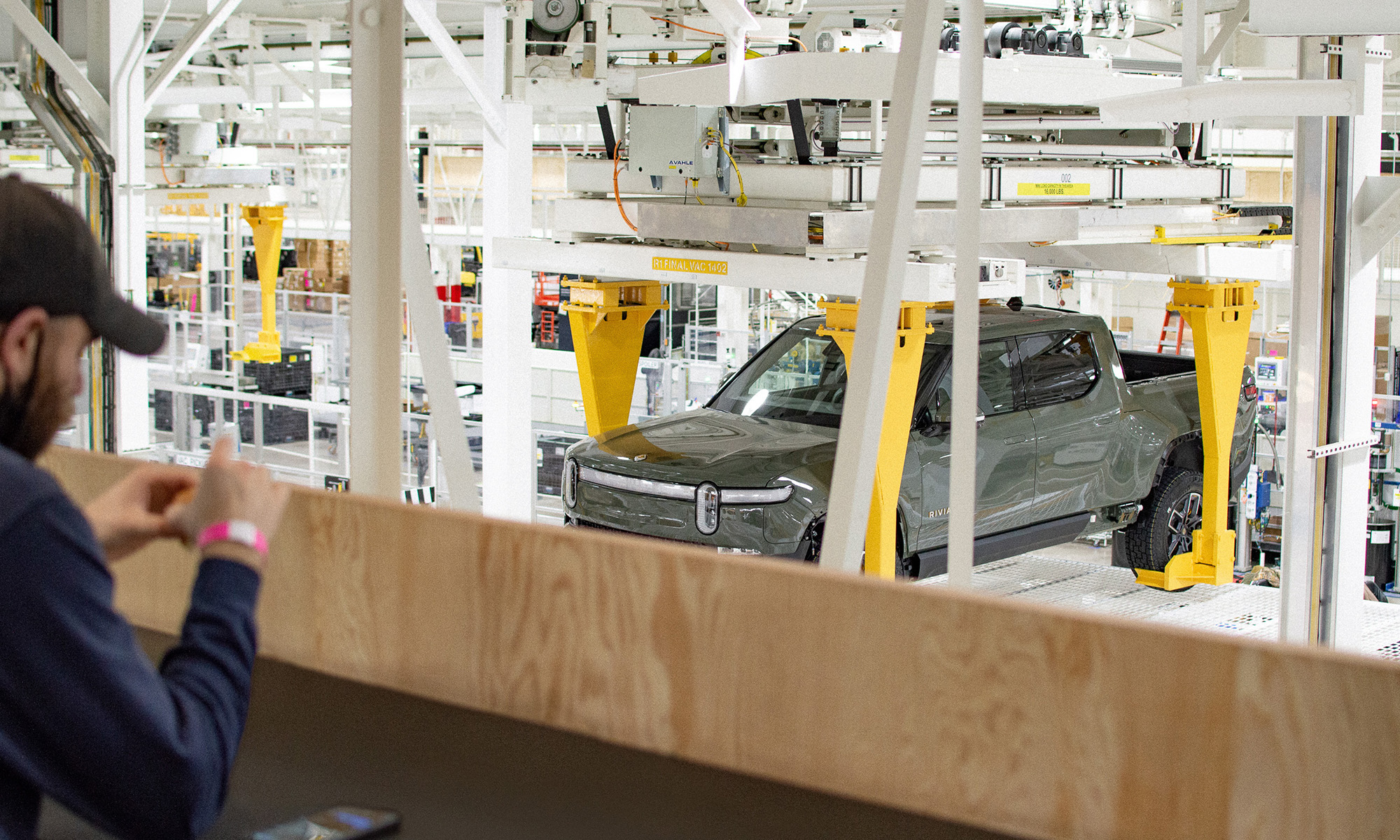
Tesla, as you may or may not be aware (though the sheer volume of news coverage suggests a certain unavoidable awareness), currently occupies a rather significant portion of the global financial landscape. It’s a company valued in the trillions, a figure so large it almost ceases to be meaningful – like trying to count all the grains of sand on a particularly ambitious beach. Rivian Automotive, on the other hand, is… considerably less so. Its market capitalization presently hovers somewhere south of $20 billion, a mere 2% of Tesla’s staggering total. A difference, one might observe, akin to comparing a blue whale to a particularly enthusiastic goldfish.
Tesla possesses a certain… maturity, shall we say. Scale, distribution networks, a general air of having figured things out (or at least appearing to). Rivian, meanwhile, is still in the process of, well, becoming. It’s a relatively recent arrival, a fledgling attempting to take flight in a rather crowded airspace. But the interesting thing about fledglings is that they occasionally grow into something rather magnificent. And, potentially, something that significantly disrupts the established order. (Disruption, in financial circles, is generally considered a good thing. Unless you’re the one being disrupted, of course. Then it’s mostly just irritating.)
Rivian’s Sales: Awaiting Liftoff
Rivian’s sales growth has, shall we say, exhibited a certain… hesitancy in recent years. The market, responding with a predictable lack of enthusiasm, has adjusted its valuation accordingly. In 2023, investors were willing to pay a premium – around 10 times sales – for the promise of Rivian. Now, that multiple has shrunk to a more modest 3.4. A two-thirds reduction. It’s a bit like offering someone a spaceship and then discovering they only really wanted a slightly used bicycle. The price adjustment is, regrettably, inevitable.
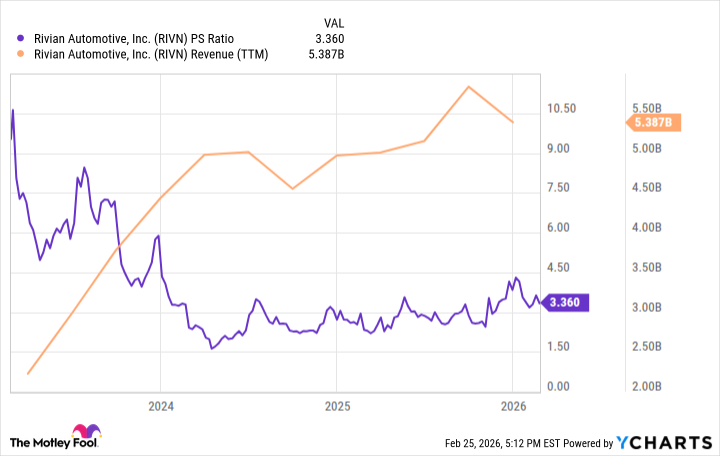
Two primary factors have contributed to this sales slowdown. First, the broader EV market has cooled somewhat. Demand, it appears, isn’t quite scaling at the exponential rate initially predicted. (Predictions, one should always remember, are notoriously unreliable, particularly those involving exponential growth. They tend to overestimate everything. Except, perhaps, the amount of coffee consumed by financial analysts.) Changes in federal subsidies haven’t helped either, effectively increasing the cost of entry for potential EV buyers. The second factor? Rivian simply hasn’t introduced any new models for a while. Refreshing a product line, it turns out, is rather important.
However, this latter issue is poised for resolution with the imminent arrival of the R2. This smaller SUV, priced at under $50,000 (for the base model, naturally), represents a significant expansion of Rivian’s addressable market. Approximately 70% of consumers are looking to spend less than $50,000 on their next vehicle. (A statistic that, when you think about it, is rather alarming. What are the other 30% doing? Buying yachts? Funding space programs?) The R1T and R1S, while undeniably impressive, carry a price tag that puts them firmly in the luxury category. The R2, therefore, has the potential to unlock a substantially larger volume of sales.
Tesla experienced a similar surge in sales when it released the Model Y and Model S. While Rivian’s success is, naturally, not guaranteed, the signs suggest a period of accelerated growth is on the horizon. Wall Street analysts concur, projecting a 30% increase in sales for 2026, followed by a further 66% jump in 2027. (These projections, of course, should be taken with a generous pinch of salt. Or perhaps a whole shaker.)
Rivian and the Improbable Rise of the AI Stock
Tesla’s current valuation is, in no small part, driven by its perceived status as an “AI stock.” The company has invested heavily in self-driving technology and is exploring opportunities in the potentially lucrative robotaxi market. (A market that, if it ever materializes, could be worth trillions. Or nothing. It’s really quite difficult to say.) Rivian, while lagging behind Tesla in terms of investment and innovation, is also making moves in this space.
The company held its first “AI Day” last December, outlining ambitious goals, including the development of a proprietary AI chip and the launch of “Universal Hands-Free” driving. (The implications of “Universal Hands-Free” driving are, frankly, terrifying. Imagine a world where cars drive themselves, making all their own decisions. It’s a recipe for chaos. Or, potentially, for remarkably efficient traffic flow. It’s really a toss-up.) Rivian recognizes that AI is the future of both self-driving cars and EVs, and is investing accordingly.
While Rivian’s AI vision is, admittedly, more speculative than its near-term sales ramp, the company appears to be taking a serious approach to all three key areas: EVs, AI, and autonomy. With a market capitalization that remains a tiny fraction of Tesla’s, Rivian presents a potentially compelling growth opportunity for patient investors seeking maximum long-term upside. It’s a rather improbable story, to be sure. But then, most interesting stories are.
Read More
- Gold Rate Forecast
- Games That Faced Bans in Countries Over Political Themes
- Silver Rate Forecast
- Unveiling the Schwab U.S. Dividend Equity ETF: A Portent of Financial Growth
- 22 Films Where the White Protagonist Is Canonically the Sidekick to a Black Lead
- 20 Movies Where the Black Villain Was Secretly the Most Popular Character
- Superman Flops Financially: $350M Budget, Still No Profit (Scoop Confirmed)
- How to Do Sculptor Without a Future in KCD2 – Get 3 Sculptor’s Things
- Celebs Who Narrowly Escaped The 9/11 Attacks
- 14 Movies Where the Black Character Refuses to Save the White Protagonist
2026-03-02 17:53