Author: Denis Avetisyan
A new machine learning model accurately fills in gaps in historical solar magnetic field data, offering a powerful tool for studying past solar activity.
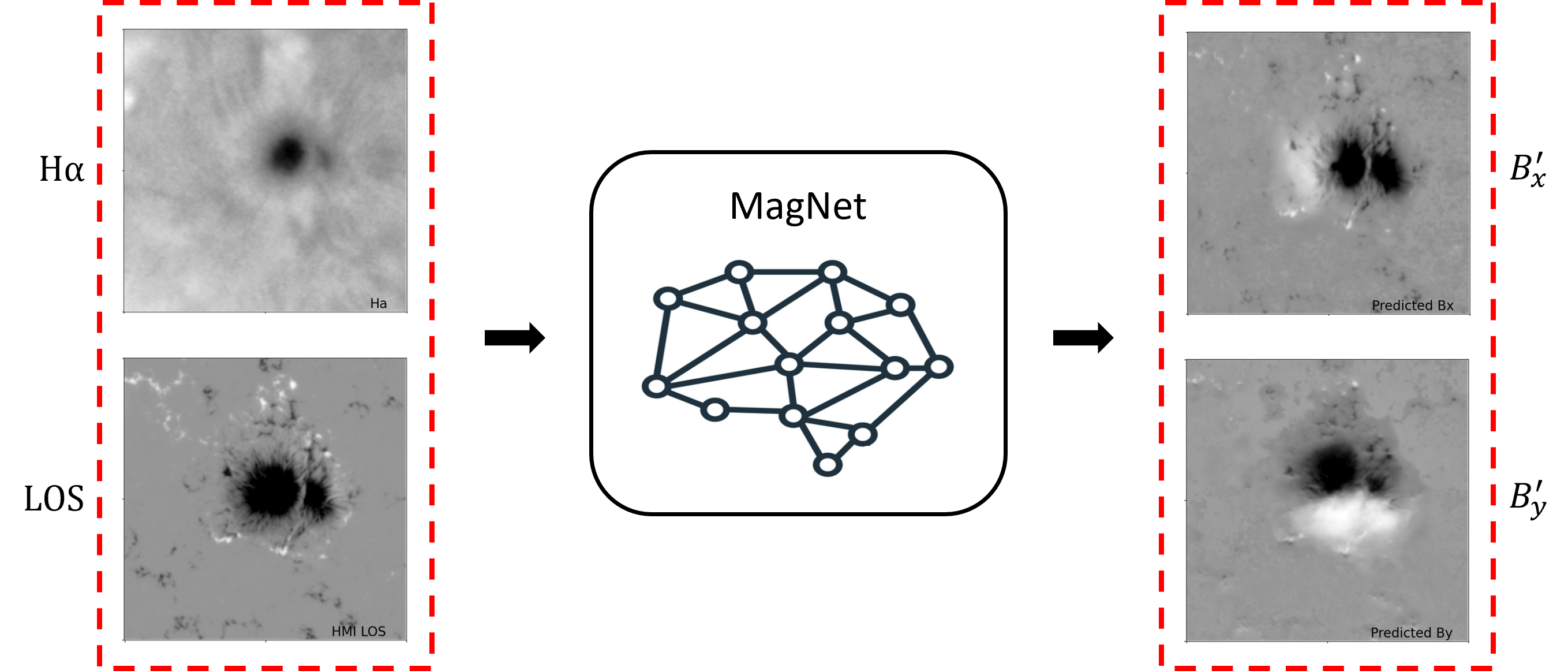
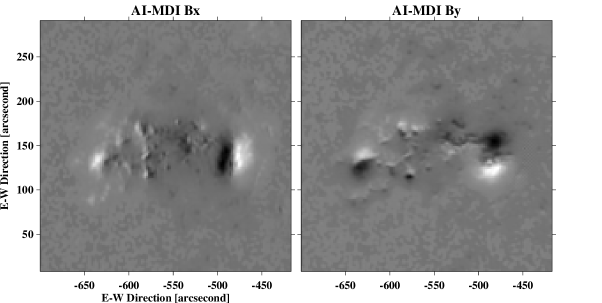
Out-of-sample validation demonstrates the successful reconstruction of vector magnetic fields from solar cycle 23 using the MagNet model.
Reconstructing the complex magnetic field of the Sun, particularly for historical observations, remains a significant challenge in solar physics due to limitations in data coverage and instrument capabilities. This is addressed in ‘Out-of-Sample Validation of MagNet’, which details the performance of a machine learning model-MagNet-designed to generate vector magnetograms from line-of-sight measurements. The study demonstrates good correlation between MagNet’s reconstructions and independent vector magnetograph observations, validating its ability to accurately estimate transverse fields in solar active regions during cycle 23. Will this approach unlock new insights into the origins and evolution of solar activity from previously inaccessible datasets?
The Sun’s Hidden Architecture: A Magnetic Puzzle
The Sun’s dramatic eruptions – solar flares and coronal mass ejections – are fundamentally driven by magnetic energy, making precise knowledge of the full vector magnetic field absolutely essential for their comprehension. These events release immense amounts of energy and particles into space, potentially disrupting satellite communications, power grids, and even posing risks to astronauts. While the strength of the Sun’s magnetic field is well-established, determining its complete three-dimensional structure – encompassing both the field’s strength and direction at every point – presents a significant hurdle. Accurate mapping of this field allows scientists to pinpoint the locations where magnetic energy builds up and is ultimately released, effectively providing a predictive capability for these potentially hazardous space weather events. Understanding the magnetic field’s complex topology, including its twists, shears, and reconnection sites, is therefore paramount to forecasting and mitigating the impacts of solar activity on Earth and near-Earth space.
Determining the Sun’s magnetic field is complicated by the fact that most measurements are made along the line of sight – essentially, how much magnetism is pointing towards the observer. This creates a fundamental ambiguity: a positive measurement could indicate a strong field pointing directly at Earth, or a strong field pointing away but with reversed polarity. Researchers have historically addressed this by relying on complex modeling assumptions about the field’s structure, attempting to extrapolate the three-dimensional field from these limited, ambiguous observations. However, these models introduce their own uncertainties, and the inherent 180-degree ambiguity in line-of-sight measurements remains a persistent obstacle to accurately reconstructing the full magnetic field vector and understanding the drivers of solar activity.
Determining the magnetic field’s strength and direction across the Sun’s surface is fundamentally complicated by the challenge of resolving the transverse components – B_x and B_y – which lie perpendicular to the observer’s line of sight. Helioseismology, the study of solar vibrations, offers a potential pathway to map these hidden fields, but accurately ‘seeing’ through the solar atmosphere remains elusive. Current techniques often rely on interpreting subtle shifts in the frequencies of sound waves traveling within the Sun, and disentangling the magnetic influence from other effects-like convection-introduces significant uncertainty. Improving the resolution and precision of these measurements, and developing more sophisticated modeling approaches, are vital steps toward constructing a complete three-dimensional map of the Sun’s magnetic field and ultimately, better predicting disruptive space weather events.
Accurate determination of the Sun’s complete magnetic field is paramount for bolstering space weather prediction capabilities and lessening the potential for disruptive geomagnetic storms on Earth. The magnetic field dictates the frequency and intensity of solar flares and coronal mass ejections – energetic events that, when directed toward Earth, can overwhelm power grids, disrupt satellite communications, and pose radiation hazards to astronauts and airline passengers. Sophisticated forecasting relies on understanding the complex interplay of magnetic fields within the solar corona, yet current limitations in fully resolving these fields introduce significant uncertainty into predictive models. Improved magnetic field inference not only refines forecasts of arrival times and intensities of space weather events but also allows for more effective mitigation strategies, protecting critical infrastructure and ensuring the continued functionality of technology reliant on a stable space environment.
Unveiling the Invisible: A Machine Learning Approach
MagNet is a machine learning model engineered to determine the transverse components of the magnetic field – specifically, B_x and B_y – using observable data. The model accepts readily available inputs, eliminating the requirement for specialized or difficult-to-obtain measurements. This reconstruction is achieved through a learned mapping from input data to the transverse field, enabling the estimation of magnetic field vectors without relying on pre-defined physical assumptions commonly used in traditional magnetic field modeling.
MagNet utilizes both Hα images and line-of-sight (LOS) magnetograms as inputs to reconstruct the transverse magnetic field. Hα images provide contextual information about the chromospheric structure, revealing active regions and fibrillar features indicative of magnetic field complexity. Simultaneously, LOS magnetograms offer direct measurements of the magnetic field component along the line of sight. By integrating these complementary data sources, MagNet can infer the full magnetic field vector, leveraging the strengths of both observational techniques and mitigating the limitations inherent in relying solely on one data type.
Traditional methods of transverse magnetic field reconstruction often rely on simplifying assumptions about the relationship between observed quantities – such as line-of-sight magnetograms and Hα images – and the full magnetic field vector. These assumptions, which may include force-free field extrapolations or potential-field source surface models, introduce inherent uncertainties. MagNet addresses this limitation by employing a machine learning approach that directly learns the complex, non-linear mapping between input observables and the target field components (Bx and By). This data-driven strategy minimizes reliance on a priori physical constraints, allowing the model to infer the magnetic field structure directly from the data and potentially achieve higher accuracy without imposing potentially inaccurate simplifying assumptions.
Traditional methods of magnetic field reconstruction often rely on simplifying assumptions about the solar atmosphere to solve the ambiguity inherent in inferring the full field vector from limited observations. MagNet distinguishes itself by employing a data-driven approach, specifically a machine learning model trained on co-registered Hα images and line-of-sight (LOS) magnetograms. This allows the model to learn the complex relationships between observable quantities and the complete transverse field components (Bx and By) directly from the data, minimizing the reliance on potentially inaccurate a priori assumptions. Consequently, this approach offers the potential for increased accuracy and robustness in magnetic field reconstruction, particularly in regions with complex field topologies where traditional methods may struggle.
Ground Truth and Validation: A Rigorous Test
Out-of-sample (OOS) validation was implemented to rigorously evaluate MagNet’s performance on unseen data, preventing overfitting and ensuring generalizability. This process involved training the model on a specific dataset and subsequently assessing its accuracy using a completely independent dataset that was not utilized during any stage of the training process. By evaluating performance on previously unseen data, OOS validation provides a more realistic estimate of MagNet’s ability to accurately reconstruct magnetic fields in operational scenarios, as opposed to simply memorizing the training data. This approach is crucial for establishing confidence in the model’s predictive capabilities and its suitability for application to novel observations.
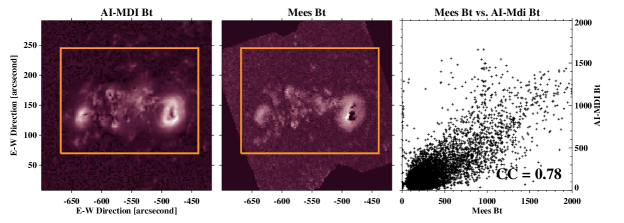
Vector magnetograms obtained from the Mees/IVM instrument are utilized as the ground truth dataset for validating MagNet’s performance. The Mees/IVM, a solar vector magnetograph, provides highly accurate measurements of the magnetic field vector at the Sun’s surface. These observations are independent of the data used to train the MagNet model, ensuring an unbiased assessment of its ability to generalize to unseen data. The established accuracy and reliability of Mees/IVM data make it an ideal benchmark against which to evaluate the quality and fidelity of the magnetic field reconstructions generated by MagNet.
Validation of MagNet’s magnetic field reconstructions addresses the inherent 180-degree ambiguity present in determining magnetic polarity. Direct comparison of vector components is complicated by this ambiguity, where opposing polarities can yield identical field line configurations. To circumvent this, the validation process utilizes the transverse field magnitude (Bt), which represents the total field strength irrespective of direction. By focusing on Bt, the comparison shifts from evaluating the accuracy of polarity determination to assessing the ability to accurately reconstruct the overall magnetic field intensity, providing a robust metric for evaluating model performance without being affected by the 180-degree ambiguity.
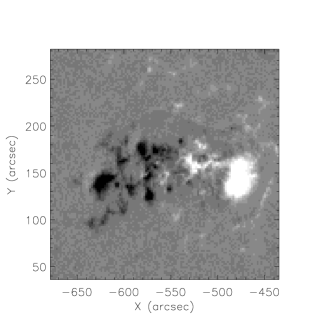
Quantitative validation confirms MagNet’s ability to accurately reconstruct the solar magnetic field. Comparison with independent observations from the Mees/IVM instrument yielded a correlation coefficient of 0.78 between the AI-generated transverse field magnitude (Bt) and the MEES Bt measurements. Further analysis, comparing the MDI Bz component with Mees/IVM Bz, demonstrated a high correlation of 0.94, indicating strong agreement between the reconstructed and observed magnetic field strengths.
Beyond Prediction: Charting the Sun’s Evolving Complexity
The sun’s dramatic eruptions, such as solar flares and coronal mass ejections, are fundamentally driven by the complex interplay of magnetic fields within its plasma. An accurate, three-dimensional reconstruction of this full magnetic field is therefore paramount to unraveling the processes that initiate and fuel these events. These eruptions pose a significant threat to Earth, potentially disrupting satellite communications, power grids, and even posing risks to astronauts; thus, understanding their origins is not merely an academic pursuit. Detailed magnetic field maps allow researchers to identify regions of magnetic stress, where energy accumulates and is eventually released in explosive bursts. By precisely mapping these fields, scientists can improve models of solar activity and, crucially, enhance the predictive capability of space weather forecasts, mitigating the potential impact of these powerful solar events on terrestrial technology and infrastructure.
Detailed magnetic field maps generated by MagNet during Solar Cycle 23 are revealing previously unseen complexities in the evolution of active regions – the areas on the Sun where flares and coronal mass ejections originate. These maps, constructed from years of observations, demonstrate how magnetic flux emerges, interacts, and ultimately reconnects, driving the dramatic events that constitute space weather. By tracking the intricate patterns of magnetic fields, researchers are gaining a clearer understanding of how active regions grow, decay, and contribute to the frequency and intensity of solar eruptions. This enhanced observational capability allows for a more nuanced assessment of the conditions leading to these events, potentially improving predictions of their arrival at Earth and mitigating their impact on technological infrastructure.
The advancement of space weather forecasting is increasingly reliant on integrating observed solar data with theoretical models. While simulations have long been a cornerstone of prediction, they often struggle with the complexity of solar phenomena; data-driven techniques, like those employing the MagNet observations, offer a crucial corrective. By directly assimilating detailed magnetic field measurements into forecasting algorithms, these methods refine model parameters and provide a more realistic representation of solar activity. This synergistic approach doesn’t replace modeling, but rather grounds it in empirical evidence, resulting in improved accuracy in predicting events like solar flares and coronal mass ejections – phenomena that can significantly impact Earth’s technological infrastructure and pose risks to space-based assets. The combination allows for more reliable alerts and better preparedness for potentially disruptive space weather events.
The MagNet system isn’t simply a tool for current solar observations; its architecture is designed to handle the escalating data streams from modern and upcoming missions like the Solar Dynamics Observatory’s Helioseismic and Magnetic Imager (SDO/HMI). This capability stems from its inherent efficiency and scalability, allowing it to process the massive volumes of data required for comprehensive solar magnetic field mapping. Crucially, MagNet leverages image alignment techniques, such as Cross Correlation, to ensure precise data registration and minimize errors when combining observations from different sources and times. This robust processing pipeline is vital for constructing detailed, time-resolved magnetic field maps, ultimately enhancing the predictive power of space weather forecasting and deepening understanding of the Sun’s complex behavior.
The pursuit of complete knowledge regarding solar magnetic fields feels, at times, like chasing a shadow. This work, reconstructing vector magnetograms from cycle 23, highlights both the power and the inherent limitations of modeling complex systems. It’s a clever application of machine learning, certainly, but one must remember that even the most robust reconstruction relies on assumptions about the underlying physics. As Erwin Schrödinger observed, “We must be clear that when we integrate the wave function, we are not talking about the actual particle itself, but rather about the probability of finding it in a certain place.” Similarly, MagNet doesn’t reveal the true magnetic field, but rather offers a statistically sound approximation, a probability distribution built upon observed data. Physics, after all, is the art of guessing under cosmic pressure, and this model represents a particularly informed guess, though one still confined by the event horizon of incomplete information.
Where Do the Shadows Fall?
The successful application of machine learning to reconstruct historical vector magnetograms, as demonstrated, is less a triumph of prediction and more a mapping of the limits of what can be known. Each reconstructed field is a ghost, convincingly shaped from incomplete data, but a ghost nonetheless. The model functions, yes, but function does not equate to truth; it merely describes a consistency within the observed data. The real question isn’t how well it predicts the magnetic field, but what systematic errors are now invisibly embedded within the historical record-errors that future analyses will mistake for genuine solar phenomena.
The utility of such reconstructions extends, naturally, to any period where direct observation is lacking. However, this invites a dangerous circularity: increasingly refined models applied to increasingly sparse data, building castles on foundations of inference. It’s a comfortable illusion, this filling of gaps. The next step isn’t simply more data, or even more sophisticated algorithms; it’s a rigorous accounting of the model’s inherent biases, and a frank acknowledgment that every theory is just light that hasn’t yet vanished beyond the event horizon of new data.
The enduring challenge remains not the reconstruction itself, but the validation-a task forever haunted by the unknowable ground truth. Models exist until they collide with data, and the further back in time one ventures, the more theoretical the collision becomes.
Original article: https://arxiv.org/pdf/2601.15926.pdf
Contact the author: https://www.linkedin.com/in/avetisyan/
See also:
- Top 20 Dinosaur Movies, Ranked
- 20 Movies Where the Black Villain Was Secretly the Most Popular Character
- 25 “Woke” Films That Used Black Trauma to Humanize White Leads
- Celebs Who Narrowly Escaped The 9/11 Attacks
- Spotting the Loops in Autonomous Systems
- Gold Rate Forecast
- Silver Rate Forecast
- 22 Films Where the White Protagonist Is Canonically the Sidekick to a Black Lead
- From Bids to Best Policies: Smarter Auto-Bidding with Generative AI
- Can AI Lie with a Picture? Detecting Deception in Multimodal Models
2026-01-23 13:52