
Right then. Quantum computing. It’s the sort of thing that makes accountants twitch. All that uncertainty, all that superposition… it’s enough to give a perfectly good balance sheet a nervous breakdown. For years, the Guild of Alchemists and Venture Capitalists1 have been throwing gold at the problem, hoping to transmute it into something… useful. And, as often happens, they’ve mostly transmuted it into hype. Still, there’s a glimmer of something real beneath the smoke and mirrors, and a sensible investor—one who prefers a sturdy pair of shoes to a flying carpet—might consider where the actual value lies.
1. Nvidia: The Foundry of Futures
Nvidia. They’re everywhere, aren’t they? Like particularly industrious gnomes, burrowing into every corner of the digital world. They don’t just make things; they seem to enable everything else to be made. And in the realm of quantum, they’re not trying to build the entire clockwork universe themselves – a common mistake amongst ambitious wizards2. They’re providing the tools – the forges, the anvils, the exceptionally precise calipers – for others to do so.
Their CUDA-Q ecosystem, for instance, isn’t about building a quantum computer in a box. It’s about letting clever people program the ones that might exist, or at least simulate them with slightly less power than it takes to boil a kettle. It’s a bit like selling blueprints for a self-stirring cauldron – you don’t need the cauldron yet, but it’s good to be prepared. And their cuQuantum kit? That’s letting researchers fiddle with qubits without having to wrestle with the actual, fragile things. It’s a sensible precaution, really. Qubits, you see, have a distinct dislike of being looked at too closely.
The long-term potential is, of course, the usual promises of breakthroughs in simulations, optimized neural networks, and energy efficiency. But what’s more interesting is that all this quantum fiddling reinforces the need for Nvidia’s existing hardware and software. It’s a bit like a dragon needing a bigger cave – good for the cave builders, you see.
2. Alphabet: The Cartographers of Possibility
Alphabet, or Google as most people still call them, are taking a different approach. They’re not just building the tools; they’re trying to map the territory itself. Their Willow chip, they claim, can solve problems in minutes that would take the world’s most advanced supercomputers… well, a very long time. A time so long, in fact, that the very concept of ‘minutes’ becomes somewhat meaningless.3
They’re also open-sourcing their platforms – Cirq and TensorFlow. Now, some might see this as altruism. I suspect it’s more about attracting a horde of free apprentices to help them sort through the chaos. Either way, it’s a clever move. It’s like inviting everyone to help you build a labyrinth, then charging them a small fee to find their way out.
The potential benefits are obvious: better indexing, improved ad targeting, and new opportunities in drug discovery and financial modeling. But what’s truly interesting is the potential for these technologies to unlock entirely new markets. Imagine a world where Google can predict your needs before you even know them. A slightly unsettling thought, perhaps, but undeniably profitable.
Why Nvidia and Alphabet Deserve a Second Look
Now, here’s the curious thing. Despite all this potential, both Nvidia and Alphabet have seen their valuations come down a bit recently. It’s as if the market is suddenly remembering that even the most promising technologies take time to mature. And that sometimes, a shiny new gadget is just that – a shiny new gadget.
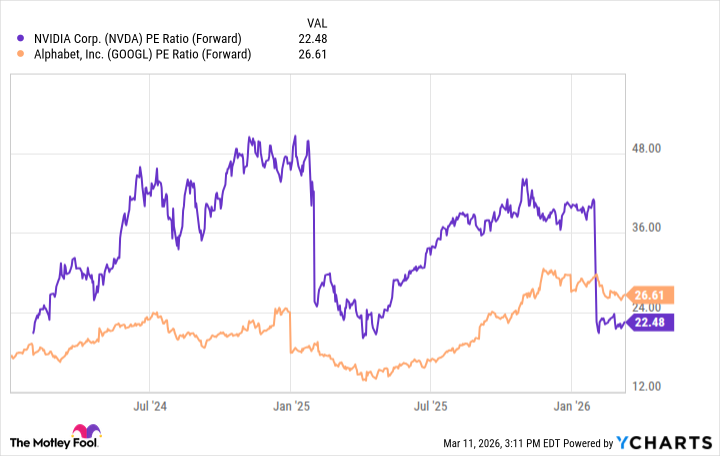
Nvidia’s forward P/E ratio is hovering around 22, which is relatively low for a company at the forefront of the AI revolution. Alphabet’s is around 27, also below its recent highs. It suggests that investors are either skeptical about the long-term potential of quantum computing, or simply worried about the sustainability of the current AI boom. Or perhaps they’ve just realized that there’s a limit to how much you can charge for a slightly faster calculation.
Whatever the reason, it presents a rare opportunity for long-term investors. Quantum computing will undoubtedly take years, perhaps decades, to reach its full potential. But the companies that are laying the groundwork today are likely to be the ones that benefit the most in the future. And sometimes, the best investments are the ones that require a little patience, a little skepticism, and a healthy dose of common sense.
I expect that quantum computing will become another structural layer in AI technology that should help Nvidia and Alphabet maintain their durable, strong positions in that landscape. For this reason, investors with long-term horizons can view this as a rare opportunity to buy the dip in these two industry-leading AI developers.
1 The Guild, you see, operates on a principle of “maximum leverage, minimum responsibility.” They’re very good at finding other people’s gold.
2 Ambitious wizards invariably overestimate their abilities and underestimate the complexity of the universe. It’s a common failing.
3 Time, after all, is merely a construct. A useful one, to be sure, but still… a construct.
Read More
- 20 Movies Where the Black Villain Was Secretly the Most Popular Character
- Celebs Who Narrowly Escaped The 9/11 Attacks
- Transformers Under the Microscope: What Graph Neural Networks Reveal
- Top 20 Dinosaur Movies, Ranked
- Trading on Thin Air: AI Agents Conquer Crypto Volatility
- Silver Rate Forecast
- Gold Rate Forecast
- Every Notable ‘Star Trek: The Original Series’ Actor Who Died
- 22 Films Where the White Protagonist Is Canonically the Sidekick to a Black Lead
- Games That Faced Bans in Countries Over Political Themes
2026-03-13 19:54