Author: Denis Avetisyan
A new framework leverages reinforcement learning to optimize both electricity market bidding strategies and long-term transmission network expansion.
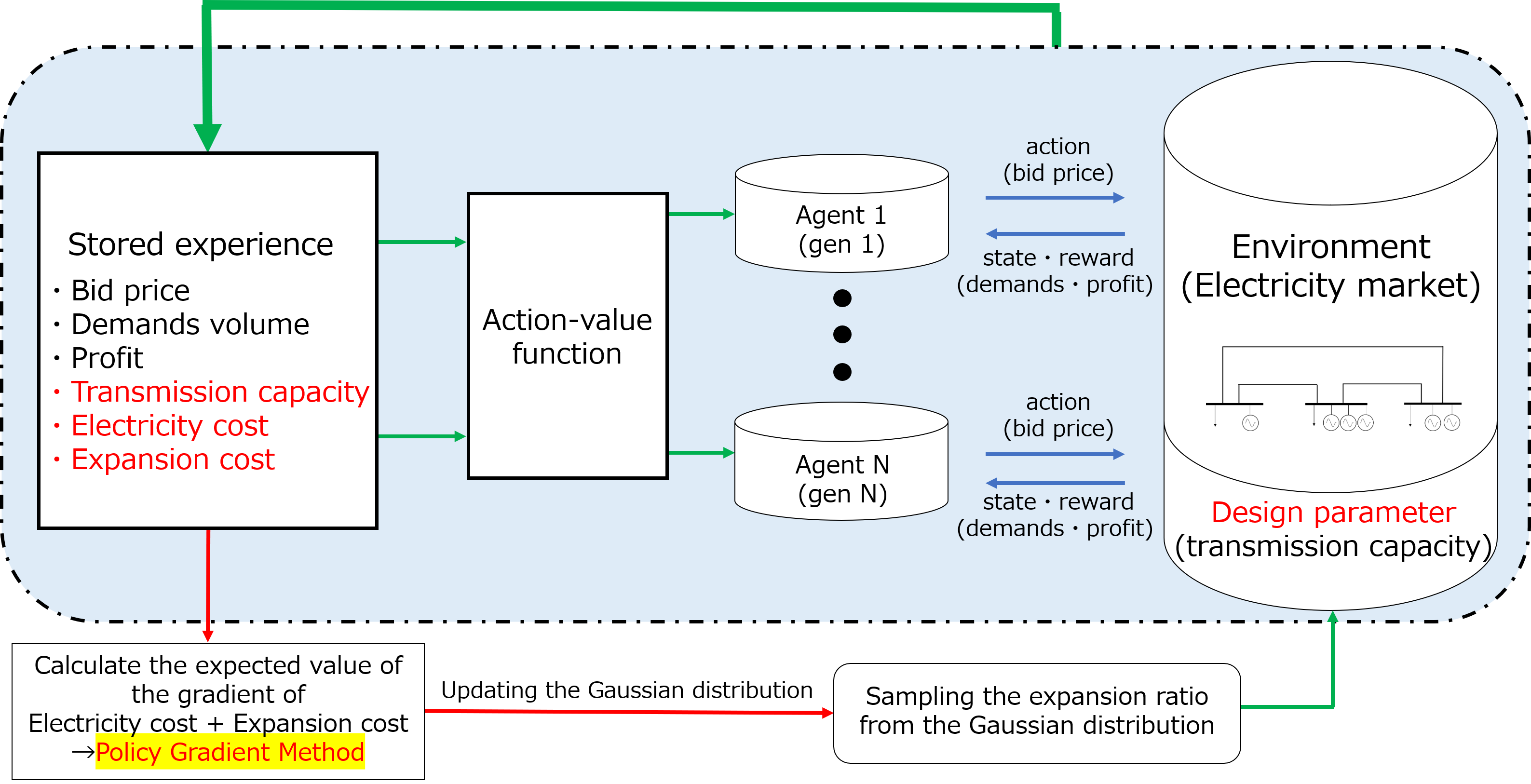
This work presents a co-optimization approach using multi-agent reinforcement learning for strategic bidding and transmission expansion planning in power systems.
Effective planning of electricity transmission networks is challenged by the complex interplay between investment decisions and the strategic bidding behaviors of generation companies. This paper presents ‘A Reinforcement Learning-based Transmission Expansion Framework Considering Strategic Bidding in Electricity Markets’-a novel co-optimization approach leveraging multi-agent reinforcement learning to simultaneously determine optimal network expansion and generator bidding strategies. The proposed framework introduces a design policy layer to effectively capture the mutual influence between these decisions, leading to consistently improved system efficiency. Could this approach unlock more robust and realistic power system planning for future energy markets?
Navigating Complexity: The Evolving Power Grid
Modern power systems face unprecedented operational complexity driven by escalating electricity demand and the rapid integration of renewable energy sources. Unlike traditional generation, which is dispatchable and predictable, solar and wind power are intermittent and geographically dispersed, necessitating constant adjustments to maintain grid stability. This influx of variable renewable energy challenges conventional power flow control and requires sophisticated forecasting techniques to anticipate fluctuations in supply. Furthermore, increased demand, particularly from electrification and data centers, strains existing infrastructure and exacerbates the need for real-time monitoring and control. Consequently, grid operators are tasked with managing a significantly more dynamic and uncertain system, demanding innovative solutions in areas like energy storage, smart grids, and advanced control algorithms to ensure a reliable and sustainable electricity supply.
Historically, planning expansions to the electrical grid relied on forecasts of static demand and predictable generation sources. However, modern power systems are increasingly characterized by volatile renewable energy integration, fluctuating loads due to electrification, and the emergence of distributed generation. This dynamism presents a significant challenge to traditional transmission expansion planning methods, which often struggle to account for the inherent uncertainties in these rapidly evolving conditions. These conventional approaches, designed for a more stable and predictable environment, frequently fail to adequately assess the risks associated with unforeseen events or accurately model the complex interactions between diverse grid components. Consequently, investment decisions based on outdated planning paradigms may prove suboptimal, potentially leading to insufficient capacity, reduced reliability, and increased costs in the face of real-world grid dynamics.
Modernizing power grids demands a shift in investment strategies, moving beyond conventional expansion planning to prioritize a delicate balance between economic feasibility, consistent service, and environmental responsibility. Traditional methods often focus solely on meeting projected demand, overlooking the potential of distributed generation, energy storage, and smart grid technologies to enhance resilience and reduce carbon footprints. Innovative approaches, such as utilizing advanced data analytics for predictive maintenance, incorporating lifecycle cost analyses into investment decisions, and incentivizing private sector participation, are crucial. These strategies enable utilities to optimize resource allocation, minimize long-term costs, and ensure a sustainable energy future while maintaining the unwavering reliability that modern society demands from its power infrastructure.
Intelligent Agents: Proactive Control for a Dynamic Grid
Multi-Agent Deep Reinforcement Learning (MADRL) provides a computational framework for modeling complex interactions within power grids, specifically simulating market participant behavior and optimizing transmission network expansion. This approach utilizes multiple independent agents, each representing a grid entity, that learn optimal strategies through trial and error within a simulated environment. Deep neural networks are employed to approximate the optimal policies for each agent, enabling them to handle the high dimensionality of the grid state space. The system can evaluate various expansion scenarios by observing agent responses to simulated load changes, renewable energy fluctuations, and market signals, ultimately identifying cost-effective and reliable transmission upgrades. This differs from traditional optimization techniques by directly accounting for the strategic interactions of multiple actors and adapting to dynamic grid conditions without requiring explicit modeling of all contingencies.
The proactive response capability of an intelligent agent system stems from the development of learned policies defining agent behavior under varied grid conditions. These policies are not pre-programmed but are derived through continuous interaction with a simulated or real-time grid environment. Agents utilize data regarding load fluctuations, generation availability, transmission line status, and pricing signals to inform their actions. Consequently, the system can anticipate potential overloads, voltage instability, or insufficient reserve margins, and autonomously implement corrective measures – such as adjusting generator output, re-routing power flow, or initiating demand response programs – before disruptions occur. This anticipatory capability distinguishes the system from traditional reactive control schemes and enhances overall grid resilience and efficiency.
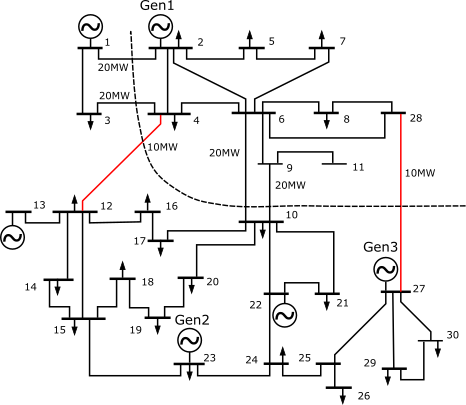
The IEEE 30-Bus System is a widely adopted power system test case utilized for the validation and performance evaluation of algorithms designed for power system analysis and control. This benchmark consists of a 30-bus, 6-generator, and 41-line transmission network, providing a standardized environment for comparing the efficacy of different approaches to grid management. Its relatively small size allows for efficient computation while still capturing key characteristics of larger, more complex power systems. Researchers leverage the IEEE 30-Bus System to assess the stability, reliability, and economic viability of novel control strategies, including those employing multi-agent deep reinforcement learning, before deployment in real-world applications. Publicly available data and established performance metrics facilitate reproducible research and objective comparisons between competing algorithms.
Validating Investment: DC Optimal Power Flow Analysis
Direct Current (DC) Optimal Power Flow (OPF) is a computationally efficient method utilized to assess the economic viability of planned transmission system reinforcements. It functions by modeling the power grid as a DC network, simplifying the analysis while maintaining sufficient accuracy for preliminary economic evaluations. This allows for the determination of whether proposed expansions, such as new transmission lines or upgrades to existing infrastructure, will reduce overall system costs by alleviating congestion, improving reliability, and facilitating access to lower-cost generation resources. The resulting solution identifies the optimal power flow across the network, providing key metrics like line loading and nodal prices, which are then used to calculate the net economic benefit of the proposed expansion and justify investment decisions.
DC Optimal Power Flow (DC OPF) calculates the optimal level of electricity generation at each power plant and the resulting flow of power across the transmission network. This calculation is performed through a mathematical optimization process that minimizes the total cost of generation, considering factors such as fuel costs and generator efficiencies. Simultaneously, the DC OPF ensures that all technical constraints of the power system are met, including limits on line capacities, voltage levels, and generator outputs. These constraints represent the physical and operational boundaries of the system, preventing overloads or violations that could lead to instability or equipment damage. The optimization problem is typically formulated as a linear program, allowing for efficient computation even for large-scale power systems.
Analysis of the proposed framework demonstrates economic viability through cost comparisons with established two-stage approaches. Results indicate a total cost comparable to, and in some instances slightly lower than, those achieved via traditional methods. This cost-effectiveness stems from the integrated optimization process, which simultaneously determines generation dispatch and network flows, minimizing overall system costs while satisfying all network operating constraints. The observed cost parity or reduction confirms the framework’s potential as a valuable tool for investment validation in transmission infrastructure.
Towards a Resilient Future: Adaptable Grid Planning
Modernizing the electrical grid demands a shift from standardized upgrades to precisely tailored solutions, and approaches like continuous capacity expansion and discrete siting decisions facilitate this evolution. Continuous capacity expansion allows for incremental increases in transmission line capacity, responding to evolving demand with granular adjustments, while discrete siting decisions pinpoint optimal locations for new infrastructure, minimizing environmental impact and maximizing efficiency. This dual methodology moves beyond blanket improvements, enabling grid planners to strategically allocate resources based on specific network vulnerabilities and projected growth – a particularly valuable asset in integrating renewable energy sources with intermittent output. The result is a more responsive and resilient power grid, capable of adapting to dynamic conditions and ensuring a stable energy supply for consumers.
Analysis within the planning framework revealed a learned expansion capacity of 76.1 MW for transmission line 4-12, indicating a significant need for increased throughput on that particular segment of the grid. Complementing this, discrete siting decisions – strategic choices regarding where to implement upgrades – resulted in 50 MW expansions being allocated to both lines 1-2 and, notably, again to line 4-12. This focused investment strategy highlights the model’s ability to pinpoint critical infrastructure bottlenecks and efficiently distribute resources, ultimately reinforcing vulnerable points within the network and optimizing the overall system capacity.
The culmination of optimized planning methodologies-including adaptable capacity expansion and strategic siting of transmission lines-yields a power grid poised for enhanced performance across multiple critical dimensions. These advancements move beyond simply meeting current demand; they establish a framework for proactive resilience, minimizing disruptions and ensuring consistent power delivery even under fluctuating conditions. Furthermore, by precisely tailoring upgrades to specific needs and leveraging data-driven insights, the approach curtails unnecessary investment, resulting in a significantly more cost-effective infrastructure. This ultimately fosters a sustainable energy landscape, reducing waste and maximizing the utilization of resources while simultaneously bolstering the long-term reliability of electricity transmission.
The presented framework addresses a critical complexity within power system planning: the interplay between generation strategy and infrastructure development. It moves beyond static optimization, acknowledging that generators do not operate in a vacuum but actively respond to market conditions. This echoes Jürgen Habermas’s assertion, “The project of modernity is not about achieving a final, finished state of knowledge, but about continually questioning and revising our understanding.” The study’s co-optimization approach-simultaneously considering strategic bidding and transmission expansion- embodies this continual revision, moving toward a more nuanced and adaptable system. Reducing the problem to this core interplay-strategic behavior and infrastructural response-demonstrates a commitment to clarity, achieving efficiency through focused analysis.
What Remains?
The pursuit of optimization, particularly within the complexities of power systems, often yields diminishing returns. This work, while demonstrably advancing the co-optimization of transmission expansion and generator bidding, reveals not so much what has been added to the field, but what was, perhaps, unnecessarily included in the first place. The framework’s strength lies in its reduction of the problem – acknowledging strategic interaction without succumbing to the infinite regress of modeling perfect rationality. Future efforts should not strive for ever-more-detailed agent representations, but rather for increasingly parsimonious ones.
A critical limitation, inherent in nearly all reinforcement learning approaches, is the reliance on simulated environments. The true test of this methodology-and, indeed, of any planning algorithm-will be its performance when confronted with the inherent messiness of real-world data and the unpredictable actions of human actors. A pragmatic shift toward data-driven validation, accepting a degree of sub-optimality in exchange for robustness, seems increasingly vital.
Ultimately, the value of this work resides not in the specific algorithms employed, but in the implicit argument for simplification. The question is not whether this framework perfectly predicts market behavior, but whether it provides a sufficiently accurate-and, crucially, understandable-approximation. The elegance of a solution, after all, is measured not by its complexity, but by what it leaves out.
Original article: https://arxiv.org/pdf/2602.19421.pdf
Contact the author: https://www.linkedin.com/in/avetisyan/
See also:
- Gold Rate Forecast
- Invincible Season 4 Gender Swaps Tech Jacket As Fans Question Major Comic Change
- 22 Films Where the White Protagonist Is Canonically the Sidekick to a Black Lead
- Why Won’t It Just *Do* What You Ask? Unpacking the Quirks of AI Language
- Silver Rate Forecast
- Unveiling the Schwab U.S. Dividend Equity ETF: A Portent of Financial Growth
- 14 Movies Where the Black Character Refuses to Save the White Protagonist
- Superman Flops Financially: $350M Budget, Still No Profit (Scoop Confirmed)
- The Best Former NFL Players Turned Actors, Ranked
- ONE PIECE Season 2 Confirms Sanji’s OTHER Backstory in the Live-Action
2026-02-24 23:33