PayPal USD (PYUSD) holders in 70 countries can now send, receive, and hold the stablecoin in their wallets, expanding from the U.S. and U.K. territories.
PayPal, a tech juggernaut of the modern age, proudly serves over 430 million consumers and 36 million merchants spread across roughly 200 countries-an empire for the digital age. A true renaissance of finance!
PayPal’s Crusade: PYUSD Now Available in 70 Countries
In a masterstroke of financial ambition, PayPal targets Africa, South America, and Asia, those high-transaction-cost zones where sending money across borders was once the stuff of nightmares.
In an interview with Fortune that probably made all the fintech nerds weak at the knees, May Zabaneh, PayPal’s Senior Vice President and head of crypto, revealed that this monumental expansion encompasses a glorious 68 new countries-Uganda, Colombia, and Peru, among them. The world is, as they say, PayPal’s oyster.
Big players like YouTube are already delighting in the sweet simplicity of PayPal’s PYUSD payout infrastructure. Meanwhile, PayPal itself has been experimenting with PYUSD internally, transferring corporate funds across borders like some sort of digital wizardry. How delightfully innovative.
Now, countries like Peru can throw off the shackles of mandatory local-currency withdrawals and instead cradle their precious funds in the rock-solid embrace of the dollar-pegged PYUSD. Meanwhile, in places like Malawi, PYUSD is granting the gift of wallets that actually store value. Bravo, PayPal, bravo.
For PYUSD holders back in the U.S., there’s an added cherry on top: a 4% annual return. Because why shouldn’t you earn interest on your stashed dollars in the digital realm? A dollar-denominated savings system for the unbanked masses-who’s surprised that this is happening? Anyone? Anyone?
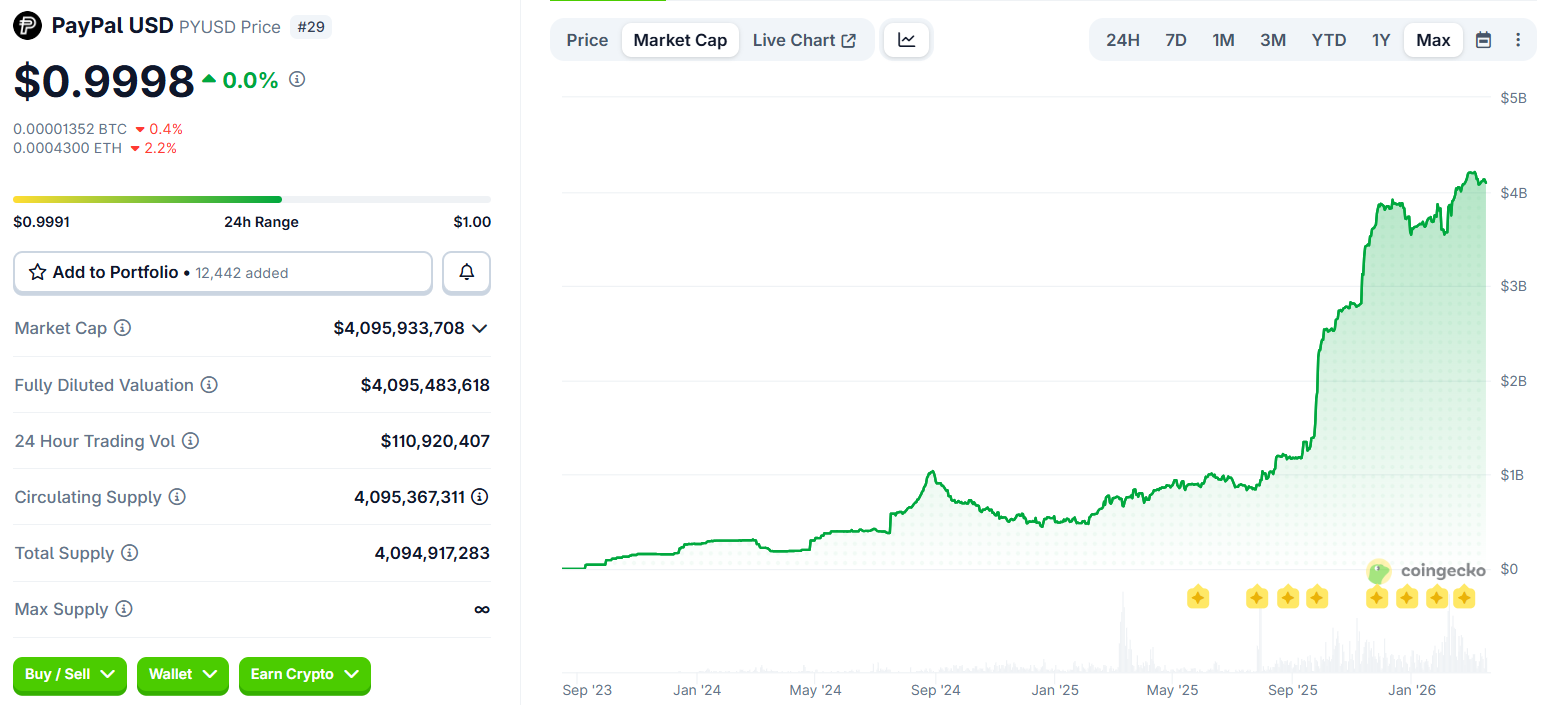
PYUSD’s market cap has soared toward $4.1 billion, a fivefold increase over the past year according to CoinGecko. If that doesn’t say “trust us, it’s going to be huge,” then I don’t know what does.
Enter the GENIUS Act, a 2025 masterpiece of legislation that set the U.S. on a path toward a stablecoin-friendly future. With this, corporate adoption was practically set on fire and launched into the stratosphere.
Meanwhile, PayPal and Fiserv have joined forces in a high-powered agreement to make their stablecoins interoperable. And why not? Why not open the floodgates to thousands of financial institutions? It’s almost like the beginning of a new financial era, where coins aren’t just shiny metal and paper bills aren’t the stars of the show anymore.
Global remittance flows to low- and middle-income countries hit a staggering $685 billion in 2024. And now, stablecoins, like PYUSD, are poised to swoop in and claim their share of that bounty. Move over, old money, the future’s digital.
Read More
- Invincible Season 4 Gender Swaps Tech Jacket As Fans Question Major Comic Change
- Building Agents That Learn and Improve Themselves
- Gold Rate Forecast
- Games That Faced Bans in Countries Over Political Themes
- Silver Rate Forecast
- Trading Crypto with AI: A New Approach to Portfolio Management
- Superman Flops Financially: $350M Budget, Still No Profit (Scoop Confirmed)
- 22 Films Where the White Protagonist Is Canonically the Sidekick to a Black Lead
- Unveiling the Schwab U.S. Dividend Equity ETF: A Portent of Financial Growth
- 15 Films That Were Shot Entirely on Phones
2026-03-17 14:30