
Now, Palantir Technologies (PLTR 3.51%). A name that sounds suspiciously like it should be selling enchanted gardening implements. It has been something of a market darling, hasn’t it? For a few years, it was growing like a particularly vigorous bindweed. But bindweed, as any sensible gardener knows, eventually gets chopped back. And so it has proven for Palantir. It peaked in October of last year, then decided to take a rather noticeable downward trajectory. We’re currently looking at a decline of around 35% from that high-water mark. A significant drop, even in a world accustomed to numbers doing what they please.
Everyone’s pointing to it as the shining example of what happens when you apply artificial intelligence to… well, everything. And the last quarter’s results were… acceptable. Guidance for the future? Reasonably optimistic. So, what’s all the fuss about? Why is the market behaving as if Palantir has suddenly started offering subscriptions to a goblin newsletter?
The Price of Seeing the Future
The problem, as is so often the case, is valuation. It’s a simple concept, really. You pay a price for something based on what you expect it to be worth. But expectations, like prophecies, are notoriously unreliable. Palantir, when the selling began, was priced as if it already was the future. Even after this correction, it remains… enthusiastic. We’re talking about a forward price-to-earnings ratio that suggests they’re not just selling data analysis, but bottled optimism.
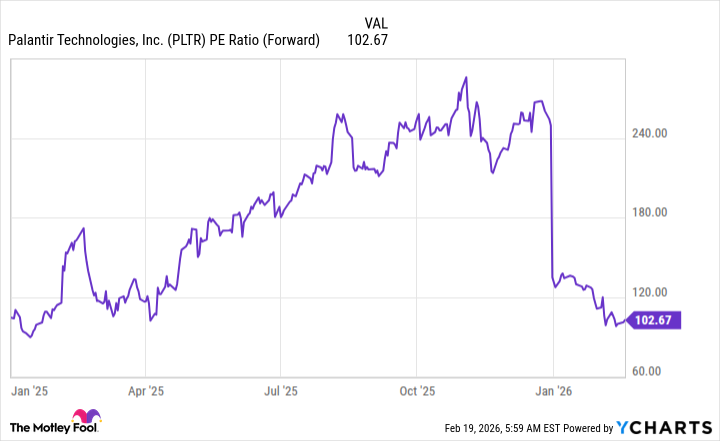
Very few companies can justify such a premium. It demands a level of sustained, almost magical, growth. If we assume a more sensible multiple – say, 30 times forward earnings – then Palantir’s earnings need to grow by a rather alarming 243%. Analysts are predicting 62% and 41% growth for the next two years. That gets us to… 129%. Which leaves a good three to four years of growth already baked into the price. It’s as if someone has already counted the gold before the dragon has even been slain.1
Nobody’s arguing that Palantir isn’t growing, or that they’re not exceptionally good at what they do. They’re one of the best in the business, and many companies could learn a thing or two from their approach to emerging technologies. But is paying a premium for three to four years’ worth of growth… sensible? I suspect the market is saying no. And I tend to agree. It’s a bit like paying a king’s ransom for a map to a treasure that may or may not exist.
Therefore, I wouldn’t be rushing to buy the dip. There are other companies out there – equally ambitious, growing rapidly, and, crucially, not priced as if they’ve already solved world hunger. They may not offer the same explosive growth, but they offer something arguably more valuable: a reasonable chance of actually delivering a return on your investment.
1It is a well-established principle of economic forecasting that any prediction involving dragons is, by definition, unreliable. This is not to say that dragons do not exist, merely that their behavior is inherently unpredictable.
Read More
- Invincible Season 4 Gender Swaps Tech Jacket As Fans Question Major Comic Change
- Building Agents That Learn and Improve Themselves
- Gold Rate Forecast
- Games That Faced Bans in Countries Over Political Themes
- Silver Rate Forecast
- Trading Crypto with AI: A New Approach to Portfolio Management
- Superman Flops Financially: $350M Budget, Still No Profit (Scoop Confirmed)
- 22 Films Where the White Protagonist Is Canonically the Sidekick to a Black Lead
- 15 Films That Were Shot Entirely on Phones
- Unveiling the Schwab U.S. Dividend Equity ETF: A Portent of Financial Growth
2026-02-24 06:32