
Right, Nvidia. Let’s be honest, the hype is…substantial. $4.5 trillion as of February 2026? It’s the sort of number that makes me slightly dizzy and question all my life choices. They’ve built an empire on AI chips, and Wall Street is currently throwing money at them like it’s going out of style. Which, let’s face it, it probably is. But here’s the thing about empires: they rarely last forever. And as someone who spends their days staring at spreadsheets and trying to predict the future (a truly humbling exercise, by the way), I’m more interested in who might be building their castles. The ones that could, dare I say, be even bigger.
Ten years. That’s the timeframe we’re talking about. Enough time for competitors to catch up, for customers to decide DIY is the way forward, and for valuations to experience a healthy dose of gravity. It’s a long time. A lifetime, almost, in tech years. So, let’s talk about two businesses that I think have a fighting chance of eclipsing Nvidia by 2036. Don’t get me wrong, I’m not saying it’s a sure thing. Investing is rarely a sure thing. It’s more like a carefully calculated gamble with a hefty dose of wishful thinking.
Alphabet: The Infrastructure Play (and a Side of Everything Else)
Alphabet. They’re everywhere, aren’t they? Google Cloud, AI, self-driving cars…it’s a bit overwhelming, frankly. And they’re happily riding the AI wave right alongside Nvidia, shoveling billions into servers and data centers. Their capital expense budget is set to double in 2027 – yes, double. It’s a bold move. Or maybe a desperate one. I’m still deciding. But here’s the clever bit: they’re not entirely reliant on Nvidia’s hardware. They’re designing their own AI accelerators, in collaboration with Broadcom and Taiwan Semiconductor Manufacturing. It’s like saying, “Thanks, but we can probably build a better one ourselves.” A little bit arrogant? Perhaps. But I respect the ambition.
And the thing is, everyone’s starting to think about in-house chip design. It’s a crowded market, and I’m not convinced Nvidia can maintain those ultra-premium prices for much longer. The AI boom has been good to Google Cloud – revenues have more than tripled in the last three years, swinging them from a mild loss to a $5.3 billion profit. They’re adaptable, which is a useful quality in a rapidly changing world. And they’re not putting all their eggs in one basket. Self-driving taxis, anyone? It’s a distraction, maybe. Or a brilliant diversification strategy. I honestly can’t tell.
How confident are they in their longevity? Well, they recently issued a 100-year bond. A century. It’s either incredibly optimistic or spectacularly delusional. I suspect it’s a bit of both. But you have to admire the audacity. How many companies can promise something like that with a straight face? Not many. And with a $3.7 trillion market cap, they’re only 20% behind Nvidia. Small advantages, compounded over time…it’s a tempting thought.
If Nvidia grows at a modest 11.5% over the next decade, and Alphabet manages a slightly more ambitious 14%, they’d end up tied at around $13.5 trillion. It’s a small difference, but in the world of high finance, small advantages can be…significant. It’s a bit like choosing between two equally charming psychopaths. The details matter.
Berkshire Hathaway: Boring Compounding, Blockbuster Results
Berkshire Hathaway. Now, that’s a company. Warren Buffett built an empire on…well, on being incredibly good at picking undervalued companies and letting them grow. It’s not glamorous, but it’s effective. They’ve got more catching up to do than Alphabet, but their market cap has averaged $1.1 trillion over the last year. If Nvidia continues its 11.5% growth trajectory, Berkshire would need a 29% CAGR to close the gap in ten years. That’s…ambitious, to say the least. But if they manage a more realistic 15%, they’d land in the same ballpark as Nvidia today – around $4.4 trillion.
That’s roughly the S&P 500’s average performance over the last decade, or Berkshire’s own 14.4% annual gains during Warren Buffett’s leadership. It’s not about hitting home runs, it’s about consistently getting on base. It’s…remarkably unexciting. And yet, it works.
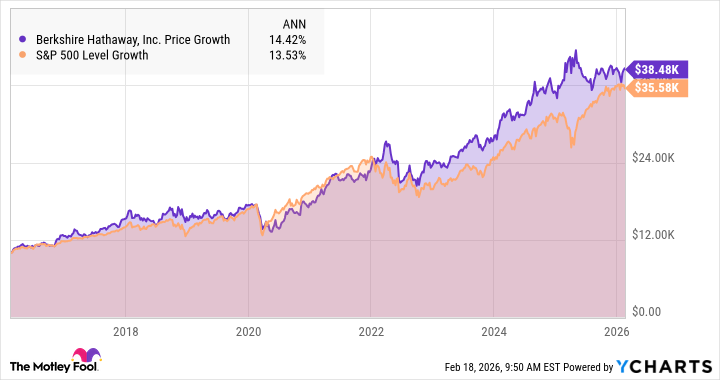
Look, Berkshire might not actually eclipse Nvidia’s market cap by 2036. But I suspect this stock will continue to climb at a steady pace, even under new management, while Nvidia’s share price bounces around like a caffeinated squirrel. And their diversified business model should keep them relevant and financially healthy for decades to come. Which, frankly, is more than I can say for most tech companies. So, even if Berkshire falls short, it’ll still be a pretty good investment. And honestly, in this market, that’s about the best we can hope for.
Read More
- 20 Movies Where the Black Villain Was Secretly the Most Popular Character
- Celebs Who Narrowly Escaped The 9/11 Attacks
- Transformers Under the Microscope: What Graph Neural Networks Reveal
- Top 20 Dinosaur Movies, Ranked
- Silver Rate Forecast
- Trading on Thin Air: AI Agents Conquer Crypto Volatility
- Gold Rate Forecast
- Invincible Season 4 Gender Swaps Tech Jacket As Fans Question Major Comic Change
- Every Notable ‘Star Trek: The Original Series’ Actor Who Died
- 22 Films Where the White Protagonist Is Canonically the Sidekick to a Black Lead
2026-02-20 17:13