
Nvidia’s Projected Growth and Market Share
Nvidia’s current trajectory positions it as a dominant force in the provision of hardware infrastructure supporting the expanding generative artificial intelligence landscape. A recent company projection anticipates global data center capital expenditures reaching between $3 trillion and $4 trillion annually by 2030. While such forecasts are subject to inherent uncertainty, they necessitate an examination of the potential implications for Nvidia’s revenue and valuation.
Data Center Spending and Nvidia’s Revenue Capture
Nvidia currently estimates global data center spending at approximately $600 billion for 2025. Fiscal year 2026 revenue reached $216 billion, representing a 36% share of projected spending. Maintaining this market share, coupled with the higher-end projection of $4 trillion in annual data center expenditures by 2030, yields a potential revenue figure of $1.44 trillion.
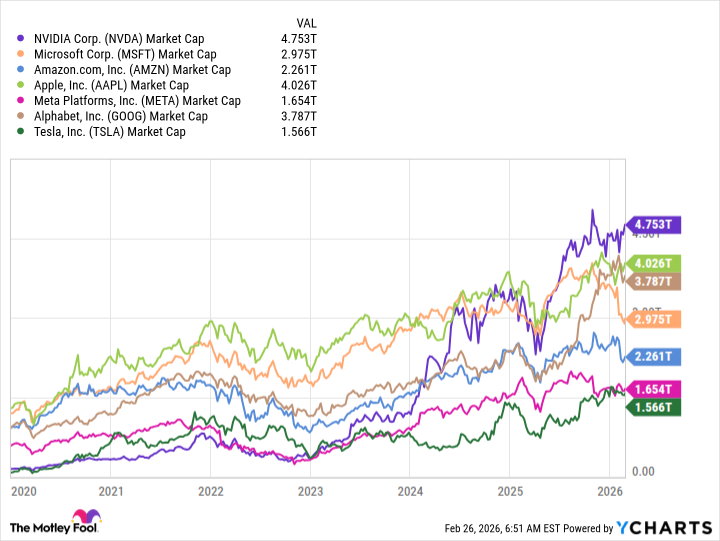
Valuation Scenario: A Theoretical Peak
Assuming a sustained 54% profit margin, Nvidia could generate approximately $780 billion in profits. Applying a 30 times trailing earnings multiple results in a theoretical valuation of $23.4 trillion. This figure, while substantial, should be considered within the context of prevailing market conditions and potential macroeconomic headwinds. It is important to note that a valuation of this magnitude would significantly exceed current market capitalization, and relies heavily on the continued maintenance of both revenue share and profitability.
Comparative Analysis: The Magnificent Seven
The combined market capitalization of the remaining “Magnificent Seven” stocks currently stands at $16.3 trillion. A scenario in which Nvidia surpasses this aggregate valuation by 2030 would represent a significant shift in market dominance, predicated on its sustained leadership in the AI hardware space.
Key Considerations and Potential Risks
Several factors could influence Nvidia’s ability to achieve this projected growth. These include:
- Competitive Landscape: Increased competition from established technology firms and emerging players could erode Nvidia’s market share.
- Technological Disruption: Advances in alternative computing architectures or software optimization could reduce demand for Nvidia’s hardware.
- Macroeconomic Conditions: Global economic downturns or geopolitical instability could negatively impact capital expenditure budgets across industries.
- Supply Chain Constraints: Continued disruptions in the supply chain could limit Nvidia’s ability to meet demand.
While Nvidia’s current position and projected growth are noteworthy, a cautious approach to valuation is warranted. The achievement of a $23.4 trillion valuation is contingent upon a confluence of favorable factors, and is subject to inherent risks.
Read More
- 20 Movies Where the Black Villain Was Secretly the Most Popular Character
- Top 20 Dinosaur Movies, Ranked
- 25 “Woke” Films That Used Black Trauma to Humanize White Leads
- Silver Rate Forecast
- Gold Rate Forecast
- 22 Films Where the White Protagonist Is Canonically the Sidekick to a Black Lead
- Can AI Lie with a Picture? Detecting Deception in Multimodal Models
- Top 10 Coolest Things About Invincible (Mark Grayson)
- Celebs Who Narrowly Escaped The 9/11 Attacks
- From Bids to Best Policies: Smarter Auto-Bidding with Generative AI
2026-03-04 04:52