
Recent market performance, evidenced by the S&P 500’s decline of 2.42% over the past month, reflects heightened political uncertainty and increasing recessionary concerns. While short-term forecasting remains inherently unreliable, historical precedent, specifically the investment philosophy of Warren Buffett, offers a framework for rational capital allocation during periods of market stress.
A Long-Term Perspective: Mitigating Behavioral Biases
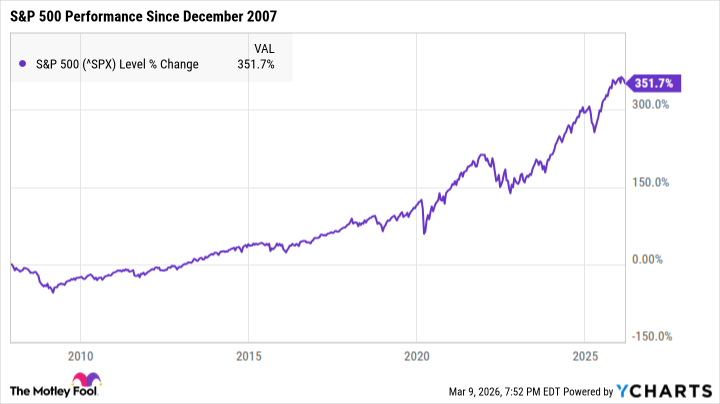
In a 2008 commentary published in The New York Times, Buffett addressed investor anxieties amidst the unfolding financial crisis. The precipitous decline in equity valuations – the S&P 500 experienced a loss exceeding 50% between 2007 and 2009 – prompted widespread risk aversion. Buffett’s central thesis, then as now, underscores the importance of disciplined, long-term investing, independent of prevailing market sentiment.
Buffett posited that near-term economic indicators – rising unemployment, declining business activity – are largely predictable during cyclical downturns. His investment strategy, however, centered on increasing equity exposure during periods of market dislocation, predicated on the principle of acquiring assets at discounted valuations. This approach, succinctly captured by his dictum – “Be fearful when others are greedy, and be greedy when others are fearful” – represents a contrarian investment philosophy that seeks to capitalize on irrational market behavior.
The persistence of short-term volatility is a characteristic feature of equity markets. However, over extended periods, equity valuations have historically demonstrated a positive correlation with economic growth. Investors who succumb to emotional decision-making – purchasing during periods of exuberance and selling during periods of distress – often underperform benchmark indices. A rational investor, conversely, focuses on intrinsic value and ignores transient market fluctuations.
Strategic Considerations for Current Market Conditions
Current market conditions, characterized by elevated geopolitical risks and inflationary pressures, have understandably prompted investor caution. However, a reflexive response to sell equity positions may prove detrimental. While a recession remains a plausible scenario, the timing and severity are subject to considerable uncertainty. Prematurely exiting the market could result in missed opportunities should valuations rebound. Conversely, delaying investment decisions could lead to locking in losses if prices continue to decline.
A consistent investment strategy, emphasizing diversification and a long-term time horizon, remains paramount. Historical data indicates that the S&P 500 has generated substantial returns since the onset of the Great Recession in December 2007 – exceeding 350%. This performance underscores the inherent resilience of equity markets and the benefits of patient capital allocation.
Focusing on high-quality companies with robust balance sheets and sustainable competitive advantages can mitigate downside risk during periods of economic contraction. While even well-managed businesses may experience temporary declines in profitability, they are generally better positioned to recover and generate long-term value. The key lies in maintaining a disciplined approach and resisting the temptation to react impulsively to short-term market fluctuations.
In summary, while market volatility is an inherent characteristic of the investment landscape, it also presents opportunities for rational investors. Adopting a long-term perspective, focusing on intrinsic value, and maintaining a disciplined approach – principles espoused by Warren Buffett – remain essential for navigating current market conditions and achieving long-term investment success. The prudent investor views short-term market setbacks not as threats, but as opportunities to acquire assets at a discounted price, thereby enhancing future returns.
Read More
- 20 Movies Where the Black Villain Was Secretly the Most Popular Character
- Celebs Who Narrowly Escaped The 9/11 Attacks
- 25 “Woke” Films That Used Black Trauma to Humanize White Leads
- Top 20 Dinosaur Movies, Ranked
- Transformers Under the Microscope: What Graph Neural Networks Reveal
- The 10 Most Underrated Jim Carrey Movies, Ranked (From Least to Most Underrated)
- 22 Films Where the White Protagonist Is Canonically the Sidekick to a Black Lead
- Trading on Thin Air: AI Agents Conquer Crypto Volatility
- The Best Directors of 2025
- Silver Rate Forecast
2026-03-11 19:04