
Microsoft, a company so large it practically has its own gravitational pull, hasn’t exactly bounded into 2026 with the exuberance one might expect. A dip of 11% for the year, punctuated by a rather dramatic 10% tumble after the last earnings report… well, it’s a reminder that even the titans occasionally stumble. It’s not ideal when you’re trying to outpace the market, naturally. It’s a bit like starting a race ten yards behind everyone else; you have to work a little harder to catch up.
The S&P 500, being a broad index, hasn’t exactly been setting the world on fire either – a modest 1% gain – but that doesn’t make Microsoft’s task any easier. It’s a bit like trying to win a slow race; there’s not much margin for error. Still, I remain cautiously optimistic. And the reason, as is so often the case in the modern world, revolves around something called ‘the cloud.’
Cloud Computing is the Key to AI
Now, the cloud. It’s not, as some might imagine, a fluffy collection of water vapor hovering above our heads. It’s a network of data centers – vast warehouses filled with humming servers – owned by companies like Microsoft. And it’s utterly crucial to the current obsession with Artificial Intelligence. You see, training an AI model requires an almost unimaginable amount of computing power. It’s a bit like trying to build a sandcastle with a hurricane blowing; you need a lot of shielding. Building and maintaining all that hardware yourself? Prohibitively expensive for most. That’s where Microsoft – and its cloud division, Azure – comes in.
Microsoft essentially builds the computing capacity, then rents it out to anyone who needs it. It’s a remarkably efficient system, provided they can keep the costs of building, operating, and cooling all those servers lower than what they charge. Simple, really. The trouble is, Microsoft doesn’t break out the individual profits for each division, which makes assessing Azure’s contribution a bit like trying to determine the weight of a single grain of rice in a haystack.
Fortunately, we can look at the competition. Amazon Web Services (AWS) and Google Cloud do publish their operating margins. AWS managed a respectable 35% in the last quarter, while Google Cloud came in at 24%. So, it’s a reasonable guess that Azure’s margins fall somewhere in the 25-35% range. Compared to Microsoft’s overall operating margin of around 47%, that could mean Azure is a bit of a drag. But then again, assumptions are often the mothers of all miscalculations.
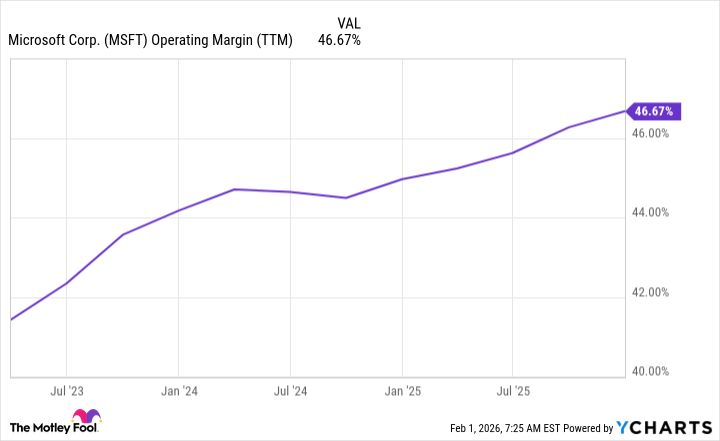
There’s a good chance Azure’s margins are better than its rivals’. Or worse. We simply don’t know. What we do know is that Azure is currently Microsoft’s fastest-growing segment, clocking in at a healthy 39% growth rate in the last quarter. Management even hinted that growth could have been even faster if they hadn’t used some of that new computing capacity internally. Apparently, even giants have to occasionally reorganize the furniture.
Microsoft’s overall growth was 17% in the same period. The next fastest-growing segment, Microsoft 365 Consumer Cloud, managed 29%. It’s clear that cloud computing is the engine driving Microsoft’s growth, and I suspect it will continue to do so for quite some time. So, while Microsoft may have stumbled out of the gate in 2026, I believe it still has the potential to outperform the broader market. And if it does, it will almost certainly be thanks to that vast, invisible network of servers we call the cloud. It’s a peculiar world, isn’t it?
Read More
- Games That Faced Bans in Countries Over Political Themes
- Gold Rate Forecast
- Silver Rate Forecast
- Unveiling the Schwab U.S. Dividend Equity ETF: A Portent of Financial Growth
- 22 Films Where the White Protagonist Is Canonically the Sidekick to a Black Lead
- Superman Flops Financially: $350M Budget, Still No Profit (Scoop Confirmed)
- 20 Movies Where the Black Villain Was Secretly the Most Popular Character
- 14 Movies Where the Black Character Refuses to Save the White Protagonist
- The Best Directors of 2025
- The Best Former NFL Players Turned Actors, Ranked
2026-02-08 15:22