MegaETH has chosen this week to launch its public mainnet, presenting itself as a performance-first contrivance intended to deliver real-time execution rather than submit meekly to the neat but misleading classifications of layer one or layer two.
MegaETH Unveils Its Mainnet, Aiming at High-Frequency DeFi and Gaming
The MegaETH venture frames its programme around ultra-low latency and prodigious throughput, with a penchant for near-instant feedback-ideal for decentralized finance ( defi), gaming, and consumer-facing apps. In the manner of a satirical novelist, it proclaims security on Ethereum while prioritizing speed at the execution layer, a compromise that politely refrains from the customary designation of blockchain.
Ahead of launch, MegaETH conducted a weeklong stress test in late January that treated 11.4 billion transactions with theatrical appetite, reaching a peak of around 55,000 transactions per second (TPS). At the mainnet debut, it announced about 50,000 TPS and block times near 10 milliseconds, numbers that set it, speed-wise, above many a rival Ethereum-compatible orchestra.
That speed is engineered around mini-blocks, emitted every few milliseconds and streaming state updates without the old-fashioned pause of block intervals. The machinery leans on node specialization and a high-performance sequencer that processes transactions without the usual gas constraints, favouring nimbleness over instantaneous finality.
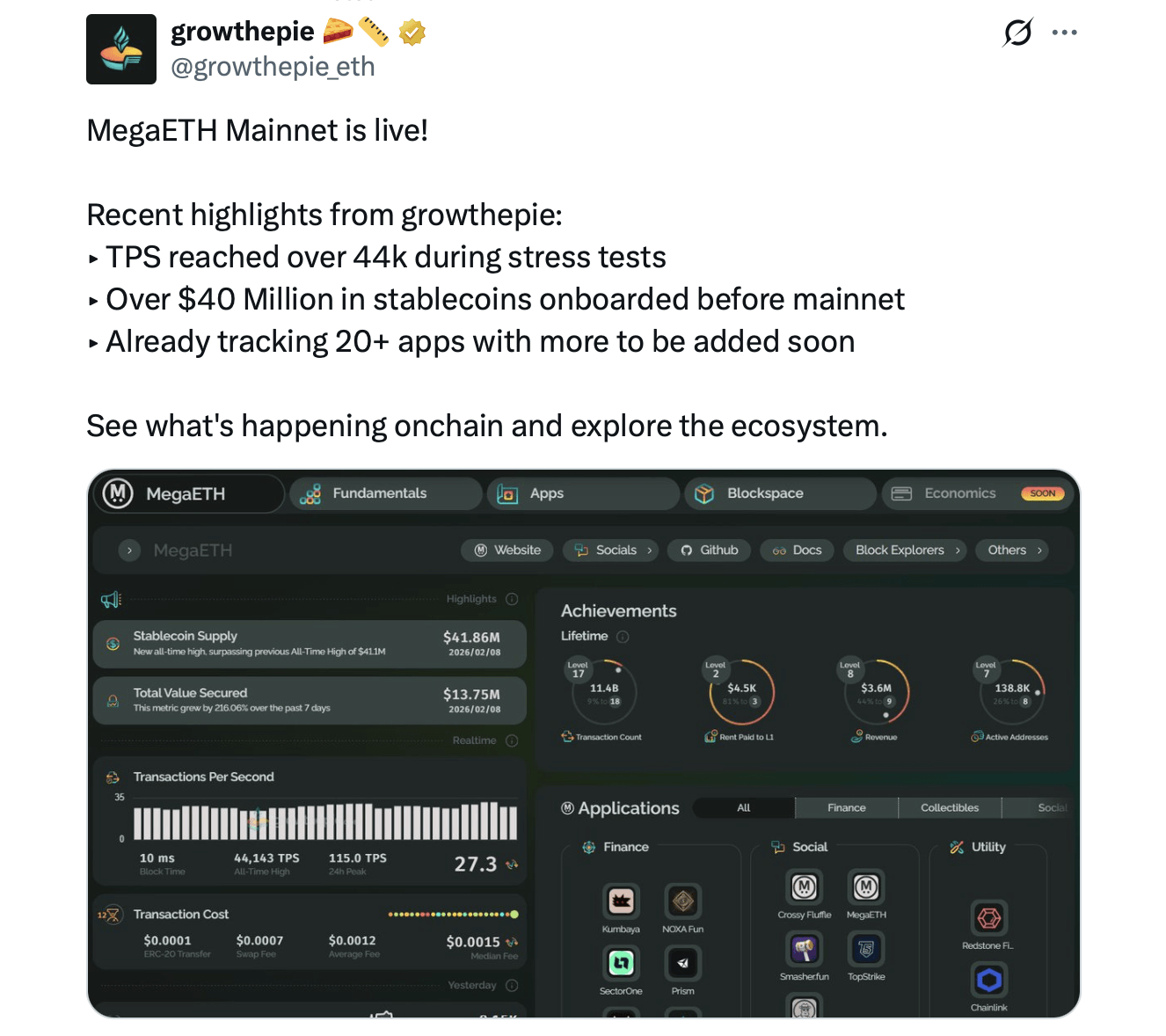
MegaETH maintains full Ethereum Virtual Machine ( EVM) compatibility, allowing developers to port existing smart contracts and tooling without rewrites. Data availability is handled off-chain, with settlement finalized on Ethereum, and the network integrates real-time oracle updates via RedStone, which can push pricing data into every mini-block for latency-sensitive applications.
The mainnet launched with more than 50 live applications spanning trading, lending, gaming, and social use cases, all accessible through a unified interface called “The Rabbithole.” Infrastructure support includes fast remote procedure call (RPC) providers, cross-chain bridges, and analytics integrations, signaling an effort to lower friction for both users and developers.
While the launch marks a significant technical milestone, MegaETH’s design introduces trade-offs, including reliance on a single active sequencer at launch and the use of preconfirmations that favor speed over immediate finality. Whether the network can balance decentralization, security, and sustained performance remains an open question, but its mainnet debut adds another serious contender to Ethereum’s increasingly crowded scaling ecosystem.
FAQ ⏱️
- What is MegaETH?
MegaETH is an EVM-compatible blockchain designed for ultra-low latency and high transaction throughput. - When did MegaETH launch its mainnet?
MegaETH’s public mainnet launched on Feb. 9, 2026. - How fast is MegaETH compared to other networks?
At launch, MegaETH reported around 50,000 TPS and block times near 10 milliseconds. - What are the main trade-offs of MegaETH’s design?
The network prioritizes speed, currently relying on a single sequencer and preconfirmations rather than immediate finality.
Read More
- 20 Movies Where the Black Villain Was Secretly the Most Popular Character
- Top 20 Dinosaur Movies, Ranked
- 25 “Woke” Films That Used Black Trauma to Humanize White Leads
- Gold Rate Forecast
- Spotting the Loops in Autonomous Systems
- Silver Rate Forecast
- 22 Films Where the White Protagonist Is Canonically the Sidekick to a Black Lead
- Top 10 Coolest Things About Invincible (Mark Grayson)
- Can AI Lie with a Picture? Detecting Deception in Multimodal Models
- Celebs Who Narrowly Escaped The 9/11 Attacks
2026-02-10 21:27