Right now, the world feels… busy. A bit like trying to assemble flat-pack furniture with the instructions in a language you only vaguely recognize. It’s understandable to feel a bit rattled when stock prices wobble and headlines shout about recessions. The natural instinct, of course, is to duck and cover. But before you do, let’s have a little look at what history – that vast, often contradictory, and occasionally helpful repository of human experience – actually tells us.
The market, you see, is a bit like a particularly temperamental Labrador. It bounds about enthusiastically for a while, then gets distracted by a squirrel, has a bit of a sulk, and then, eventually, comes back for a cuddle. It rarely does what you expect, and predicting its behavior with any certainty is, frankly, a fool’s errand. But over the long haul, it has a remarkable tendency to go up.
Is a Recession Looming in 2026?
The experts, bless their hearts, are currently giving us a roughly 50/50 chance of a recession in the next year or so. Which, when you think about it, isn’t much more helpful than flipping a coin. A lot hinges on oil prices, which are always a bit of a mystery, and events in the Middle East, which are, let’s just say, complicated. It reminds me a bit of the early 2000s. We had a war going on, the internet was having its first awkward teenage phase (the dot-com bubble, if you recall), and everyone was rather anxious.
Now, comparing today to the early 2000s isn’t perfect. AI is a whole new kettle of fish, and whether we’re heading for another bubble remains to be seen. But it’s useful to remember that markets have weathered storms before. And, crucially, they’ve always, eventually, recovered. It’s a bit like a very resilient weed; you can stomp on it, pour weedkiller on it, but it’ll probably still pop up somewhere unexpected.
The Good News and the Slightly Less Bad News
That dot-com bubble burst was a particularly nasty one. The S&P 500 lost nearly half its value between 2000 and 2002. It didn’t regain its former glory until 2007. A long time to wait, admittedly. Bear markets, on average, tend to last about nine months. But averages are notoriously slippery things. They’re a bit like saying the average family has 2.5 children. It’s statistically true, but you rarely encounter half a child running around.
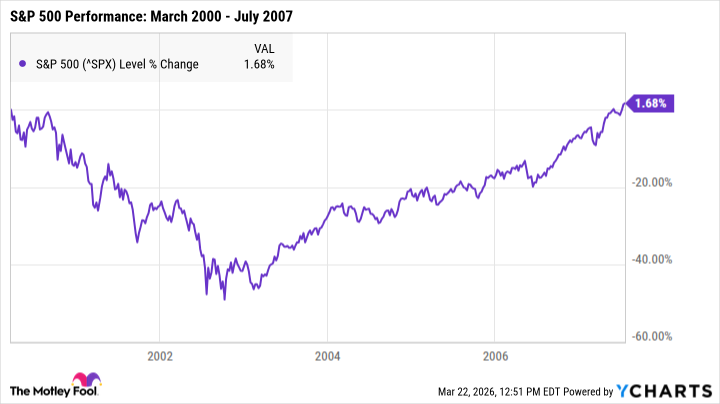
Here’s the thing, though. Since 2000, the S&P 500 has soared by 326%. If you’d had the courage (or perhaps the foolishness) to invest $10,000 at the bottom of that bear market, you’d have around $42,600 today. Which, when you think about it, is a rather impressive return. It’s a reminder that even the most terrifying downturns are, ultimately, temporary. The market, like a determined traveler, always finds a way forward.
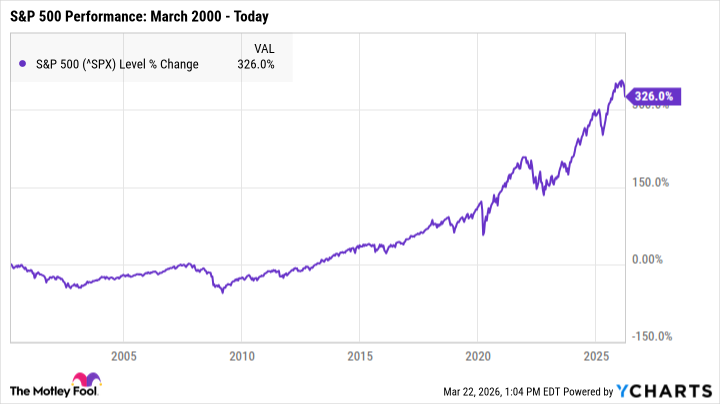
Of course, that doesn’t diminish the pain felt by those who lost money in the early 2000s. Volatility is never pleasant. But history teaches us that markets are remarkably resilient. They have a knack for bouncing back from even the most severe setbacks.
A Silver Lining, If You Can Find It
Nobody enjoys a market downturn. It’s like discovering a hole in your favorite pair of socks. Annoying, inconvenient, and slightly disheartening. But downturns also present opportunities. They allow you to buy high-quality investments at a discount. Think of it as a sale on future prosperity.
During that dot-com bust, the S&P 500 fell by 50%. Another way to look at that is that investors could buy S&P 500 index funds for half price. It’s like finding a perfectly good antique at a flea market. A bargain, if you can find it. If you’d invested in October 2002, when the market hit bottom, you’d have earned total returns of nearly 730% by today. A truly remarkable return. It’s a testament to the power of patience and a long-term perspective.
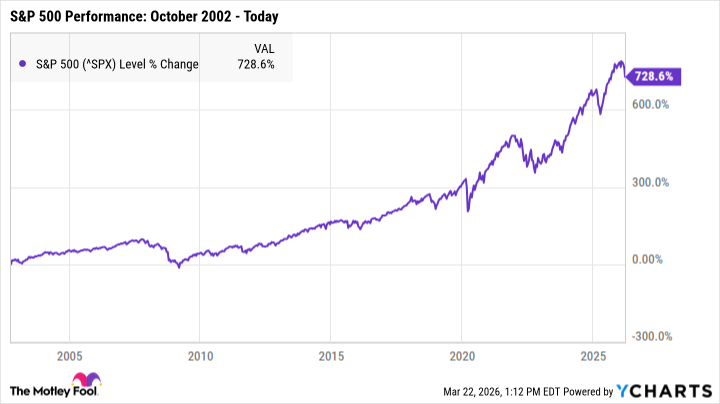
It’s tempting to sit on the sidelines and wait for prices to rebound. But that’s often a mistake. Market slumps are incredible buying opportunities. By continuing to invest, even when things are shaky, you can earn far more than if you only invest when the market is thriving. It requires a bit of courage, perhaps a touch of stubbornness, but the rewards can be substantial.
The short-term future is always uncertain. That’s just the way it is. But if history proves one thing, it’s that the market’s long-term potential is lucrative. By staying invested for the long haul, you can set yourself up for potentially life-changing gains. And who doesn’t want a bit of that?
Read More
- 20 Movies Where the Black Villain Was Secretly the Most Popular Character
- Top 20 Dinosaur Movies, Ranked
- Silver Rate Forecast
- Can AI Lie with a Picture? Detecting Deception in Multimodal Models
- 25 “Woke” Films That Used Black Trauma to Humanize White Leads
- 22 Films Where the White Protagonist Is Canonically the Sidekick to a Black Lead
- Top 10 Coolest Things About Invincible (Mark Grayson)
- When AI Teams Cheat: Lessons from Human Collusion
- From Bids to Best Policies: Smarter Auto-Bidding with Generative AI
- Unmasking falsehoods: A New Approach to AI Truthfulness
2026-03-24 10:03