Right. So, the market. Apparently, more than half of us are feeling a bit gloomy about its future, according to some survey. Honestly, who isn’t? It’s like watching a slightly unstable tower of Jenga, isn’t it? I checked the figures this morning – pessimism is up. Up! As if I needed another reason to obsessively refresh my brokerage account. It’s a compulsion, really. Units of Cryptocurrency Lost: 3. Hours Spent Watching Charts: 7. Number of Times I’ve Considered Becoming a Beekeeper: 4.
The thing is, everyone keeps saying “know what might happen.” As if knowing makes it any less terrifying. It’s like knowing you’re about to stub your toe doesn’t make the actual stubbing any less painful. Still, let’s try to be rational. Let’s dissect this. There’s good news, apparently. And also, less-good news. Naturally.
The Long View (Which I’m Trying to Adopt)
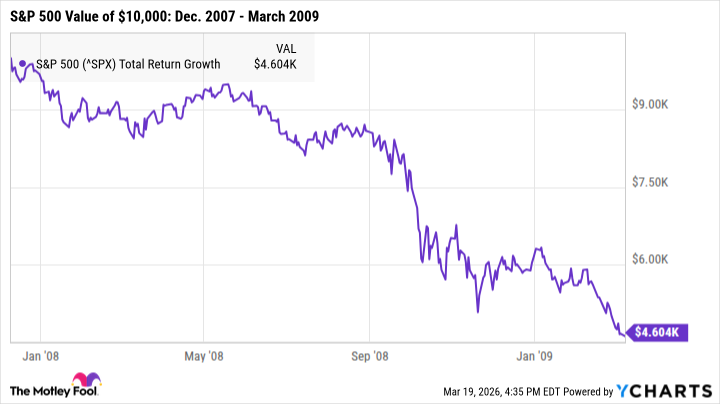
No one, absolutely no one, has a crystal ball. Which is just as well, because I’d probably break it. But, generally speaking, if things go south – a bear market, a crash, a full-blown recession – your investments will, almost certainly, lose value. It’s just… physics, isn’t it? I mean, it feels deeply personal, like a reflection on my life choices, but it’s just numbers. During the Great Recession, the S&P 500 lost more than half its value. Half! I wasn’t investing then, thankfully, I was mostly eating pasta and worrying about finding matching socks. But the thought… it’s unsettling.
If you had ten thousand dollars invested in December 2007, by March 2009, it would have shrunk to around four thousand six hundred. Which, let’s be honest, is a significant amount of pasta money. But here’s the slightly less depressing bit. Losing value isn’t the same as losing money. Not yet, anyway. The actual losing-money bit happens when you panic and sell at the bottom. Which, naturally, is exactly what I’m trying not to do. I keep telling myself, “Hold, hold, hold.” It’s like trying to hold onto a slippery bar of soap.
And get this – if you’d just held that four thousand six hundred dollars’ worth of S&P 500 ETF for ten years, you’d have more than doubled your money. Doubled! It’s almost enough to make you forgive the market its little tantrums. Almost. It’s all about the long term, isn’t it? Which is a phrase I’m trying to internalize. Long term. Like, decades. It feels… daunting.
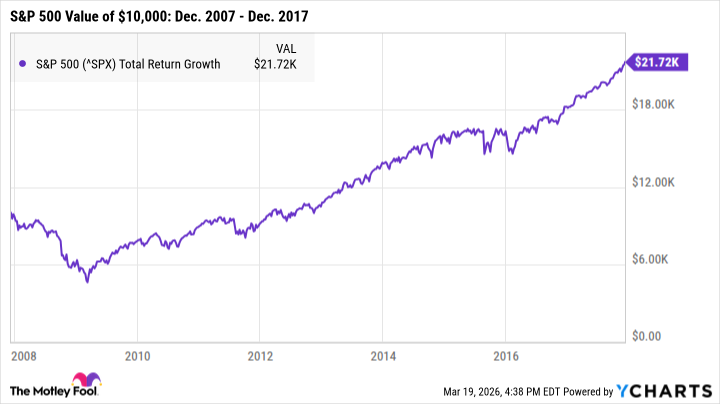
Honestly, the market is a bit like a moody teenager. It throws a fit, then apologizes with gains. The key is to remember that it usually recovers. Usually. Which is, admittedly, not a 100% guarantee. But it’s enough to stop me from selling all my possessions and moving to a remote island. For now.
Surviving the Storm (Or, How to Avoid Total Financial Ruin)
The market itself might be resilient, but individual companies aren’t guaranteed to survive. It’s like a school reunion – some people are thriving, others are… not so much. If you’re invested in shaky companies, the ones that are barely hanging on, you’re likely to lose money. It’s just common sense, really. Stock price isn’t everything. A company can look good on paper, but underneath, it could be a disaster. You need to look at the fundamentals. Is it a solid business? Does it have a competitive advantage? Is it run by competent people? These are the questions I’m asking myself. Constantly.
Healthy organizations, the ones with strong foundations and clear advantages, are more likely to bounce back. They might still lose value in the short term, but that’s normal. It’s like a temporary setback. If you hold these stocks for a few years, your portfolio has a much better chance of surviving even the worst crash. It’s about being patient, disciplined, and resisting the urge to make rash decisions. Which, let’s be honest, is easier said than done. Days Spent Trying to Time the Market: 12. Number of Times I Failed: 12. Number of Cups of Tea Consumed While Panicking: Uncountable.
Read More
- Games That Faced Bans in Countries Over Political Themes
- Gold Rate Forecast
- Silver Rate Forecast
- Unveiling the Schwab U.S. Dividend Equity ETF: A Portent of Financial Growth
- 22 Films Where the White Protagonist Is Canonically the Sidekick to a Black Lead
- The Best Directors of 2025
- 15 Films That Were Shot Entirely on Phones
- Superman Flops Financially: $350M Budget, Still No Profit (Scoop Confirmed)
- 14 Movies Where the Black Character Refuses to Save the White Protagonist
- 20 Movies Where the Black Villain Was Secretly the Most Popular Character
2026-03-22 02:12