
There’s this notion, often attributed to Mark Twain (though, as with most things attributed to Mark Twain, it’s probably not true), that history doesn’t repeat itself, but it does rather enjoy rhyming. It’s a comforting thought, really. Complete repetition would be utterly terrifying. A gentle rhyme, though? Manageable. And right now, the market feels less like a full-blown replay and more like a slightly unsettling lyrical echo of 1973.
Let’s consider. A significant geopolitical kerfuffle in the Middle East, oil prices behaving as though they’ve been startled by a badger, inflation stubbornly refusing to lie down, and economic growth…well, let’s just say it’s taking a very leisurely stroll. Sound familiar? It should. Because this is, with unnerving precision, what things looked like half a century ago.
Déjà Vu All Over Again
Back in ’73, the Yom Kippur War and the subsequent oil embargo sent shockwaves through the global economy. The price of oil quadrupled, inflation went into a furious gallop, and the U.S. economy shuddered its way into recession. It was, by all accounts, a thoroughly unpleasant time. Core inflation, previously behaving itself, took off like a scalded cat. It’s a peculiar thing, inflation. It’s not something you can see happening, not in the way you can see a building being constructed, yet it erodes everything, slowly but relentlessly.
Today, we don’t have a formal embargo, thankfully. But Iran’s flexing of its muscles around the Strait of Hormuz – a rather crucial waterway, responsible for about 20% of the world’s oil supply – is causing a similar ripple effect. Oil prices have jumped, gasoline is becoming noticeably more expensive (a gallon of regular now costs roughly the same as a decent paperback), and the specter of stagflation – that charming combination of slow growth and rising prices – is looming large. Fourth-quarter GDP growth, revised down to a measly 0.7%, isn’t exactly setting the world on fire.
A Grim Outlook for Stocks?
The 1973 bear market was, to put it mildly, brutal. The S&P 500 lost over 40% of its value. And to add insult to injury, the index was heavily populated by the “Nifty Fifty” – large-cap stocks trading at valuations that would make even the most optimistic venture capitalist blush. They were, in essence, priced for perfection, and when reality inevitably intervened, the fall was spectacular.
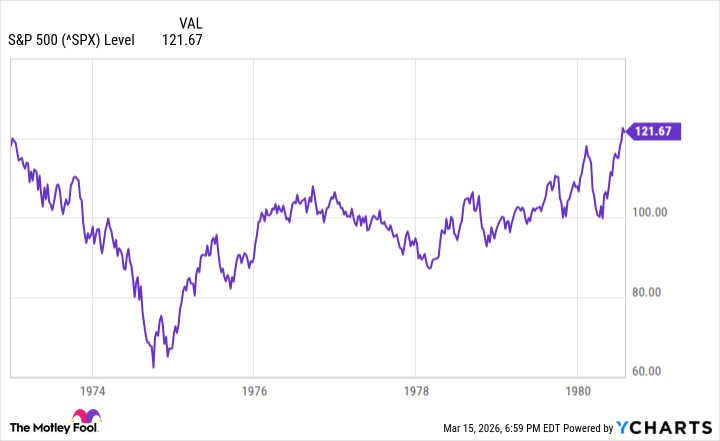
Fast forward to the present day. The “Nifty Fifty” are gone, replaced by the “Magnificent Seven” – a handful of tech giants that now account for roughly a third of the S&P 500. They’re undeniably impressive companies, but they’re also trading at premiums that are…well, let’s just say they require a considerable amount of faith in future growth. A “lost decade” like the 1970s isn’t out of the question.
What Should Investors Do?
If history does rhyme, a bit of diversification might be a sensible move. Commodities, particularly gold (a perennial safe haven), could offer some protection. Energy stocks and gold stocks might also benefit from the current environment. And, following in the footsteps of the famously prudent Warren Buffett, keeping a healthy allocation to U.S. Treasuries wouldn’t be a bad idea. He started doing that before stepping down from Berkshire Hathaway, and the man knows a thing or two about investing.
However, it’s important to remember that 2024 is not 1973. We have artificial intelligence, a force that could potentially offset some of the negative economic pressures. The situation in the Middle East might de-escalate. And, frankly, the market is a notoriously unpredictable beast. Assuming the future will mirror the past is a dangerous game.
The smartest approach, then and now, is to think long-term. Invest in companies that are well-positioned to thrive over the next 20 years, regardless of short-term market fluctuations. Even after the malaise of the 1970s, the S&P 500 had delivered a remarkable 260% return two decades later. I suspect history will continue to rhyme, but it will also throw in a few unexpected verses. And that, after all, is what makes it interesting.
Read More
- Invincible Season 4 Gender Swaps Tech Jacket As Fans Question Major Comic Change
- Gold Rate Forecast
- Silver Rate Forecast
- 20 Movies Where the Black Villain Was Secretly the Most Popular Character
- Building Agents That Learn and Improve Themselves
- 22 Films Where the White Protagonist Is Canonically the Sidekick to a Black Lead
- 15 Films That Were Shot Entirely on Phones
- Celebs Who Narrowly Escaped The 9/11 Attacks
- Games That Faced Bans in Countries Over Political Themes
- 20 Films Where Black Directors Subverted Hollywood’s White Savior Tropes
2026-03-16 10:52