Author: Denis Avetisyan
New research leverages unsupervised neural networks to analyze the complex spectral fingerprints of galaxies, paving the way for the discovery of unusual celestial objects.
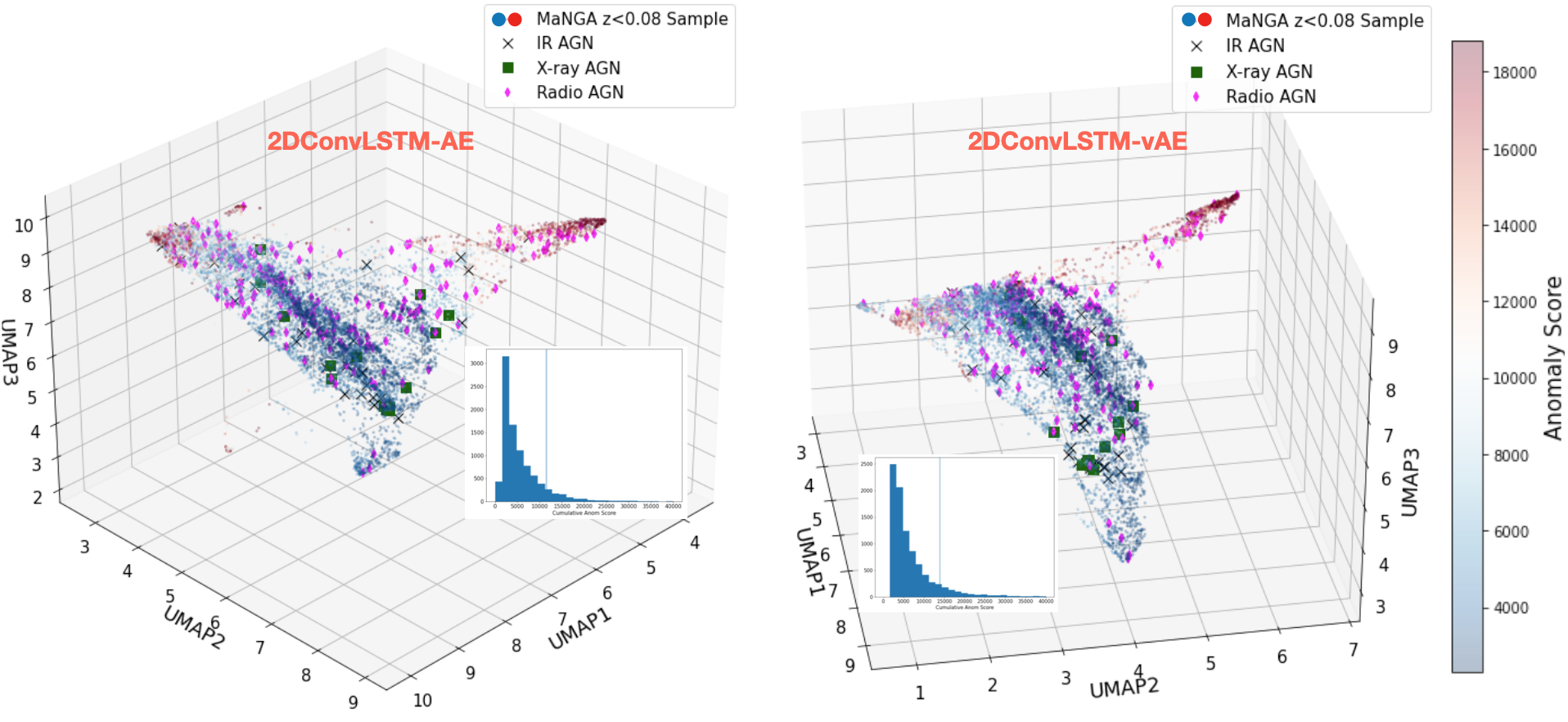
This study demonstrates the use of 2D Convolutional LSTM Autoencoders and Variational Autoencoders for spatio-spectral analysis of integral field spectroscopy data, enabling anomaly detection in galaxy spectra.
Despite the increasing volume of spatially resolved spectroscopic data from integral field surveys, extracting meaningful insights regarding galaxy evolution remains a challenge. This work, ‘Spatio-Spectroscopic Representation Learning using Unsupervised Convolutional Long-Short Term Memory Networks’, introduces a novel unsupervised deep learning framework leveraging 2D Convolutional LSTM Autoencoders to learn generalized feature representations from both the spatial and spectral dimensions of ~9000 galaxies observed by the MaNGA survey. Our approach effectively encodes information across 19 optical emission lines, enabling the identification of anomalous galaxies and potentially revealing previously unknown spectral signatures. Could this method unlock a more comprehensive understanding of the complex interplay between spatial structure and spectral properties in galaxy evolution?
The Universe Speaks in Whispers: Decoding Galactic Light
Galaxies, as dynamic systems, undergo constant evolution shaped by complex processes like star formation, black hole activity, and mergers. Discerning the specific mechanisms driving these changes requires a deep understanding of a galaxy’s composition, age, and kinematics – information remarkably encoded within the light it emits. This light, when dispersed into its constituent wavelengths – a process called spectroscopy – reveals absorption and emission lines that act as fingerprints of the elements present and their motions. The wavelengths themselves are subtly shifted due to the Doppler effect, indicating whether a galaxy is approaching or receding, and how quickly its components are rotating. By meticulously analyzing these spectral properties, astronomers can effectively ‘decode’ a galaxy’s history and current state, constructing detailed models of its formation and evolution, and ultimately, piecing together the broader story of the universe.
Historically, characterizing the complex inner workings of galaxies through their light has been hampered by the limitations of conventional spectroscopic analysis. These traditional methods, designed for observing integrated light from a galaxy as a whole, often fail to adequately resolve the spatial variations within. A galaxy isn’t a uniform entity; properties like star formation rates, gas composition, and stellar velocities differ significantly across its structure. Extracting this spatially resolved information – understanding where these processes occur – demands analyzing spectra taken at many points across the galaxy’s surface. The sheer volume of data generated by such an approach quickly overwhelms standard processing techniques, creating a bottleneck in astronomical research and hindering detailed investigations into galactic evolution. This challenge necessitates innovative data handling and analytical tools to unlock the full potential of spectroscopic observations.
The landscape of galaxy research underwent a significant transformation with the advent of the Mapping Nearby Galaxies at Apache Point (MaNGA) survey. Building upon the extensive foundation laid by the Sloan Digital Sky Survey, MaNGA dramatically expanded the scope of galactic studies by employing integral field spectroscopy (IFS) to observe a remarkable sample of 9043 galaxies. This innovative technique doesn’t just capture the overall light from a galaxy; it dissects that light across its entire two-dimensional surface, creating a ‘data cube’ revealing variations in chemical composition, stellar populations, and gas kinematics within each galaxy. Consequently, researchers moved beyond integrated spectra, obtaining spatially resolved insights into the complex processes driving galaxy formation and evolution – a feat previously limited by observational constraints and data processing demands. The sheer volume and detail of the MaNGA data have become a cornerstone for modern astrophysical research, enabling unprecedented statistical analyses and theoretical modeling of galactic structures.
From Shadows to Essence: A Deep Learning Mirror
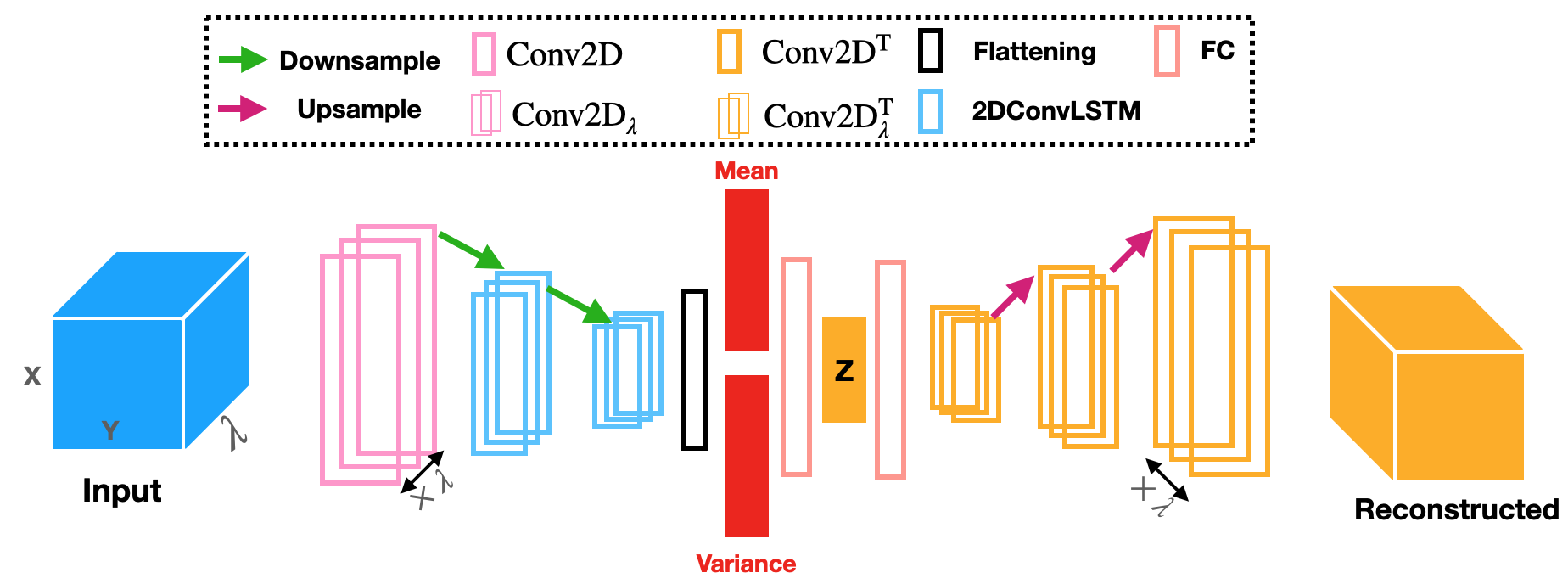
A 2D Convolutional LSTM Variational Autoencoder (CLVAE) was developed to generate efficient representations from Integral Field Spectrograph (IFS) data. This architecture integrates 2D convolutional layers to process spatial information within IFS data cubes, Long Short-Term Memory (LSTM) networks to model temporal dependencies across spectral channels, and a Variational Autoencoder (VAE) to learn a compressed, probabilistic latent space. The convolutional component extracts spatial features, the LSTM component captures spectral sequences, and the VAE component enforces a lower-dimensional representation suitable for downstream tasks like galaxy classification or anomaly detection. The resulting CLVAE outputs a latent vector that encapsulates the essential characteristics of the input IFS data in a reduced dimensionality, facilitating efficient data analysis and modeling.
The architecture integrates convolutional neural networks (CNNs) to process spatial information present in the input IFS data, leveraging their ability to identify patterns and features across spectral channels. Long Short-Term Memory Networks (LSTMs), a type of recurrent neural network, are incorporated to model temporal dependencies – in this case, relationships between spectral lines – effectively capturing sequential information within the data. Finally, a variational autoencoder (VAE) is employed to learn a compressed, probabilistic representation of the data, enabling dimensionality reduction and focusing on the most salient features while also providing a means for generative modeling and uncertainty estimation. This combined approach allows the model to simultaneously analyze spatial arrangements of spectral features and the sequential relationships between emission lines, offering a comprehensive understanding of the data’s underlying structure.
The model learns a compressed representation of galaxy data by mapping high-dimensional input features into a lower-dimensional ‘latent space’. This dimensionality reduction is achieved through the variational autoencoder component, enabling the system to prioritize and retain the most salient characteristics of each galaxy. Specifically, the input data consists of measurements from 19 distinct optical emission lines within the spectral range of 3800Å to 8000Å. These emission lines serve as proxies for physical conditions such as temperature, density, and chemical composition, and their combined signal is used to define the input feature vector for the autoencoder.
Whispers of the Unusual: Detecting Galactic Anomalies
The identification of unusual galaxy spectra relies on an ‘Anomaly Score’ generated by our deep learning model, quantifying the deviation of a given spectrum from the established norm. This score is not uniformly distributed; the median anomaly score across the analyzed galaxy population is 3000. However, the 90th percentile reaches a value of 12000, indicating a substantial range in spectral peculiarity and highlighting the model’s sensitivity to even relatively subtle deviations from typical galactic spectra. Galaxies exceeding this 90th percentile threshold are flagged for further investigation as potential outliers.
Uniform Manifold Approximation and Projection (UMAP) is employed to reduce the dimensionality of the latent space generated by our deep learning model, allowing for two-dimensional visualization of galaxy spectral relationships. This dimensionality reduction preserves both local and global structure within the data, enabling the identification of galaxies that deviate significantly from the cluster of normal galaxies. Outliers, representing galaxies with unusual spectral characteristics, appear as isolated points in the UMAP visualization, providing a clear visual indication of anomalous objects for further investigation. The technique facilitates exploration of the high-dimensional spectral data and highlights potential candidates for detailed analysis.
The efficacy of this anomaly detection method is confirmed by its successful identification of previously cataloged peculiar galaxies, specifically including examples known as ‘Blueberry Galaxies’. These galaxies are characterized by diffuse, extended emission and are visually distinct from typical galaxy morphologies. The model’s ability to flag these known outliers within the spectral data demonstrates its capacity to accurately discern statistically unusual galaxies, validating its performance beyond the synthetic data used for training and suggesting a robust approach to identifying previously unknown peculiar objects.
Beyond the Expected: Unveiling Hidden Galactic Engines
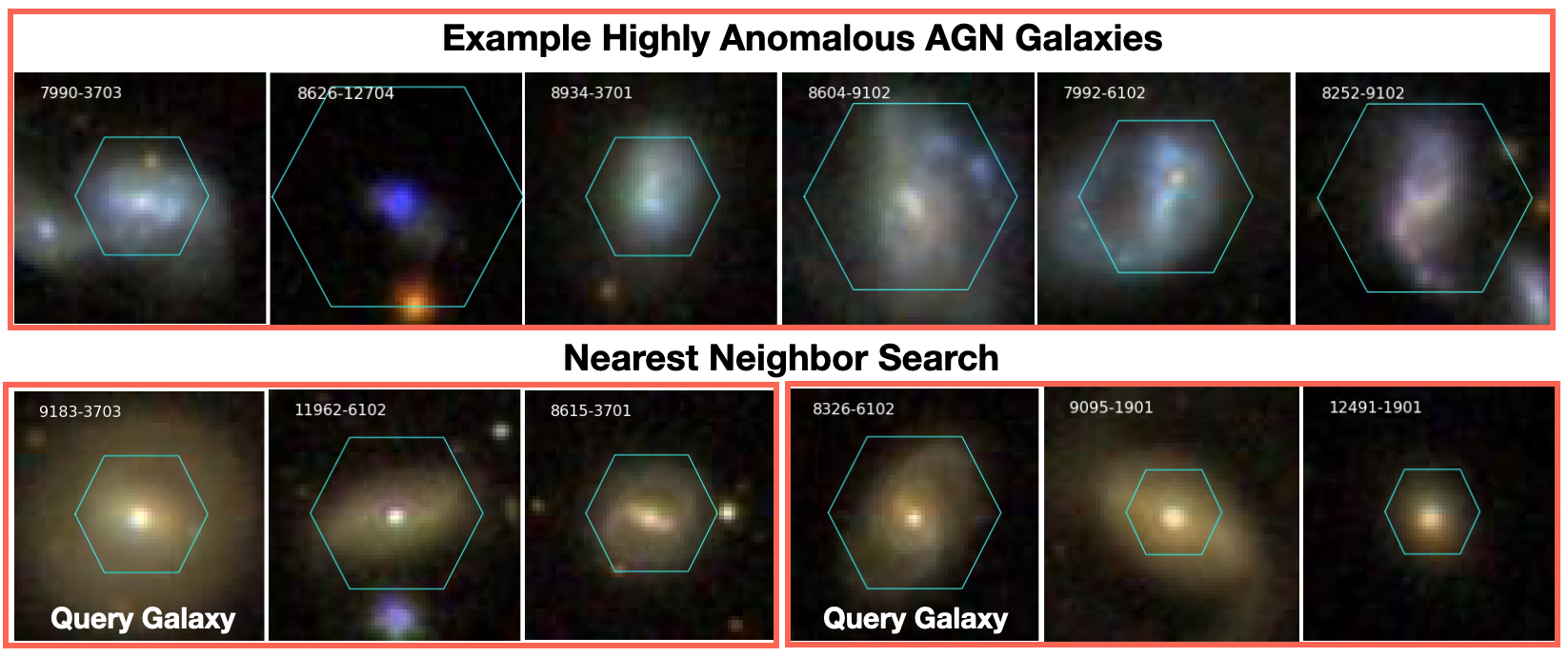
The study demonstrates a compelling correlation between galaxies flagged as anomalous by a novel detection method and those harboring Active Galactic Nuclei (AGN). This suggests that unusual spectral characteristics – subtle deviations from typical galaxy emissions – often indicate the presence of an AGN, a supermassive black hole actively accreting matter. The anomaly detection system effectively identifies galaxies exhibiting these atypical emission-line signatures, which might otherwise be overlooked in traditional surveys. This connection implies that the method isn’t simply flagging noise, but genuinely pinpointing physical processes associated with AGN activity, offering a new avenue for discovering and characterizing these energetic phenomena within galaxies and furthering understanding of their role in galactic evolution.
Investigations utilizing established Baldwin, Phillips & Terzian (BPT) diagrams – a foundational tool in extragalactic astronomy for discerning the dominant ionization source within a galaxy – consistently reinforce the connection between anomalous spectral signatures and the presence of Active Galactic Nuclei (AGN). These diagrams, which plot ratios of strong emission lines, reliably categorize galaxies based on whether their emission is driven by star formation, AGN activity, or other mechanisms. The observed correlation from the anomaly detection method aligns strongly with expectations from BPT classifications; galaxies flagged as unusual exhibit emission-line ratios characteristic of AGN, providing independent confirmation that these anomalies aren’t merely statistical flukes but genuine indicators of energetic processes at the galactic core. This agreement validates the automated approach and underscores its potential for identifying previously unrecognized AGN, even in cases where traditional methods might struggle.
A novel automated system streamlines the identification and analysis of galaxies exhibiting unusual spectral characteristics, offering a significant leap in the study of galaxy evolution. This system efficiently sifts through large datasets, pinpointing rare and previously overlooked galaxies that deviate from established norms. Central to its efficacy is a data augmentation technique, applied threefold to the emission-line cubes, which artificially expands the dataset and enhances the system’s ability to recognize subtle anomalies. By automating the process of discovering these unusual galaxies, researchers can now focus on in-depth analysis, gaining insights into the diverse processes that shape galactic development and challenging existing theoretical models.
The pursuit of understanding galaxy spectra, as detailed in this work, feels remarkably akin to staring into the abyss. This research employs unsupervised deep learning – Convolutional LSTM Autoencoders and Variational Autoencoders – to distill patterns from spatially resolved data, seeking anomalies where current models falter. It’s a beautiful exercise in letting the data speak, a necessary humility when confronting the cosmos. As Ernest Rutherford observed, “If you can’t explain it, then you’re not reaching far enough.” This sentiment rings true; the ambition to map the spectral fingerprints of galaxies, even those exhibiting unusual signatures, demands pushing the boundaries of existing techniques and embracing the unexpected. Physics, after all, is the art of guessing under cosmic pressure.
Where the Light Ends
The pursuit of spectral signatures, of anomalies within the glow of distant galaxies, feels increasingly like charting the interior of a black hole. This work, employing convolutional LSTM autoencoders, offers a method – a map, if one will – but any map is inherently limited by the light that reaches it. The boundaries of knowledge are not defined by what is known, but by what remains unseen, unrepresented in the learned latent space. The very act of encoding, of distilling complexity into manageable parameters, inevitably discards information – perhaps the most interesting information.
Future iterations will undoubtedly refine the architecture, incorporate larger datasets, and seek to identify more subtle deviations from the norm. Yet, it is crucial to remember that ‘anomaly detection’ is itself a construct, a judgment imposed by the observer. What appears anomalous today may simply be a phenomenon not yet accounted for in the theoretical framework. The models are adept at recognizing what resembles the familiar; their failure lies in anticipating the truly novel.
The true test will not be in identifying unusual galaxies, but in confronting the limitations of the representation itself. Any theory, no matter how elegant, is good until it crosses the event horizon, until the data reveals a reality beyond its grasp. The silent regions of the spectrum may hold the most profound lessons, if only one knew where – and how – to listen.
Original article: https://arxiv.org/pdf/2602.18426.pdf
Contact the author: https://www.linkedin.com/in/avetisyan/
See also:
- Invincible Season 4 Gender Swaps Tech Jacket As Fans Question Major Comic Change
- Building Agents That Learn and Improve Themselves
- Gold Rate Forecast
- Silver Rate Forecast
- Games That Faced Bans in Countries Over Political Themes
- Trading Crypto with AI: A New Approach to Portfolio Management
- Superman Flops Financially: $350M Budget, Still No Profit (Scoop Confirmed)
- 22 Films Where the White Protagonist Is Canonically the Sidekick to a Black Lead
- 15 Films That Were Shot Entirely on Phones
- Unveiling the Schwab U.S. Dividend Equity ETF: A Portent of Financial Growth
2026-02-23 13:51