Author: Denis Avetisyan
Researchers are leveraging the power of artificial intelligence to not only improve the accuracy of ADHD detection, but also to provide clinicians with deeper insights into the factors driving those diagnoses.
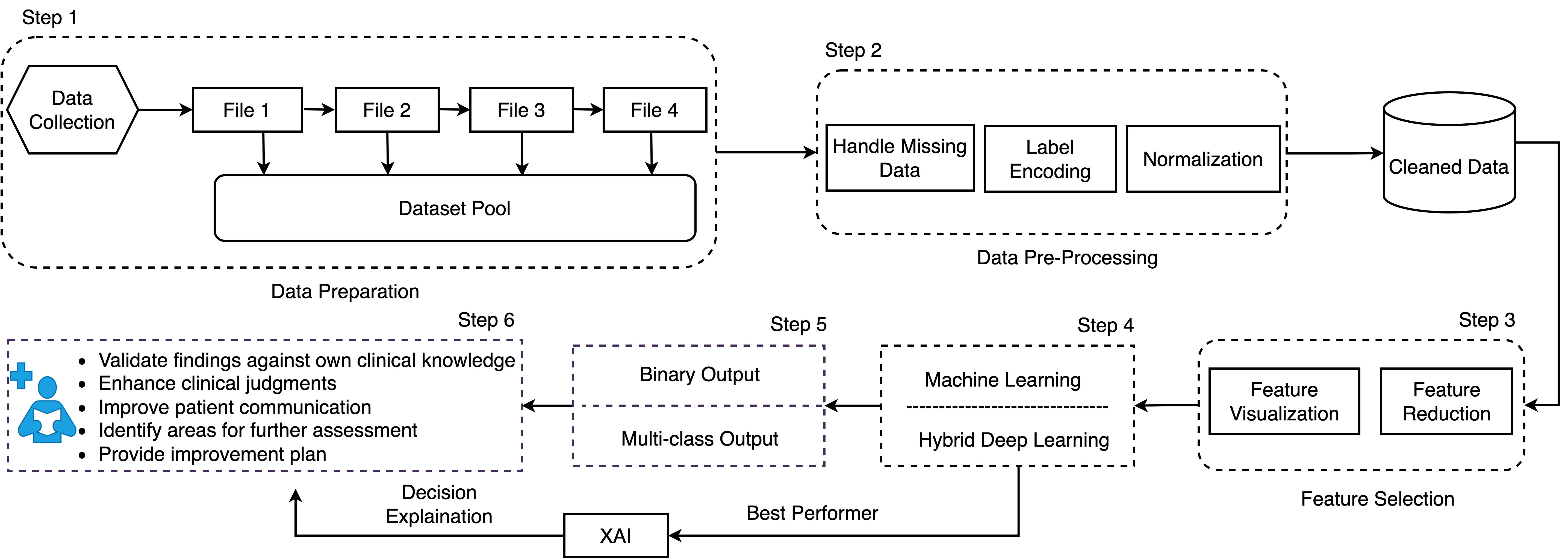
This review details a hybrid deep learning framework, HyExDNN-RNN, combined with Explainable AI (XAI) techniques like SHAP, for enhanced ADHD diagnosis and feature selection.
Accurate and transparent diagnosis of Attention Deficit Hyperactivity Disorder (ADHD) remains a significant clinical challenge, demanding increasingly sophisticated analytical approaches. This is addressed in ‘Enhancing Psychologists’ Understanding through Explainable Deep Learning Framework for ADHD Diagnosis’, which proposes a novel hybrid deep learning model, HyExDNN-RNN, integrated with explainable AI (XAI) techniques. The framework achieves high diagnostic accuracy-up to 99% F1 score in binary classification-while simultaneously providing interpretable insights into the decision-making process via methods like SHAP and Permutation Feature Importance. Could this combination of artificial intelligence and clinical expertise fundamentally reshape the landscape of ADHD assessment and personalized treatment strategies?
The Shifting Sands of Diagnosis: Unveiling ADHD’s Complexity
Attention Deficit Hyperactivity Disorder affects an estimated millions of individuals globally, yet pinpointing a diagnosis presents a significant challenge for clinicians. The difficulty stems from considerable overlap in symptoms with other conditions – anxiety, mood disorders, and even typical variations in childhood behavior can mimic ADHD presentations. Furthermore, current diagnostic practices heavily rely on subjective behavioral observations and reports, opening the door to potential biases from the observer and inconsistencies in interpretation. This subjectivity makes differentiating between genuine ADHD and transient attention lapses, or simply exuberant personality traits, a complex undertaking, hindering timely and accurate interventions for those who truly need them.
Currently, identifying Attention Deficit Hyperactivity Disorder (ADHD) largely depends on behavioral assessments – detailed reports from parents, teachers, and sometimes the individual themselves – which, while providing valuable insight, present significant challenges. These evaluations are often lengthy processes, requiring substantial time from clinicians and potentially delaying crucial interventions. Furthermore, the subjective nature of behavioral observations introduces the possibility of bias, influenced by the observer’s expectations or differing interpretations of a child’s behavior. Cost also plays a role, as comprehensive assessments can be financially burdensome for families and healthcare systems. Consequently, the reliance on these traditional methods highlights the need for more standardized, objective tools to ensure accurate and equitable ADHD diagnosis, ultimately improving patient care and resource management.
The pursuit of objective biomarkers for Attention Deficit Hyperactivity Disorder (ADHD) represents a critical shift in diagnostic methodology, promising benefits that extend beyond simply confirming a diagnosis. Currently, reliance on behavioral assessments introduces inherent subjectivity, potentially delaying appropriate intervention and hindering access to care, particularly within stretched healthcare systems. Data-driven approaches, leveraging neuroimaging, genetic analysis, and even wearable sensor technology to track activity and physiological responses, offer the potential for earlier, more accurate identification of ADHD. This, in turn, allows for targeted interventions, optimizing treatment plans for individual patients and ensuring resources are allocated effectively – moving away from broad-spectrum approaches toward personalized medicine and ultimately improving long-term outcomes for those impacted by this neurodevelopmental condition.
A Symphony of Networks: Modeling Temporal Dynamics in ADHD
HyExDNN-RNN is a novel hybrid neural network architecture designed for the analysis of sequential data in ADHD detection. This model integrates the capabilities of Deep Neural Networks (DNNs), which excel at feature extraction, with those of Recurrent Neural Networks (RNNs), specifically chosen for their ability to process temporal dependencies. By combining these approaches, HyExDNN-RNN aims to leverage the strengths of both – the DNN component initially processes input features, and the resulting representations are then fed into the RNN component for sequential analysis. This architecture facilitates the identification of patterns and trends in time-series data related to ADHD symptoms, potentially improving diagnostic accuracy and providing insights into symptom progression.
Long Short-Term Memory (LSTM) architectures are incorporated into the Recurrent Neural Network (RNN) component to address the challenges of modeling temporal dependencies in ADHD symptom data. Traditional RNNs often struggle with vanishing gradients when processing extended sequences, hindering their ability to learn long-range correlations. LSTMs mitigate this issue through a specialized cell state and gating mechanisms – input, forget, and output gates – which regulate the flow of information and allow the network to selectively retain or discard data over time. This capability is particularly relevant to ADHD detection, as symptom presentation is dynamic and can exhibit patterns evolving across extended observation periods; LSTMs effectively capture these temporal relationships, improving the model’s accuracy in identifying subtle but significant changes in behavioral indicators.
The HyExDNN-RNN model incorporates Explainable AI (XAI) via SHapley Additive exPlanations (SHAP) values to address the need for transparency in clinical applications. SHAP values quantify the contribution of each input feature – derived from EEG data and behavioral assessments – to the model’s ADHD detection outcome for a given patient. This feature-level explanation allows clinicians to understand why the model made a specific prediction, rather than treating it as a “black box.” By providing these individualized explanations, SHAP values facilitate trust and enable informed clinical decision-making, crucial for the responsible implementation of AI in healthcare settings.
Distilling Signal from Noise: Feature Selection and Validation
Feature reduction was implemented on the ADHD200 Dataset utilizing Pearson Correlation analysis to determine inter-variable relationships and redundancy. This statistical method quantifies the linear association between each feature, allowing for the identification and subsequent removal of highly correlated variables-those exceeding a predetermined threshold-to minimize multicollinearity. The goal was to streamline the dataset by retaining only the most informative, independent features, thereby reducing computational complexity, mitigating overfitting, and potentially improving model generalization performance. The resulting feature set consisted of variables demonstrating minimal correlation with others, ensuring each retained feature contributed unique information to the predictive model.
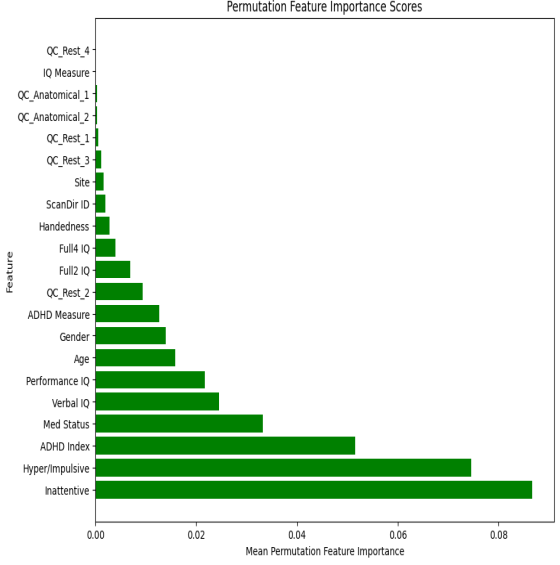
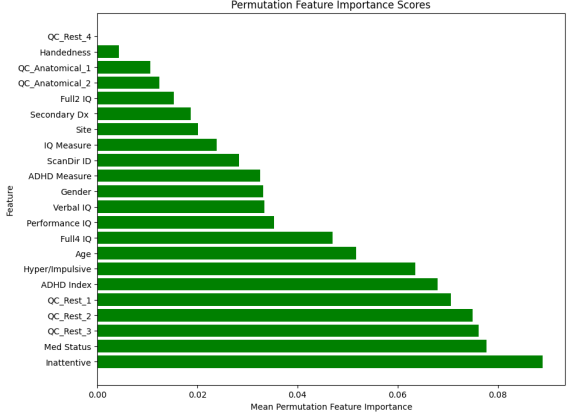
Permutation Feature Importance (PFI) was implemented to quantitatively assess the predictive power of the features selected through Pearson correlation analysis. This technique operates by randomly shuffling the values of a single feature while holding all others constant, then measuring the resulting decrease in model performance. A substantial decrease indicates the feature is highly important; conversely, a minimal impact suggests limited contribution. PFI analysis consistently demonstrated a significant reduction in accuracy when key features were permuted, thereby validating their selection and confirming their substantial influence on the HyExDNN-RNN model’s predictive capability. This corroboration strengthens the confidence in the chosen feature subset and supports the model’s overall performance.
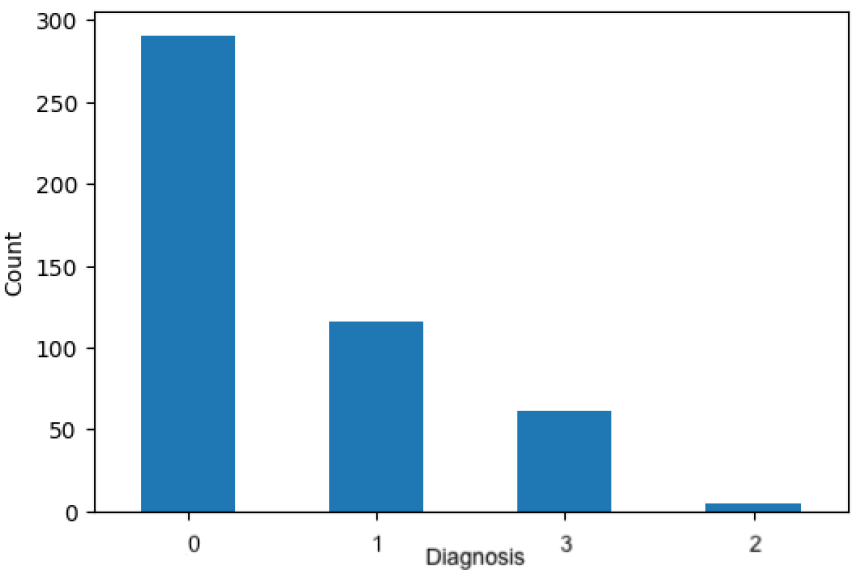
The HyExDNN-RNN model achieved performance levels exceeding those of established machine learning algorithms when tested on the ADHD200 Dataset. In binary classification tasks, the model attained 99% accuracy, while multi-class classification yielded 94.2% accuracy. These results represent a quantifiable improvement over previously reported performance; specifically, the HyExDNN-RNN model demonstrated a 9.09% increase in accuracy compared to a prior Support Vector Machine (SVM) implementation and an 8.13% improvement over Logistic Regression performance on the same dataset.
Beyond Prediction: Towards a Deeper Understanding of the Attentive Mind
The HyExDNN-RNN model distinguishes itself through the incorporation of Explainable Artificial Intelligence (XAI), a crucial feature for clinical adoption and responsible application. Unlike many ‘black box’ diagnostic tools, this system doesn’t simply deliver a diagnosis; it elucidates the reasoning behind it. Clinicians are presented with the key neurophysiological features – patterns in EEG data, for instance – that most influenced the model’s prediction, fostering a deeper understanding and building trust in the system’s output. This transparency is paramount, enabling informed treatment decisions, facilitating discussions with patients about their diagnosis, and allowing clinicians to validate the model’s findings against their own expertise and observations. Ultimately, XAI integration transforms the HyExDNN-RNN from a predictive tool into a collaborative diagnostic aid, enhancing the physician’s capacity to provide personalized and effective care.
The power of HyExDNN-RNN extends beyond accurate ADHD diagnosis, offering a novel pathway to unravel the complex neurobiology of the disorder. By pinpointing the specific neuroimaging features – patterns of brain activity and structure – that most heavily influence the model’s predictions, researchers can move past correlation and begin to discern causal relationships. This detailed feature identification illuminates which neural substrates are most critically involved in ADHD, potentially revealing previously unknown biomarkers and refining existing theories about the condition’s origins. The ability to dissect the model’s ‘reasoning’ isn’t simply about transparency; it’s a tool for scientific discovery, allowing for the generation of testable hypotheses regarding the brain mechanisms underlying attentional differences and ultimately contributing to a more nuanced understanding of ADHD itself.
The development of HyExDNN-RNN signifies a crucial step towards reshaping diagnostic practices and clinical care. By moving beyond generalized assessments, this approach promises tools tailored to the unique neurobiological profile of each individual. This personalization extends beyond mere diagnosis; it facilitates the design of targeted interventions, optimizing treatment strategies for maximum efficacy. Consequently, clinicians can move from broad-spectrum therapies to precisely calibrated plans, potentially minimizing side effects and accelerating positive outcomes. Ultimately, this refined level of precision aims to not only address the immediate symptoms of conditions like ADHD, but also to significantly enhance a patient’s overall quality of life and long-term well-being.

The pursuit of diagnostic accuracy, as demonstrated by the HyExDNN-RNN framework, inherently acknowledges the inevitable decay of purely observational methods. Just as systems evolve and require recalibration, so too must diagnostic tools adapt to nuanced data. Donald Davies observed, “The real problem is that people think in terms of boxes and lines, and not in terms of continuous flow.” This resonates with the framework’s ability to move beyond static feature selection, embracing the continuous flow of information within the RNN to provide a more dynamic and interpretable diagnostic process. The framework doesn’t seek to eliminate complexity, but rather to illuminate it, mirroring the acceptance that all systems, even diagnostic ones, exist within a timeline of constant change and require ongoing assessment.
What Lies Ahead?
The pursuit of automated diagnostic tools, even those framed by explainable artificial intelligence, merely shifts the inevitable entropy. This work, focused on ADHD diagnosis through the HyExDNN-RNN framework, achieves a temporary ordering of complex data, a fleeting moment of clarity before the system, like all systems, begins to degrade. The accuracy gained is not a solution, but a postponed complication. The inherent plasticity of neurological conditions ensures that the patterns identified today will not hold perfectly tomorrow.
Future efforts will undoubtedly focus on dynamic models, attempting to capture the evolving nature of these conditions. However, chasing perfect adaptation is a fool’s errand. The true challenge lies not in minimizing error, but in understanding the rate of decay. Identifying which features consistently foreshadow diagnostic drift, rather than simply predicting a static outcome, offers a more realistic, if less glamorous, path forward. Stability, after all, is often just a delay of disaster.
The emphasis on feature selection, while valuable, hints at a deeper truth: any model is a simplification. The richness of the human brain will always exceed the capacity of even the most sophisticated algorithm. Perhaps the ultimate contribution of such tools won’t be accurate diagnosis, but a more nuanced appreciation of the limits of our understanding. Time, as always, will tell.
Original article: https://arxiv.org/pdf/2602.02535.pdf
Contact the author: https://www.linkedin.com/in/avetisyan/
See also:
- Gold Rate Forecast
- Invincible Season 4 Gender Swaps Tech Jacket As Fans Question Major Comic Change
- Silver Rate Forecast
- 22 Films Where the White Protagonist Is Canonically the Sidekick to a Black Lead
- 14 Movies Where the Black Character Refuses to Save the White Protagonist
- Unveiling the Schwab U.S. Dividend Equity ETF: A Portent of Financial Growth
- How to Do Sculptor Without a Future in KCD2 – Get 3 Sculptor’s Things
- Superman Flops Financially: $350M Budget, Still No Profit (Scoop Confirmed)
- ONE PIECE Season 2 Confirms Sanji’s OTHER Backstory in the Live-Action
- Why Won’t It Just *Do* What You Ask? Unpacking the Quirks of AI Language
2026-02-04 23:49