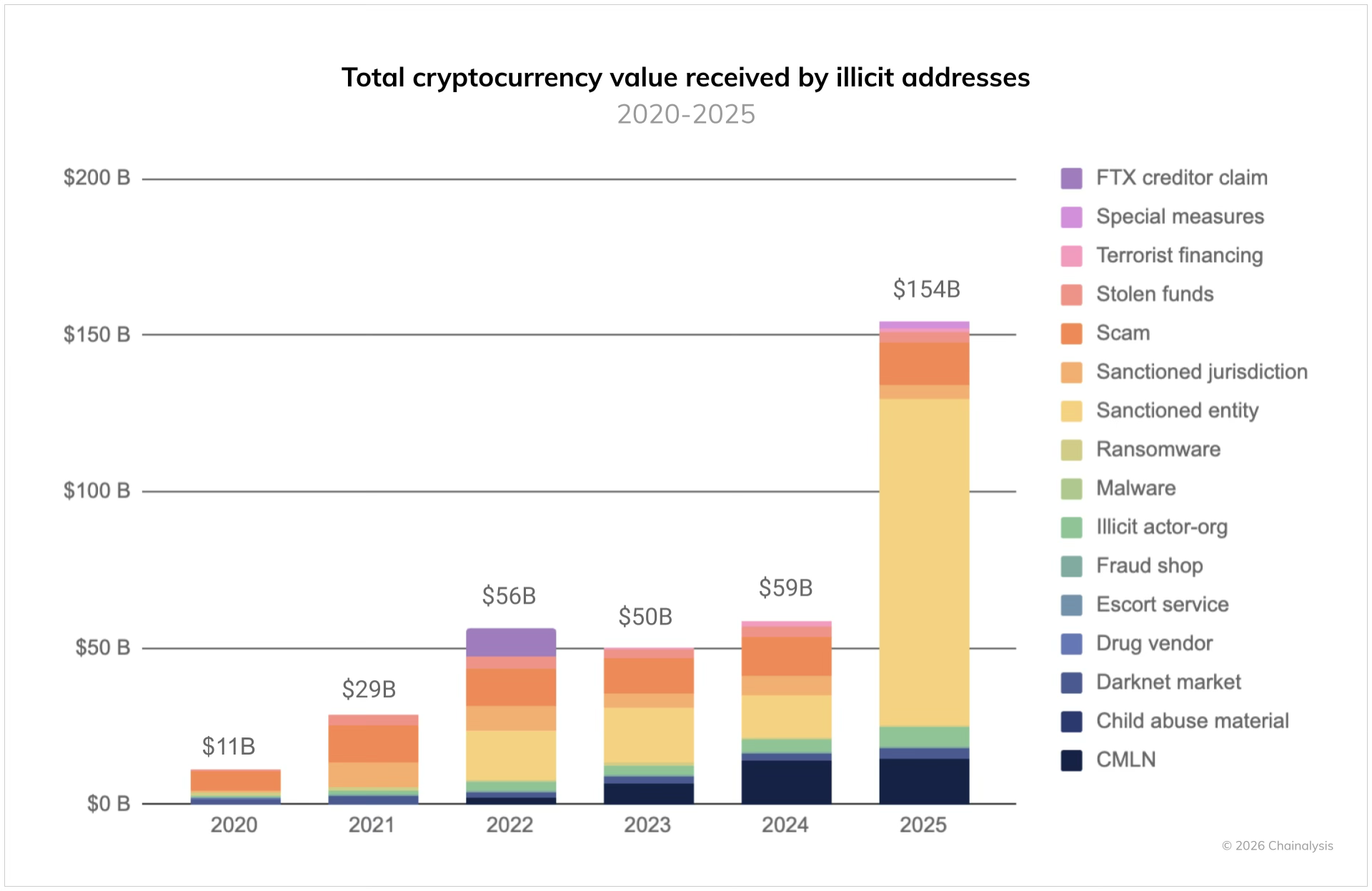
Oh, the tangled webs we weave! Cryptocurrency crime has reached stratospheric heights in 2025, with nefarious addresses raking in a jaw-dropping $154 billion-a 162% leap from the year before, as per the latest revelations from the illustrious oracle of blockchain analytics, Chainalysis.
The meteoric rise is largely attributed to a staggering 694% uptick in funds funneled to those oh-so-lucky sanctioned entities, heralding, according to our dear Chainalysis, a bold new epoch of “large-scale nation-state antics” within the shadowy realm of crypto crime. Who knew evading sanctions could be such a lucrative hobby? 💰
From Cybercriminals to Nation-States
Our report paints 2025 as the triumphant third wave of crypto crime evolution-imagine a bad sequel that somehow becomes a blockbuster! The first wave (2009-2019) was the playground of quirky cybercriminals; the second wave (2020-2024) ushered in the professionalization of these merry miscreants, engineering an on-chain infrastructure for their villainous enterprises. Now, behold the third wave: nation-states diving headfirst into this digital cesspool at scale, like seasoned lifeguards avoiding the water on a hot summer day.
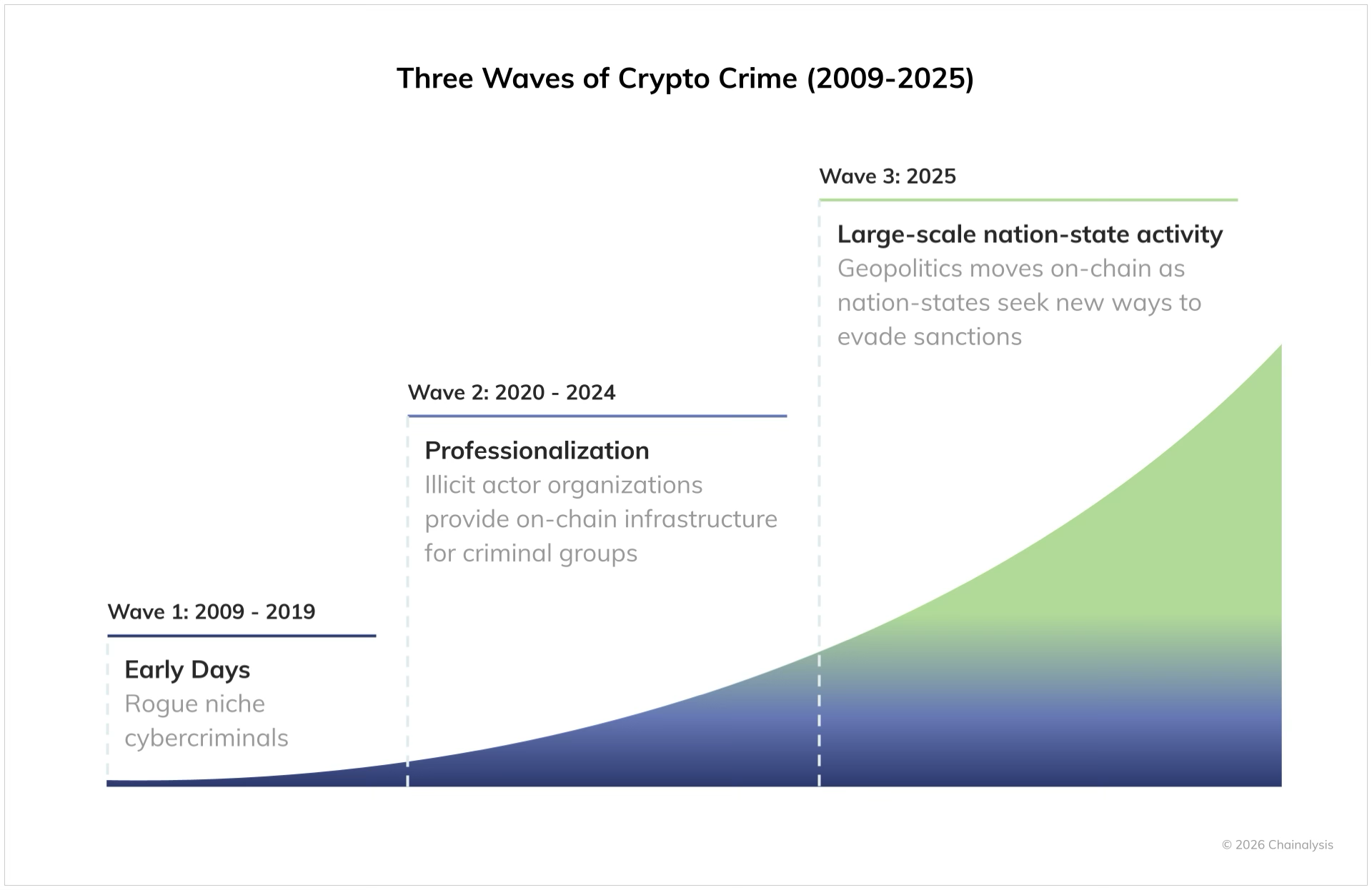
“As nation-states plug into the illicit crypto supply chains originally built for cybercriminals and organized crime groups, government agencies and compliance and security teams now face significantly higher stakes on both the consumer protection and national security fronts,” states the ever-pensive report. Ah, the irony! 🕵️♂️
Meanwhile, Russia, in a dazzling display of creative financial acrobatics, unveiled its ruble-backed A7A5 stablecoin in February 2025, boasting over $93.3 billion in transactions in less than a year-because who doesn’t love a good maneuver around sanctions? 🎩
Our friends from North Korea had their most destructive year yet, pilfering a remarkable $2 billion in 2025 alone. Their February Bybit exploit accounted for nearly $1.5 billion of that total, earning it the title of the largest digital heist in crypto history-move over, Ocean’s Eleven! 🏴☠️
As for Iran, its proxy networks orchestrated over $2 billion in money laundering, illicit oil sales, and weapons procurement through wallets that seem to have been designed by a mad scientist. Organizations including Hezbollah, Hamas, and the Houthis have taken to cryptocurrency like ducks to water-or should we say, like thieves to the night? 🦆💸
Stablecoins: The New Currency of Crime
Perhaps the most astonishing revelation from the data is the paradigm shift in criminal asset preferences, akin to a fashion week for rogues.
In 2020, Bitcoin was the darling of the illicit world, comprising roughly 70% of dirty deals, while stablecoins timidly occupied a mere 15%. Fast forward to 2025, and we’ve seen a dramatic role reversal: stablecoins now dominate with an impressive 84% of all illicit transaction volume, leaving Bitcoin-poor, forlorn Bitcoin-shrinking to a paltry 7%. Talk about a glow-up! 🌟
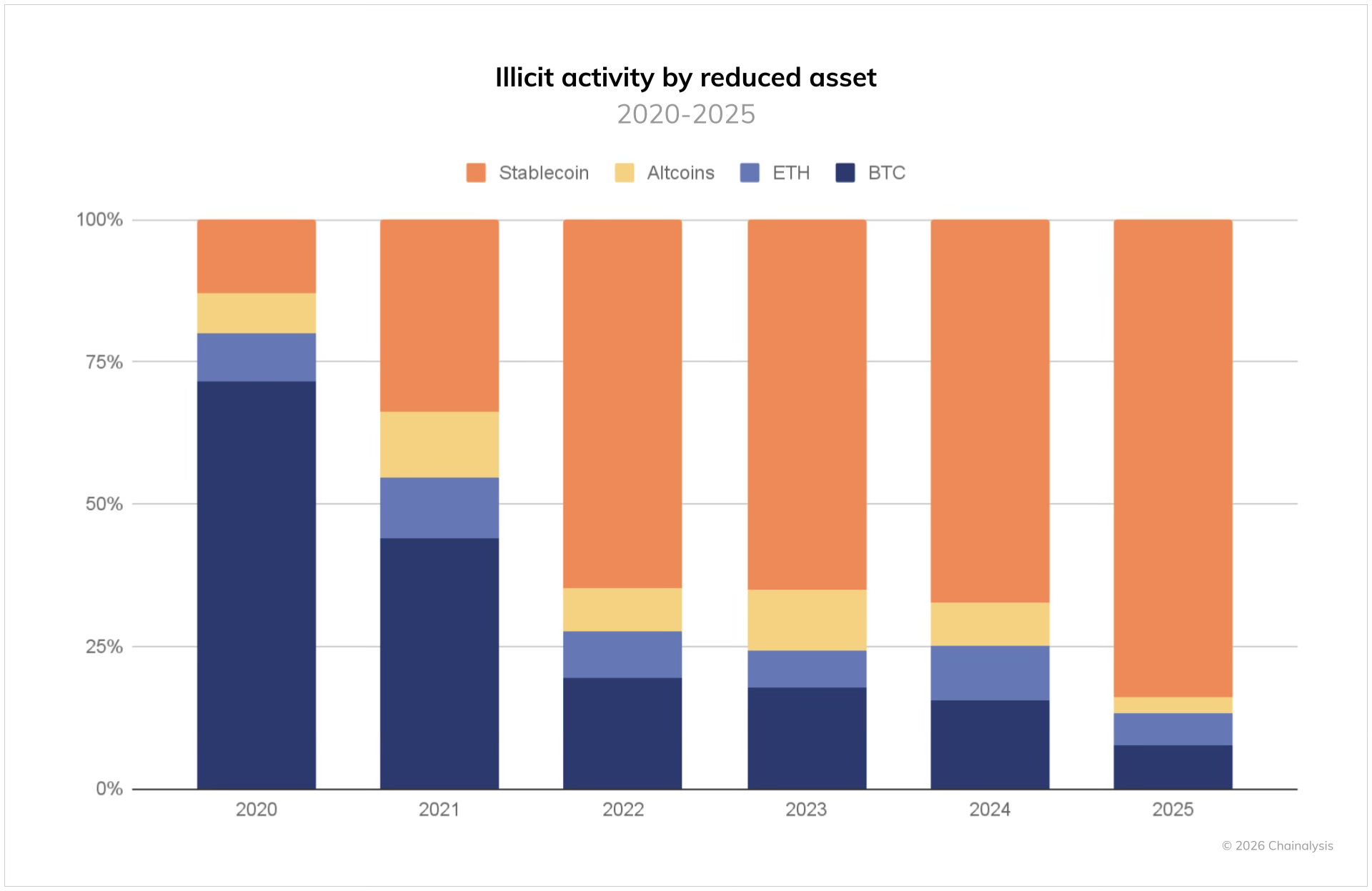
Chainalysis explains this seismic shift as a consequence of stablecoins’ practical perks: seamless cross-border transfers, delightful low volatility, and wider utility. It mirrors legitimate crypto activity, where stablecoins have similarly commandeered an increasing share of overall transaction volume-who knew criminals could be so practical? 🤔
Chinese Money Laundering Networks Emerge
The report brings to light the rise of Chinese Money Laundering Networks (CMLNs), now strutting their stuff as dominant players in the underworld. They’re the new kids on the block, offering “laundering-as-a-service” and other specialized criminal infrastructure, reminiscent of a boutique shop for nefarious deeds.
These full-service operations range from fraud and scams to laundering those sweet North Korean hacker profits, all while dodging sanctions like seasoned Olympians. 🏅
Chainalysis also warns of escalating connections between on-chain activities and acts of violent crime. Human trafficking operations are increasingly leveraging cryptocurrency, while “physical coercion attacks”-wherein unsavory characters force victims to transfer assets-have spiked sharply, often timed with those delightful cryptocurrency price peaks. What a time to be alive! 🙃
Context and Outlook
Despite these record figures, Chainalysis clarifies that illicit activity still represents a minuscule fraction-less than 1%-of all attributed crypto transaction volume. They also caution that the $154 billion figure is merely a “lower-bound estimate” based on identified illicit addresses so far. Oh, what a comforting thought!
Historical data reveals that crypto crime doesn’t always trend upward: volumes actually dipped from $56 billion in 2022 to $50 billion in 2023 during the notorious crypto winter. However, the 2025 explosion marks an undeniable shift in the threat landscape, like a plot twist no one saw coming.
“While the overall percentage of illicit activity remains small relative to legitimate crypto usage, the stakes have never been higher for maintaining the integrity and security of the cryptocurrency ecosystem,” Chainalysis concludes, calling for increased cooperation among law enforcement, regulators, and crypto businesses. In other words, everyone hold hands and sing Kumbaya! 🎶
Read More
- 20 Movies Where the Black Villain Was Secretly the Most Popular Character
- Celebs Who Narrowly Escaped The 9/11 Attacks
- 25 “Woke” Films That Used Black Trauma to Humanize White Leads
- Top 20 Dinosaur Movies, Ranked
- Transformers Under the Microscope: What Graph Neural Networks Reveal
- The 10 Most Underrated Jim Carrey Movies, Ranked (From Least to Most Underrated)
- 22 Films Where the White Protagonist Is Canonically the Sidekick to a Black Lead
- Silver Rate Forecast
- Gold Rate Forecast
- Trading on Thin Air: AI Agents Conquer Crypto Volatility
2026-01-08 16:44