Author: Denis Avetisyan
A new AI agent is automating the search for models explaining the universe’s earliest moments, potentially reshaping our understanding of cosmic origins.
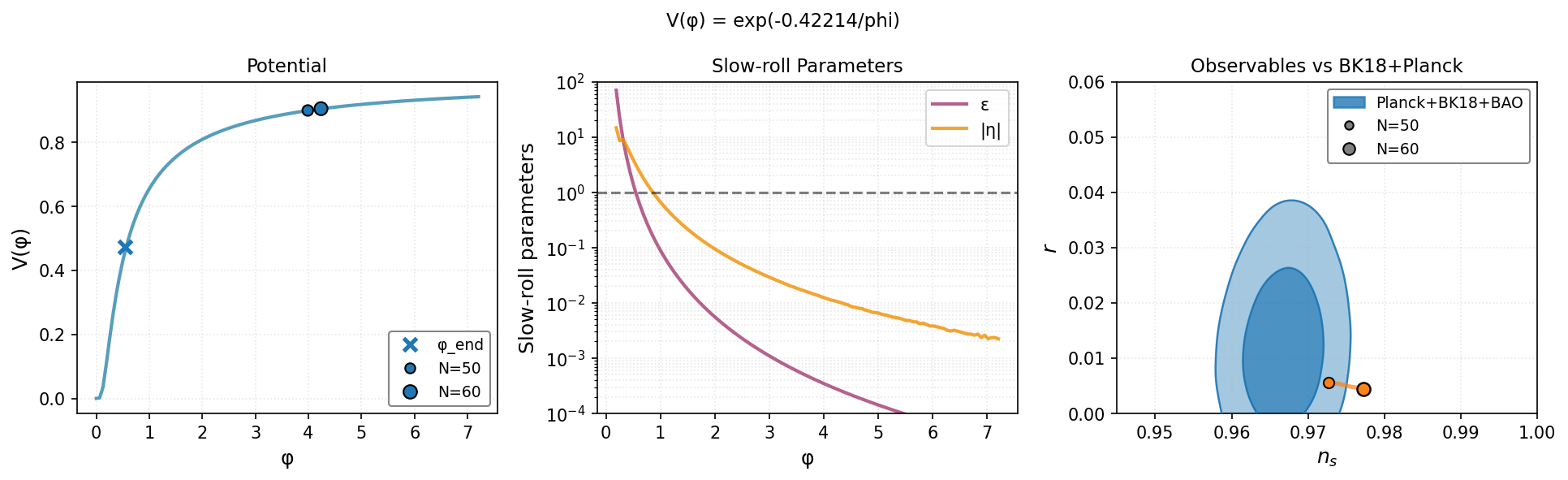
DeepInflation leverages large language models, symbolic regression, and a retrieval-augmented generation framework to discover and verify inflationary cosmology models.
The vast landscape of inflationary cosmology presents a significant challenge for model discovery and verification, demanding innovative approaches to navigate its complexity. This paper introduces DeepInflation: an AI agent for research and model discovery of inflation, a novel framework integrating large language models, symbolic regression, and a retrieval-augmented generation knowledge base to automate this process. DeepInflation successfully discovers viable single-field slow-roll inflationary potentials consistent with observational constraints-such as those from the ACT DR6-and provides contextual understanding of even obscure scenarios. Could this represent a paradigm shift towards autonomous scientific exploration in cosmology, empowering researchers and broadening access to complex theoretical landscapes?
The Universe’s Whispers: Seeds of Structure in Cosmic Inflation
The prevailing cosmological model, cosmic inflation, posits an epoch of extraordinarily rapid expansion in the universe’s earliest moments. This period wasn’t simply an enlargement of space, but a dramatic stretching that amplified quantum fluctuations – tiny, inherent uncertainties in the fabric of reality – to cosmic scales. These amplified fluctuations served as the initial “seeds” for all the structure observed today, from the vast cosmic web of galaxies to the subtle variations in the cosmic microwave background. Essentially, inflation predicts that the universe wasn’t perfectly uniform after the Big Bang; instead, it contained minute density differences, imprinted by these quantum seeds, which gravity then gradually sculpted over billions of years into the complex universe we inhabit. The remarkable aspect of this theory is its ability to explain the observed homogeneity and flatness of the universe, as well as the origin of the large-scale structure, all stemming from these microscopic quantum origins.
The universe’s earliest moments imprinted subtle fluctuations on the cosmic microwave background, patterns that cosmologists analyze to understand the inflationary epoch. A key parameter in this analysis is the scalar spectral index, n_s, which describes the scale-dependence of these primordial fluctuations. Current, highly precise measurements place this index at 0.974, with an uncertainty of only 0.003. This value, however, presents a significant challenge for many leading inflationary models, which typically predict values closer to unity. The discrepancy isn’t large enough to entirely rule out these models, but it demands refinement and encourages exploration of more complex inflationary scenarios capable of accommodating this nuanced observational constraint, pushing the boundaries of theoretical cosmology.
Current cosmological models attempting to describe the universe’s earliest moments face increasing scrutiny as independent datasets reveal subtle, yet significant, disagreements. Observations from the Planck satellite in 2018, providing a full-sky map of the cosmic microwave background, do not perfectly align with those from the Atacama Cosmology Telescope’s DR6 release, particularly when characterizing the fluctuations that ultimately grew into galaxies. This divergence suggests that relying on pre-defined theoretical frameworks may be limiting a complete understanding of cosmic inflation. Consequently, researchers are actively pursuing more adaptable, data-driven methodologies-allowing the data itself to guide model construction-rather than forcing observations to fit existing, potentially incomplete, paradigms. This shift promises a more robust and accurate picture of the universe’s inflationary epoch and its subsequent evolution, potentially revealing new physics beyond the standard models.
DeepInflation: An Automated Mirror to the Early Universe
DeepInflation operates as an autonomous agent within the field of early universe cosmology, specifically designed to investigate inflationary models. It achieves this through a process of automated hypothesis generation and testing, moving beyond traditional methods reliant on manually constructed potential functions. The agent employs advanced reasoning capabilities to navigate the parameter space of possible inflationary potentials, formulating and evaluating models without direct human intervention. This contrasts with typical cosmological simulations which often require pre-defined potentials; DeepInflation aims to discover these potentials algorithmically, searching for those consistent with observational data and theoretical constraints. The system’s autonomy is central to its design, allowing for the exploration of a wider range of potential solutions than would be feasible through manual analysis.
Symbolic Regression (SR) is employed within DeepInflation to derive explicit analytical forms for inflationary potentials, contrasting with traditional methods that rely solely on numerical simulations. This approach involves searching for mathematical equations – typically expressed as V(\phi) = a_0 + a_1\phi + a_2\phi^2 + \dots – that best fit the observational data derived from cosmic microwave background anisotropies and other cosmological probes. By recovering the functional form of V(\phi), SR enables direct analysis of model parameters, facilitates predictions about observable quantities, and provides insights into the underlying physics driving inflation, offering a more interpretable and efficient alternative to computationally intensive numerical approaches.
The Agno Framework serves as the foundational architecture for DeepInflation, implementing a multi-agent system designed for automated scientific discovery. This framework facilitates task decomposition into manageable sub-problems, enabling agents to independently execute specialized tools such as symbolic regression and numerical simulation. Agno manages inter-agent communication and data transfer, coordinating the workflow and ensuring efficient utilization of computational resources. Its planning module dynamically adjusts task prioritization based on intermediate results, allowing the system to explore the space of inflationary models with improved efficiency compared to traditional, monolithic approaches. The framework’s modular design allows for the seamless integration of new tools and algorithms as they become available, enhancing the system’s adaptability and long-term scalability.
Knowledge Integrated: Weaving Theory and Observation
DeepInflation leverages the Encyclopædia Inflationaris, a curated database containing a broad range of theoretical inflationary models and their associated parameters, to guide its search for viable cosmological solutions. This integration isn’t simply a lookup; the Encyclopædia Inflationaris provides a structured knowledge base that informs the model discovery process by offering a pre-existing landscape of possibilities and constraints. DeepInflation analyzes this data to prioritize model exploration, evaluate the plausibility of generated candidates against known scenarios, and identify potentially novel solutions that align with, or deviate from, established inflationary theory. The Encyclopædia Inflationaris effectively functions as a prior, improving the efficiency and interpretability of the model discovery process by focusing computational resources on a more informed search space.
Retrieval-Augmented Generation (RAG) is implemented to improve the reasoning capabilities of the system by providing access to and incorporation of external knowledge sources. This process involves retrieving relevant scientific literature and data based on the current reasoning task and then using this retrieved information to augment the generative process. By grounding responses in verifiable evidence, RAG mitigates the potential for hallucination and improves the factual accuracy and reliability of the system’s conclusions. The system dynamically accesses and integrates this external knowledge, allowing it to leverage a broader information base than what is contained within its internal parameters.
Symbolic Regression (SR) efficiency is significantly improved through the implementation of the PySR library, which provides optimized routines for model discovery and evaluation. Crucially, the Loss Function used in SR is optimized to accurately quantify the error between the model’s predictions and the target data. This optimization process, combined with PySR’s capabilities, enables DeepInflation to identify a viable potential inflationary model – a mathematical expression accurately representing the observed data – within a matter of minutes, a substantial reduction in computational time compared to traditional methods. The Loss Function’s accuracy is paramount; a well-defined Loss = \sum_{i=1}^{N} (y_i - \hat{y}_i)^2 ensures that the discovered model effectively captures the underlying relationships within the data.
Echoes Beyond the Standard Model: Dark Matter and the Universe’s Expansion
The search for dark matter may find answers in the earliest moments of the universe, specifically through the potential formation of Primordial Black Holes (PBHs). DeepInflation, a sophisticated computational approach, expands the scope of investigation into inflationary potentials – the theoretical drivers of the universe’s rapid expansion shortly after the Big Bang. By probing a broader range of these potentials, DeepInflation increases the likelihood of identifying conditions conducive to PBH formation. These hypothetical black holes, created not from stellar collapse but from density fluctuations in the early universe, represent a compelling dark matter candidate, and a refined understanding of inflationary dynamics, as offered by DeepInflation, is crucial for determining their abundance and characteristics. The ability to map a wider spectrum of inflationary scenarios provides a powerful tool for assessing whether PBHs could constitute a significant portion of the universe’s missing mass, potentially resolving one of cosmology’s most enduring mysteries.
The persistent Hubble Tension, a significant discrepancy between locally measured and early-universe-predicted expansion rates, may find resolution through a more nuanced understanding of the universe’s inflationary epoch. Current cosmological models struggle to reconcile these differing measurements, prompting investigation into alternative scenarios for the universe’s initial moments. By meticulously exploring a wider range of inflationary potentials – the theoretical driving force behind the universe’s rapid expansion – researchers aim to identify models that alleviate this tension. This approach doesn’t simply adjust existing parameters but fundamentally revises the framework for understanding cosmic evolution, potentially revealing previously unknown physics at play in the very early universe and offering a more accurate description of the universe’s expansion history. Successfully matching theoretical predictions to observational data could not only resolve the Hubble Tension but also provide crucial insights into the fundamental nature of dark energy and the composition of the cosmos.
Recent computational work utilizing DeepInflation has successfully identified a range of inflationary potentials that align with current observations of the universe’s earliest moments. Specifically, the analysis yielded scalar spectral indices-a measure of the initial fluctuations that seeded cosmic structure-ranging from 0.97271 to 0.97725, remarkably consistent with the established value of 0.974 ± 0.003. This precision is coupled with a correspondingly low tensor-to-scalar ratio, falling between 0.00442 and 0.00564, suggesting a relatively smooth period of expansion in the immediate aftermath of the Big Bang. These findings not only bolster the theoretical framework of cosmic inflation but also provide crucial constraints for models seeking to explain the universe’s composition and evolution, potentially offering insights into phenomena like dark matter and the persistent discrepancy known as the Hubble Tension.
The pursuit of inflationary cosmology, as detailed in this research, feels less like unveiling fundamental truths and more like constructing elaborate echoes. DeepInflation, an AI agent designed to navigate this complex theoretical landscape, diligently searches for models aligning with observable data. Yet, the very notion of a ‘correct’ model feels precarious. As Nikola Tesla observed, “The universe is an inexhaustible source of energy, but our understanding of it is limited.” This agent, while impressive in its automation of model discovery and verification, operates within the confines of current knowledge, a knowledge perpetually threatened by the event horizon of the unknown. Any model, however elegant, remains a transient approximation, vulnerable to the next observation that reveals its incompleteness. The search continues, but the destination – absolute understanding – remains perpetually beyond reach.
What Lies Beyond the Horizon?
The automation of cosmological model discovery, as demonstrated by DeepInflation, presents a peculiar paradox. Each successful retrieval of a slow-roll potential, each proposed genesis for primordial black holes, feels less like an unveiling and more like a refinement of the questions it avoids. The agent excels at navigating the known landscape, yet the most interesting features likely reside beyond its current map – beyond the reach of its training data, or perhaps beyond the limits of symbolic representation itself.
Future iterations will undoubtedly increase the sophistication of the knowledge base and the symbolic regression algorithms. But a more fundamental challenge remains: the very act of translating the universe into a tractable model introduces a bias, a simplification. Each measurement is a compromise between the desire to understand and the reality that refuses to be understood. The agent, for all its power, remains tethered to the assumptions embedded within its design.
Perhaps the true progress lies not in building ever-more-complex agents, but in cultivating a more profound awareness of their limitations. It is a humbling realization: the universe does not yield its secrets easily, and the tools built to decipher them may ultimately reveal more about the builder than the built. One does not uncover the universe – one tries not to get lost in its darkness.
Original article: https://arxiv.org/pdf/2601.14288.pdf
Contact the author: https://www.linkedin.com/in/avetisyan/
See also:
- Top 20 Dinosaur Movies, Ranked
- 20 Movies Where the Black Villain Was Secretly the Most Popular Character
- 25 “Woke” Films That Used Black Trauma to Humanize White Leads
- Silver Rate Forecast
- Gold Rate Forecast
- Spotting the Loops in Autonomous Systems
- From Bids to Best Policies: Smarter Auto-Bidding with Generative AI
- Celebs Who Narrowly Escaped The 9/11 Attacks
- 22 Films Where the White Protagonist Is Canonically the Sidekick to a Black Lead
- Can AI Lie with a Picture? Detecting Deception in Multimodal Models
2026-01-22 07:29