Taming Shifting Data: A New Approach to Adaptive Filtering

Researchers have developed a novel framework that leverages overparameterization to achieve stable and efficient online learning in dynamic, real-world time series.
Researchers have developed a novel framework that leverages overparameterization to achieve stable and efficient online learning in dynamic, real-world time series.
This review explores the diverse landscape of regularization techniques used to improve the performance and reliability of deep learning models.
A new unsupervised learning method uses synthetic data to sharpen the detail in hyperspectral images, offering a path to higher-resolution remote sensing without relying on labeled datasets.
![The Agent Payment Protocol (AP2) [2] establishes a standardized framework for secure and reliable financial transactions between agents.](https://arxiv.org/html/2601.22569v1/Picture1.png)
Researchers have discovered vulnerabilities in Google’s Agent Payments Protocol that could allow malicious actors to siphon funds through cleverly crafted prompts.
![A discrepancy in color feature map characteristics-specifically, the difference between negative log-likelihood [latex]NLL[/latex] and entropy [latex]H[/latex]-effectively distinguishes photographic images from those generated by AI on the GenImage dataset, as demonstrated by a clear separation in anomaly score distributions computed using DCCT trained solely on photographic content.](https://arxiv.org/html/2601.22778v1/x3.png)
A new technique leverages subtle color patterns inherent in real camera sensors to reliably identify images created by artificial intelligence.
![The Inverse Quantile Graph (InvQG) method maps synthetic time series data to quantile graphs, a technique adapted from prior work [Campanharo et al., 2011] and suggesting that complex system behavior can be understood through the distribution of its constituent events.](https://arxiv.org/html/2601.22879v1/inverse_ts_mapping_qg.png)
A new method leverages the principles of network science to create synthetic time series data, offering a compelling alternative to computationally intensive deep learning approaches.
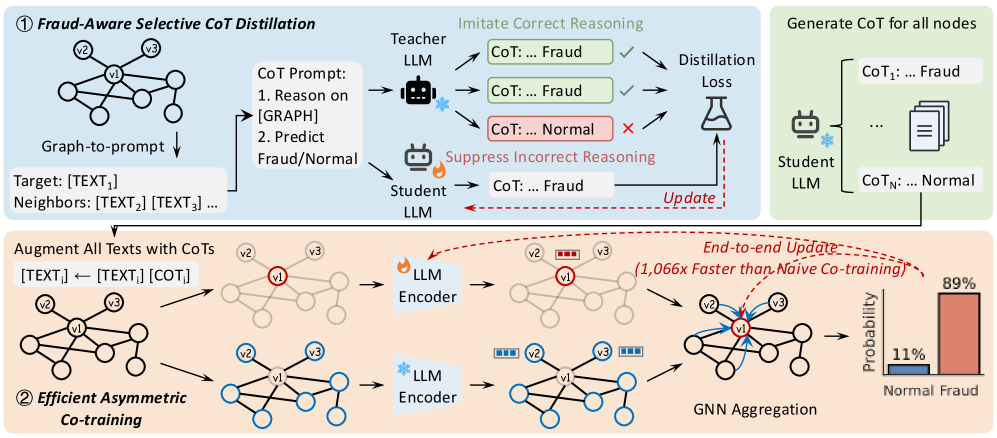
A new approach combines the power of artificial reasoning with graph networks to identify fraudulent activity in complex, text-rich data.

A new forecasting approach decouples prediction horizons to achieve more stable and accurate long-term time series analysis.
A new analysis reveals that while AI-powered search summaries initially boost user experience, they risk stifling content creation and, ultimately, search engine revenue.
A new artificial intelligence framework is unlocking centuries of hidden climate data from historical Chinese records, providing an unprecedented look at past weather patterns.