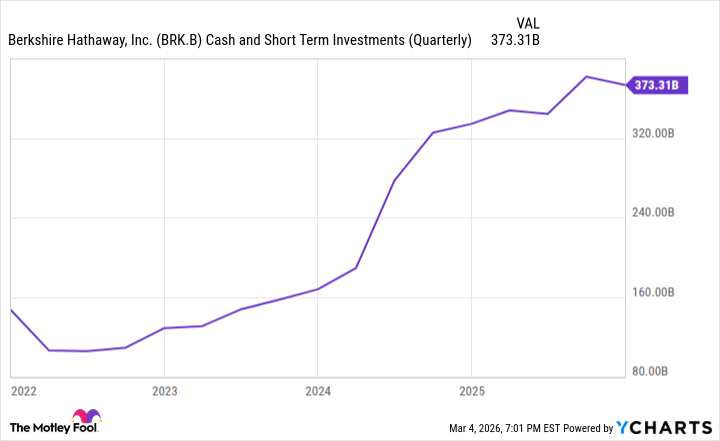
Buffett walked away from Berkshire Hathaway at the end of ’25, leaving behind a pile of cash that could choke a horse – $373.3 billion, give or take. He wasn’t buying, not much, even as the market climbed like a desperate man on a ladder. That struck me as odd. The Oracle doesn’t usually leave loose ends. It smelled like a warning.
The Numbers Talk, If You Listen
In ’24 alone, Berkshire shed about $134 billion in equities. Just dumped it. Apple, Bank of America, even Amazon took a haircut – a 77% trim on the latter in the fourth quarter. That’s not pruning, that’s a shearing. Meanwhile, the cash hoard grew. From $128.6 billion in ’22, it ballooned to that obscene $373.3 billion. It wasn’t just caution; it was a fortress being built, brick by slow, deliberate brick.
The Old Man’s View
In his last letters, Buffett compared the market to a casino. Said it had more in common with a rigged game than a rational exchange. He wasn’t impressed with the new breed of investor, the ones chasing hype and fueled by algorithms. He wasn’t interested in feverish activity. Berkshire would never risk permanent loss of capital, he wrote. That’s a line in the sand, a promise kept.
He saw the AI frenzy, the willingness to pay any price for future promises, the instability simmering under the surface. He saw the market stretched thin, a rubber band pulled too tight. It wasn’t a prediction, exactly. It was a reckoning he expected, and was preparing for.
The Playbook
If Buffett suspected a coming storm, a “conflagration” as he called market crashes, this makes a kind of grim sense. Locking in profits and building a cash reserve isn’t just defense; it’s a power play. It’s the way he navigated the ’08 crisis, stepping in when others were running scared.
He deployed roughly $14.5 billion into Goldman Sachs, GE, and Bank of America. He got terms nobody else could, because he was the only one with both the capital and the nerve. The Goldman deal alone generated around $3.1 billion. The Bank of America warrants eventually became a $12 billion gain. He wasn’t waiting for the rescue; he was the rescue.
The Other Side of the Coin
There’s a softer interpretation, of course. Maybe Buffett was simply handing his successor, Greg Abel, a blank check, a war chest to build his own legacy. Abel’s first letter emphasized flexibility, the ability to “respond swiftly when opportunities arise.” That’s a polite way of saying “do whatever you want.”
And let’s be honest, Berkshire is so massive, moving the needle requires a lever the size of a battleship. Accumulating cash might just be the default position when you’re managing hundreds of billions. Or maybe the old man simply made a mistake. Kraft Heinz and those airline stocks come to mind. Even the Oracle isn’t immune to bad calls.
What It Means for You
I can’t claim to know Buffett’s mind, not for certain. But I suspect he had serious reservations about the market before he stepped down. That doesn’t mean you should panic. Take a hard look at your portfolio. Ask yourself if you believe in the companies you own, if they can survive a downturn. And remember, a little cash on hand never hurt anyone. It’s a life raft in a sea of trouble, and Buffett, even in retirement, understood that better than most.
Read More
- Invincible Season 4 Gender Swaps Tech Jacket As Fans Question Major Comic Change
- Silver Rate Forecast
- Gold Rate Forecast
- Building Agents That Learn and Improve Themselves
- 22 Films Where the White Protagonist Is Canonically the Sidekick to a Black Lead
- 15 Films That Were Shot Entirely on Phones
- 20 Movies Where the Black Villain Was Secretly the Most Popular Character
- Celebs Who Narrowly Escaped The 9/11 Attacks
- Games That Faced Bans in Countries Over Political Themes
- 14 Movies Where the Black Character Refuses to Save the White Protagonist
2026-03-15 22:03