Author: Denis Avetisyan
A new approach leverages the dynamics of gradient flow to intelligently prune connections and route information, surpassing traditional methods focused solely on weight size.

This review details how decoupling gradient magnitude from learning potential using Alternating Gradient Flows enables a unified framework for structural pruning and dynamic routing in deep neural networks.
While contemporary deep learning relies heavily on magnitude-based metrics for network compression, these methods often fail to preserve critical functional pathways during structural pruning and dynamic routing. This work, ‘Alternating Gradient Flow Utility: A Unified Metric for Structural Pruning and Dynamic Routing in Deep Networks’, introduces a decoupled kinetic paradigm leveraging Alternating Gradient Flows (AGF) to define a network’s structural ‘kinetic utility’ – focusing on dynamic learning potential rather than static weight amplitude. By uncovering a topological phase transition at extreme sparsity and addressing a sparsity bottleneck in Vision Transformers, we demonstrate improved efficiency and Pareto-optimal performance on large-scale benchmarks. Can this AGF-guided approach unlock a new era of truly adaptive and resource-efficient deep learning architectures?
The Efficiency Bottleneck: A Whisper of Chaos
Deep neural networks, despite their remarkable capacity for complex pattern recognition, frequently exhibit computational redundancy as their architectures expand. This inefficiency stems from the sheer number of parameters and operations required to process information, leading to significant scaling challenges. As models grow deeper and wider to achieve higher accuracy, the computational cost increases disproportionately, often exceeding the benefits of added complexity. This phenomenon isn’t simply a matter of needing more powerful hardware; it represents a fundamental limitation in how these networks utilize their resources, hindering the possibility of deploying advanced AI on devices with limited processing power and energy budgets. Consequently, researchers are increasingly focused on strategies to streamline these networks, seeking methods to maintain performance while substantially reducing their computational footprint and enabling wider accessibility.
Conventional methods for shrinking the size of deep neural networks frequently prioritize the removal of connections with small weights, operating under the assumption that less influential parameters can be safely discarded. However, this magnitude-based pruning often overlooks the dynamic interplay of activations within the network, failing to recognize that even seemingly insignificant connections can play a critical role in propagating information for specific inputs or tasks. Consequently, crucial activation patterns and the underlying structural importance of certain connections are lost, leading to a disproportionate performance drop, especially when dealing with complex datasets or nuanced feature representations. A more holistic approach is needed, one that considers not just the size of a weight, but its functional role within the network’s overall computational graph.
The escalating computational demands of deep neural networks present a significant obstacle to their widespread adoption, particularly in scenarios defined by limited resources. While model accuracy continues to improve, the associated increase in parameters and operations frequently exceeds the capabilities of edge devices like smartphones, embedded systems, and IoT sensors. This discrepancy restricts the deployment of sophisticated AI solutions to cloud-based infrastructure, introducing latency and privacy concerns. Consequently, the potential for real-time applications-such as autonomous driving, augmented reality, and personalized healthcare-remains largely untapped, as immediate responsiveness and on-device processing are crucial for optimal performance and user experience. Addressing this efficiency bottleneck is therefore paramount to unlocking the full transformative power of deep learning across a broader range of applications and platforms.

Beyond Static Pruning: Sculpting Dynamic Efficiency
Alternating Gradient Flows (AGF) represent a departure from static pruning methods in neural network optimization by establishing a dynamic spatial criterion for structural efficiency. Traditional static pruning techniques assess and remove network weights based on a fixed metric calculated at a single point in training. In contrast, AGF iteratively refines this criterion by alternating between gradient descent on network weights and gradient ascent on a structural efficiency parameter. This allows the network to adapt its structure during training, effectively learning which connections are most crucial for performance and minimizing redundancy. The framework reconstructs an efficiency landscape that is responsive to the evolving dynamics of learning, potentially leading to more robust and performant networks compared to those obtained through static methods.
The Alternating Gradient Flows (AGF) Utility metric provides a quantitative assessment of a neural network’s learning capacity by moving beyond simple magnitude-based evaluations. This metric explicitly accounts for topological phase transitions occurring within the loss landscape during training, recognizing that network performance isn’t solely determined by reaching a minimum, but also by the path taken and the landscape’s characteristics. Furthermore, the AGF Utility incorporates the impact of stochastic gradient descent (SGD) noise as a form of implicit regularization; this noise, while seemingly detrimental, can prevent overfitting and promote generalization by effectively smoothing the optimization trajectory and altering the network’s final configuration. The resulting utility value, therefore, reflects not just the achieved performance but also the network’s inherent adaptability and robustness to noise, offering a more holistic measure of learning potential.
Accurate quantification of Alternating Gradient Flow (AGF) utility – a measure of a network’s learning potential – is complicated by the phenomenon of signal compression. During dynamic AGF analysis, signals representing structural changes can experience a reduction in magnitude, leading to an underestimation of the actual physical cost ratio associated with those changes. This compression arises from the inherent limitations in representing complex, high-dimensional structural modifications with finite precision, effectively masking the true energetic cost of network adaptation and potentially biasing evaluations of structural efficiency. Consequently, observed AGF utility values may not fully reflect the genuine trade-off between performance gains and physical cost, necessitating careful consideration when interpreting results and designing structurally efficient networks.

Decoupling Topology: A Kinetic Approach to Adaptation
The Decoupled Kinetic Paradigm utilizes a hybrid routing framework by distinguishing between the static construction of a neural network’s topology and its dynamic execution. Offline topology construction involves pre-defining a broad network structure and potential pathways, allowing for exploration of diverse architectural configurations without incurring runtime overhead. This pre-defined topology is then leveraged during online dynamic execution, where input-dependent routing mechanisms determine the active pathways. This separation enables the network to adapt its computational graph at inference time, selectively activating portions of the pre-defined topology based on input characteristics, without requiring architectural changes during the execution phase. The result is a system that combines the benefits of static graph optimization with the flexibility of dynamic computation.
Dynamic Neural Networks adjust computational workload based on input characteristics through techniques such as Mixture-of-Experts (MoE) and Early Exiting. MoE architectures employ multiple sub-networks (“experts”), selectively activating only those most relevant to a given input, thereby reducing overall computation. Early Exiting allows a network to terminate processing an input before reaching the final layer if a sufficient confidence level is achieved at an intermediate stage. These methods enable conditional computation, meaning that simpler inputs require fewer operations while complex inputs can utilize the full network capacity, leading to improved efficiency and reduced latency without necessarily sacrificing accuracy.
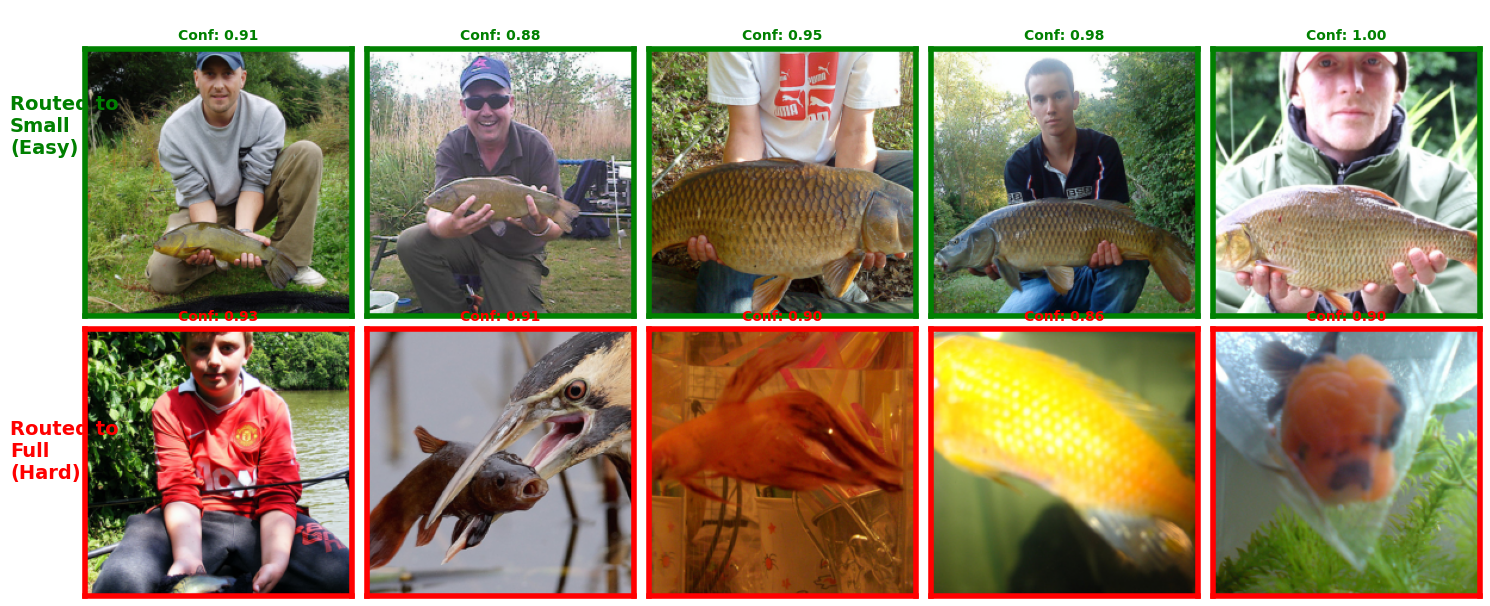
Within the decoupled kinetic paradigm, confidence scores generated during inference are utilized as a zero-cost prior to direct dynamic execution. These scores, representing the model’s certainty in its predictions, are used to selectively activate or deactivate computational pathways without introducing additional overhead. Specifically, higher confidence scores indicate less need for deeper processing, enabling the network to exit early or bypass certain modules, while lower scores trigger more extensive computation. This confidence-guided routing optimizes resource allocation by focusing computational effort on inputs requiring it most, reducing overall latency and energy consumption without requiring explicit retraining or architectural modifications.

From Static to Adaptive: A Chronicle of Pruning Techniques
Traditional channel pruning methods, such as Optimal Brain Damage (OBD) and Optimal Brain Surgeon (OBS), generally assess network saliency through second-order derivative information of the loss function with respect to network weights. Activation-aware pruning techniques, including Wanda and RIA, improve upon these methods by incorporating activation statistics during the pruning process. Specifically, these techniques analyze the distribution of activations to identify and remove channels with minimal impact on overall performance, often focusing on outlier activations or those exhibiting low signal-to-noise ratios. This contrasts with OBD and OBS, which primarily rely on weight magnitude as a proxy for importance. By considering activation patterns, Wanda and RIA can achieve higher sparsity levels without significant accuracy degradation, particularly in over-parameterized models.
Activation-aware pruning methods demonstrate increased efficacy within Large Language Models (LLMs) by identifying and removing redundant parameters based on the distribution of neuron activations. These techniques move beyond magnitude-based pruning by analyzing activation patterns during forward passes, specifically targeting outlier activations – those neurons that exhibit significantly higher or lower activity compared to the average. The rationale is that these outlier activations often indicate neurons contributing disproportionately to the model’s output, or conversely, those rarely engaged and therefore representing redundant capacity. By prioritizing the removal of connections associated with these outlier activations, models can achieve greater sparsity with minimal impact on performance, leading to reduced computational cost and memory footprint without significant accuracy degradation.
The Lottery Ticket Hypothesis posits that within a randomly initialized, densely connected neural network, there exists a sparse subnetwork – a “winning ticket” – capable of achieving comparable or superior performance to the original dense network when trained in isolation from its initial weights. This hypothesis is verified by iteratively pruning weights from a network, retraining the remaining connections, and repeating the process; the resulting sparse networks often demonstrate training curves comparable to those achieved when training the full, dense network. Importantly, these “winning tickets” can be identified early in training, and when re-initialized with the original weights and trained from scratch, consistently outperform other randomly selected subnetworks of the same size, validating the notion that sparsity is not merely a byproduct of training but a fundamental property beneficial for optimization and generalization.
The Horizon: Pruning in a Transformer-First World
Vision Transformers, unlike their convolutional counterparts, initially lack the inherent structural biases that facilitate effective pruning; this presents a significant challenge known as the Sparsity Bottleneck. Traditional pruning techniques, designed to remove redundant connections based on magnitude or other static metrics, often disrupt the carefully learned relationships within these transformers. Because Vision Transformers rely more heavily on attention mechanisms to establish feature dependencies – rather than the localized connectivity of convolutions – indiscriminately removing connections can lead to a disproportionate loss of representational capacity. This is because each attention head dynamically computes relationships across the entire input, meaning even seemingly unimportant connections may contribute to crucial feature interactions; thus, standard pruning methods struggle to identify truly redundant parameters without severely degrading performance, requiring new strategies specifically tailored to the unique architecture and dynamic nature of transformers.
Effective pruning of Vision Transformers hinges on moving beyond static assessments of neural network importance and embracing a concept of dynamic utility – recognizing that a connection’s value isn’t fixed, but shifts with evolving input data and network states. Current pruning strategies often fail because they don’t account for this fluidity, leading to the removal of connections crucial for handling diverse or novel scenarios. Consequently, researchers are exploring innovative approaches to topology construction – methods that don’t simply eliminate connections, but actively reshape the network’s architecture to maintain or even enhance performance with fewer parameters. This involves developing algorithms that can intelligently rewire connections, create new pathways, and adapt the network’s structure on the fly, effectively building a more resilient and efficient model capable of generalizing well across a broad range of inputs.
The future of deep learning increasingly hinges on its ability to operate efficiently within resource limitations, and continued advancements in dynamic neural networks and adaptive pruning techniques are poised to be central to this evolution. These methods move beyond static network architectures, enabling models to adjust their structure and computational demands in real-time, based on input data and available resources. By intelligently eliminating redundant connections and activating only essential parameters, adaptive pruning minimizes computational overhead and memory footprint without significantly sacrificing performance. This is particularly critical for deployment on edge devices, mobile platforms, and in data centers striving for energy efficiency. Further research focusing on algorithms that can dynamically reshape networks – growing, shrinking, and reorganizing connections – promises to unlock even greater potential, allowing deep learning models to become more versatile, sustainable, and accessible across a wider range of applications.
The pursuit of neural efficiency, as detailed in this work on Alternating Gradient Flows, feels less like optimization and more like coaxing a chaotic system. It observes that static weight magnitude is a poor proxy for genuine learning potential, a notion echoing a sentiment expressed by Geoffrey Hinton: “The problem with deep learning is that it’s a black box.” This isn’t a failure of the model, but a consequence of attempting to impose order on inherently unpredictable processes. The decoupling of gradient magnitudes from feature learning potential, a core tenet of the paper, acknowledges this fundamental uncertainty. It suggests that the true measure of a network isn’t its present state, but its capacity for dynamic adaptation-a spell that holds, not through rigid structure, but through flexible persuasion.
What’s Next?
The decoupling of gradient magnitude from kinetic potential, as demonstrated by this work, feels less like an answer and more like a well-aimed question at the heart of network learning. The observed improvements in structural pruning and dynamic routing are… predictable. Anything that survives optimization is, by definition, less interesting than what did not. The true test will be how readily this ‘Alternating Gradient Flow’ succumbs to the inevitable curse of dimensionality as models scale. Any metric that claims unification deserves suspicion – the universe prefers fragmentation.
The notion of a ‘topological phase transition’ in gradient space is a compelling narrative, though one suspects such transitions are merely artifacts of the chosen observation window. A more pressing concern remains: what happens when this framework encounters genuinely adversarial perturbations? A network optimized for graceful degradation under known constraints is still a brittle construct. The real chaos lies not in the weights themselves, but in the data that seeks to corrupt them.
Future work will undoubtedly focus on extending this decoupled paradigm to more complex architectures. But perhaps a more fruitful avenue lies in embracing the inherent messiness of learning. Any system that can perfectly predict its own failure is not learning – it’s memorizing. The ultimate challenge isn’t building more efficient networks, but building ones that are gracefully, beautifully, and unpredictably wrong.
Original article: https://arxiv.org/pdf/2603.12354.pdf
Contact the author: https://www.linkedin.com/in/avetisyan/
See also:
- Invincible Season 4 Gender Swaps Tech Jacket As Fans Question Major Comic Change
- Silver Rate Forecast
- Gold Rate Forecast
- Building Agents That Learn and Improve Themselves
- 22 Films Where the White Protagonist Is Canonically the Sidekick to a Black Lead
- 15 Films That Were Shot Entirely on Phones
- 20 Movies Where the Black Villain Was Secretly the Most Popular Character
- Celebs Who Narrowly Escaped The 9/11 Attacks
- Games That Faced Bans in Countries Over Political Themes
- 14 Movies Where the Black Character Refuses to Save the White Protagonist
2026-03-16 14:51