
Many years later, as the rain tasted of iron and the scent of damp earth clung to the ledgers, old Manolo remembered the year the numbers began to whisper of decline, a year not so different from any other, save for the peculiar stillness that settled over Omaha, a stillness that foreshadowed a quiet season for the House of Hathaway. It was a stillness that spoke not of ruin, but of a necessary pause, a moment for the river to find a new course, even as the crocodiles slept beneath the surface. The reports arrived, as they always did, bearing the weight of billions, yet carrying within them a subtle tremor, a hint that the usual abundance had diminished, a loss of ten billion dollars, a sum large enough to build a city, but small enough to be absorbed by the vastness of the empire. And yet, the whispers persisted, speaking of a downturn, a 30% drop in operating earnings, a fall from grace that, to the uninitiated, might seem catastrophic, but to those who knew the rhythms of the market, felt more like a seasonal shedding of leaves.
The new captain, Abel, a man of quiet competence, inherited this subdued landscape. Some spoke of an inauspicious start, a shadow cast upon his leadership. But the market, like a seasoned gambler, understands that fortunes ebb and flow, that even the most formidable empires experience moments of quietude. It’s a truth as old as the hills, as inevitable as the turning of the seasons. The numbers, however, demanded scrutiny, revealing a contraction not merely in earnings, but in the very essence of what had driven Berkshire’s ascent. The insurance business, once a relentless engine of profit, had begun to yield a smaller harvest, a consequence of years of extraordinary growth, a growth that, like all things, could not last forever.
To compare this present moment to the years past, however, is to invite a distortion, a misreading of the signs. The previous year had been an anomaly, a burst of improbable fortune, a windfall that had inflated expectations and obscured the underlying realities. To measure the current performance against that peak is to set an impossible standard, to demand that the river flow ever upward, defying the laws of gravity. The true measure lies not in the absolute numbers, but in the long-term trajectory, in the resilience of the underlying businesses, in the ability to adapt to the changing tides. The chart, a sprawling tapestry of lines and figures, told a story of cyclical patterns, of inevitable fluctuations, of a business that, despite the recent setbacks, remained remarkably robust.
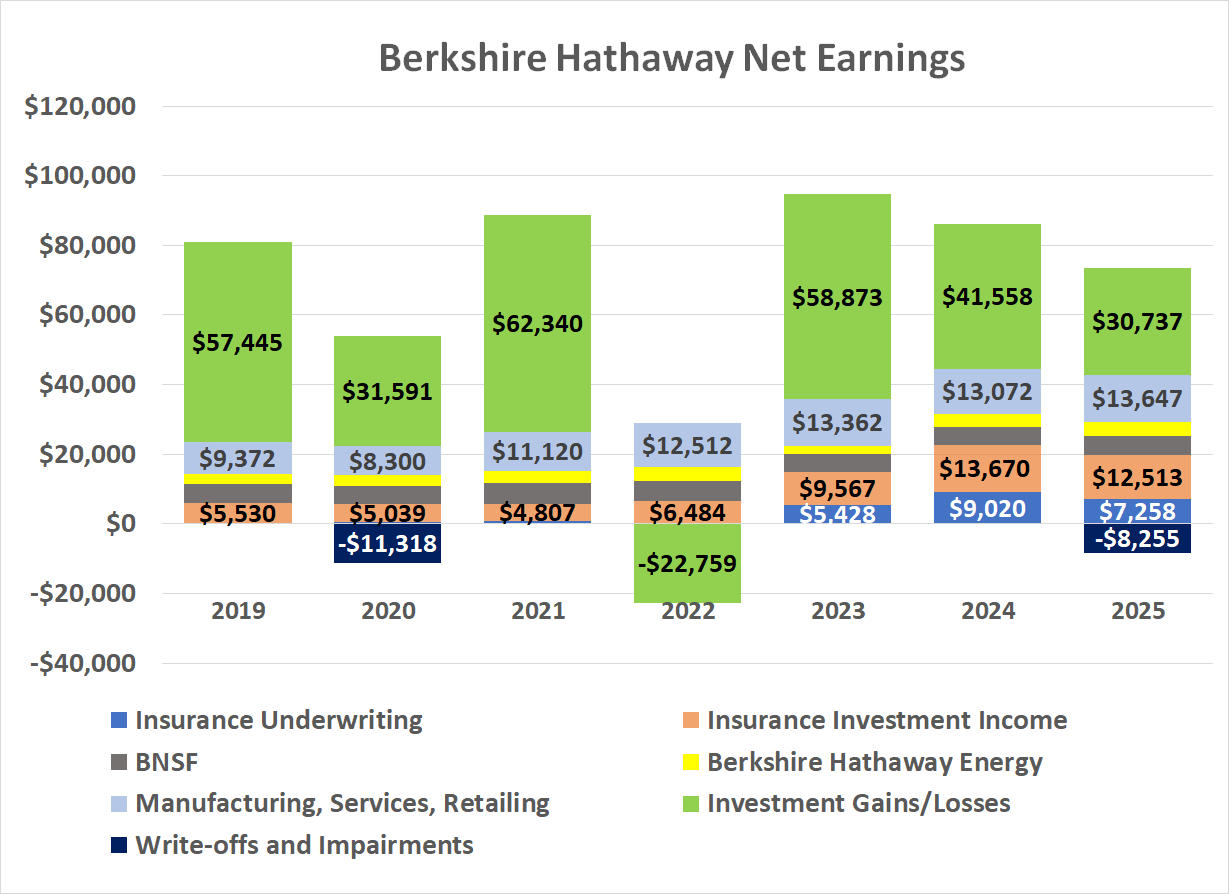
Much of the recent deceleration, it was said, stemmed from a deliberate pruning of the portfolio, a strategic withdrawal from certain investments. The old man, Buffett, had begun to shed holdings, to accumulate a vast hoard of cash, a fortress against the uncertainties of the future. It was a decision that, while prudent, inevitably dampened the immediate returns. Less money in the market, of course, meant fewer opportunities to reap profits, even as the market itself continued to climb. And then there was the matter of Bank of America, a once-favored son, now slowly relinquished, a parting of ways that cost Berkshire a significant stream of dividend income. It was a decision whispered about in the corridors of power, a symbol of a changing guard, a shifting of allegiances.
New dividends, however, were sought, a trickle of income from Domino’s Pizza and Chubb, attempts to offset the loss, to fill the void left by the departing giant. But the sums were modest, insufficient to restore the former abundance. And then there were the impairments, the write-downs on Kraft Heinz and Occidental Petroleum, unexpected expenses that further clouded the picture. These were the ghosts of past ventures, reminders that even the most astute investors are not immune to the vagaries of fate.
The insurance business, the heart of the empire, was feeling the strain, buffeted by unpredictable weather patterns, by the rising costs of claims. It was a battle against the elements, a struggle to maintain profitability in the face of mounting risks. Abel, the new captain, understood this challenge, knew that he would have to navigate these turbulent waters with skill and determination. The pricing had to remain competitive, yet the payouts had to be managed with care. It was a delicate balancing act, a constant negotiation with the forces of nature.
But the insurance business, like the river itself, is self-correcting. Prices will adjust, payouts will stabilize, and the long-term averages will eventually prevail. It is a truth as old as the hills, a rhythm as predictable as the changing of the seasons. And for those who understand this rhythm, the recent pullback in the stock price is not an omen of doom, but an opportunity to acquire a piece of a timeless empire, a share in a legacy that will endure long after the rain has stopped and the sun has returned.
Read More
- Top 20 Dinosaur Movies, Ranked
- 20 Movies Where the Black Villain Was Secretly the Most Popular Character
- 25 “Woke” Films That Used Black Trauma to Humanize White Leads
- Celebs Who Narrowly Escaped The 9/11 Attacks
- Silver Rate Forecast
- Gold Rate Forecast
- Spotting the Loops in Autonomous Systems
- From Bids to Best Policies: Smarter Auto-Bidding with Generative AI
- 22 Films Where the White Protagonist Is Canonically the Sidekick to a Black Lead
- Can AI Lie with a Picture? Detecting Deception in Multimodal Models
2026-03-06 02:52