
I remember when Star Trek: The Next Generation first came out in 1987 – a lot of us longtime Star Trek fans weren’t thrilled! It felt wrong to have a new Enterprise crew trying to live up to the original team of Kirk, Spock, and the others. But TNG really proved itself, running for seven seasons and 178 episodes, and it eventually became a classic. Now, a lot of people think it’s the best Star Trek series ever. So, I’ve been thinking – which season was truly the greatest? I decided to rank all seven seasons, from the weakest to the absolute best.
7. Season 1 (1987-1988)
As a huge fan of The Next Generation, it’s honestly amazing the show went on to have seven seasons after that rocky start! The first season was apparently a real mess behind the scenes. While the cast was fantastic and it looked great, creator Gene Roddenberry was constantly battling the writers about where the show should go. That led to a lot of changes in the writing team and some unhappy people on set. In fact, Denise Crosby actually left before the season finished, and Gates McFadden was unexpectedly fired after disagreements with the producers. It’s a testament to the show’s potential that it overcame all that drama!
The first season of TNG contains many of the show’s weakest episodes, including the problematic and racially insensitive “Code of Honor” and the awkwardly suggestive “Justice.” However, even early on, a few episodes showed promise, like the mind-bending “Where No One Has Gone Before” and the intriguing holodeck mystery “The Big Goodbye.” The show wasn’t an immediate hit, but thankfully, it was renewed for a second season – and we’re all glad it was!
Here are some of the best episodes: “Where No One Has Gone Before,” “The Big Goodbye,” “Heart of Glory,” and “The Neutral Zone.”
6. Season 7 (1993-1994)

Season seven marked the end of the original cast’s run, as they prepared for a movie adaptation. Interestingly, it was the only season of The Next Generation to be nominated for a Best Dramatic Series Emmy. Despite this, it’s often ranked as one of the weaker seasons. The episodes aren’t necessarily bad – with the exception of the somewhat infamous “Sub Rosa” – but it feels like the writers and actors were losing their creative energy by this point.
The season is truly saved by its incredible finale, “All Good Things,” which remains one of the best series endings ever made. However, many of the episodes leading up to it are just average. There are a few highlights, such as “Pegasus,” which delves into a difficult part of Will Riker’s history, and “Attached,” where Jean-Luc Picard and Beverly Crusher finally admit their feelings for each other through a unique psychic connection.
Best Episodes: “Dark Page,” “Attached,” “Parallels,” “The Pegasus,” “Lower Decks,” “All Good Things”
5. Season 2 (1988-1989)

Season two of TNG faced some challenges similar to the show Growing Pains. A writer’s strike hit just before filming began, meaning the team had to quickly find scripts and resulted in a shorter season. They also introduced a new doctor, Dr. Pulaski, played by Diana Muldaur, which changed the show’s feel. However, the season also had some great additions! We met Guinan (Whoopi Goldberg) and the new bar, Ten-Forward, and saw Geordi promoted to Chief Engineer and Worf take on the role of head of security – all of which really enhanced the series.
Season two of the show had its ups and downs. While some episodes were truly terrible, like the Wesley Crusher romance “The Dauphin” and the awkward clip show finale “Shades of Gray,” it also delivered some fantastic moments. Episodes like “A Matter of Honor,” which focused on the Klingons, and “Q Who,” which introduced the Borg, were highlights. Many fans consider the Data courtroom drama, “The Measure of a Man,” to be the best episode of the entire series. Thankfully, these strong episodes balance out the weaker ones.
Here are some of the show’s best episodes: “Elementary, Dear Data,” “A Matter of Honor,” “The Measure of a Man,” “Q Who,” and “The Emissary.”
4. Season 4 (1990-1991)
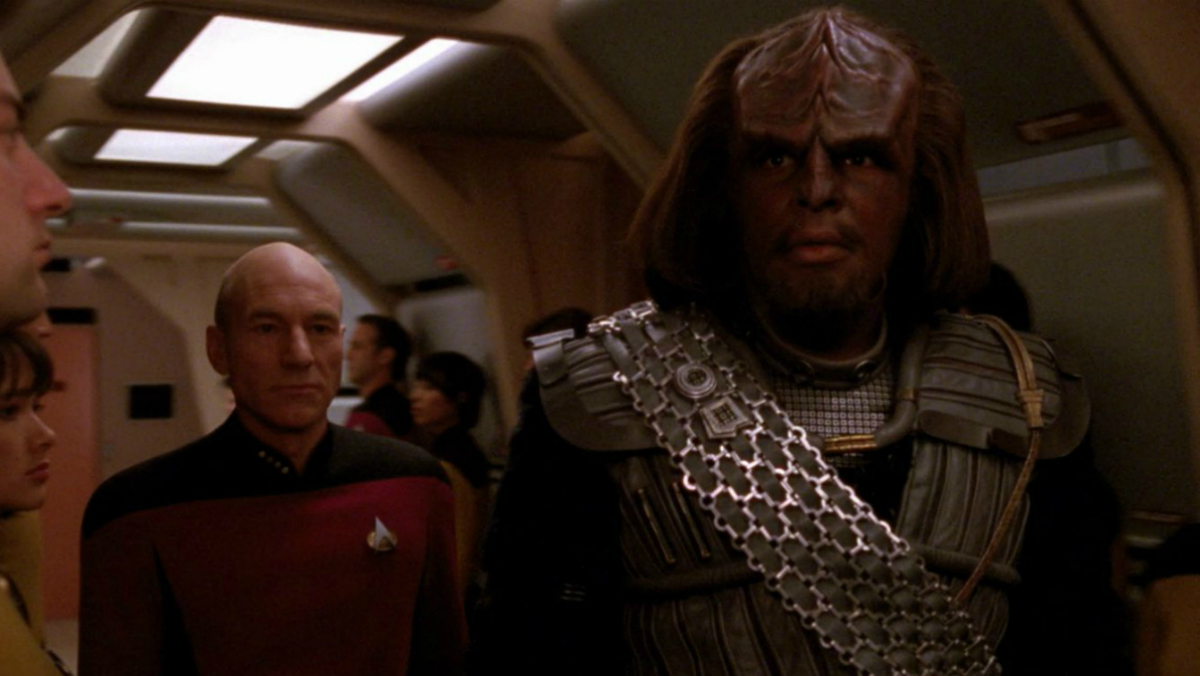
Season four of TNG is notable because, unlike season four of TOS, it actually happened! After resolving the intense cliffhanger with the Borg, the season delivers strong episodes like “Family,” where Picard confronts his past and has a physical altercation with his difficult brother. “Reunion” significantly advanced the political storylines within the Klingon Empire, and “Remember Me” presented Dr. Crusher with a memorable science fiction puzzle that became a popular meme years later.

Season four of TNG explored complex themes, such as assisted suicide in the episode “Half a Life,” and featured a rare, well-received appearance by Majel Barrett as Lwaxana Troi. The episode “The Drumhead,” with its focus on political manipulation and fear, feels particularly relevant today. While the Q-centered episode, “Q-pid,” leans into the lighter, more whimsical style of the original Star Trek, it slightly weakens the season compared to the last. Despite this, season four is still a strong and compelling continuation of TNG.
Here are some of the show’s best episodes: “The Best of Both Worlds, Part II,” “Family,” “Remember,” “Reunion,” “Data’s Day,” “Half a Life,” “In Theory,” and “Redemption.”
3. Season 6 (1992-1993)

Season six of TNG marked a new era for the Star Trek franchise, as production began on Deep Space Nine simultaneously. Despite this increased workload, TNG continued to excel. The season featured the powerful two-part episode “Chain of Command,” which explored the devastating effects of torture through the perspective of Captain Picard. Alongside this, the season also included a compelling workplace drama focusing on the challenges of a new, overbearing captain on the Enterprise. It remains surprising that Patrick Stewart didn’t receive an Emmy nomination for his performance during this season.
This season of Star Trek cleverly addressed the common question of why so many aliens look so much like humans. The episode “Tapestry” was particularly strong, offering a fresh and insightful look into Jean-Luc Picard’s history as a rebellious young man. While there were a few weaker episodes – such as the holodeck-based western “A Fistful of Datas” – that slightly hold the season back compared to seasons four and five, it still delivers several truly excellent installments.
Here are some of the show’s best episodes: “Relics,” “Chain of Command, Parts I & II,” “Face of the Enemy,” “Tapestry,” “Lessons,” “The Chase,” and “Second Chances.”
2. Season 5 (1991-1992)

By its fifth season, The Next Generation was consistently strong, with even the weaker episodes remaining enjoyable. The season featured some of the show’s best moments, including the deeply moving “The Inner Light,” where Picard experiences an entire lifetime on another planet. “I, Borg” was also a standout, challenging viewers and Picard to see the Borg as more than just emotionless machines. And the show addressed LGBTQ+ issues – albeit through allegory – with the episode “The Outcast.”
Season 5 of Star Trek: The Next Generation really shines, showcasing everything fans love about the show. The episode “Darmok,” with its unique communication challenge, is a standout. Even Wesley Crusher gets a strong storyline in “The First Duty,” and the season marked the exciting return of Leonard Nimoy as Spock in the popular two-part episode, “Unification.” The introduction of Ro Laren, played by Michelle Forbes, was another fantastic addition to the cast. However, the frequent appearances of Worf’s son, Alexander, and his often irritating behavior, hold the season back from being the very best – there were just too many episodes focused on him.
Here are some of the show’s most highly-regarded episodes: “Darmok,” “Ensign Ro,” “Unification (Parts I & II),” “Ethics,” “The Outcast,” “I, Borg,” “Cause and Effect,” “The First Duty,” and “The Inner Light.”
1. Season 3 (1989-1990)

As a huge Next Generation fan, I always say that the show really found its footing in season three. The first couple of years were a bit uneven, but then Michael Piller stepped in as showrunner and completely turned things around. You could tell right away – new opening credits, updated uniforms, and a much stronger focus on developing the characters instead of just rushing through plots. The result was a fantastic season with 26 episodes that were consistently good, often great, and sometimes truly exceptional. A few standouts for me are the incredible time-travel story “Yesterday’s Enterprise,” the really compelling Worf episode “Sins of the Father,” and the heartbreaking story of Data trying to be a father in “The Offspring.”
Season three marked a significant moment by bringing Mark Lenard, an original Star Trek cast member, to The Next Generation as Spock’s father in the episode “Sarek.” This episode sensitively portrayed the effects of dementia on a gifted intellect. The season concluded spectacularly with “The Best of Both Worlds,” Star Trek’s first-ever season finale cliffhanger, where Picard is captured by the Borg and assimilated into their collective. This single episode firmly established TNG as a standout series, surpassing the legacy of Kirk and Spock and paving the way for four more seasons and over 100 additional episodes. It’s widely considered not only the most crucial season of TNG, but also the highest in quality.
Here are some of the show’s most highly-rated episodes: “The Survivors,” “Who Watches the Watchers,” “The Bonding,” “Yesterday’s Enterprise,” “Sins of the Father,” “The Offspring,” “Sarek,” “Tin Man,” and “The Best of Both Worlds, Part I.”

All seven seasons of Star Trek: The Next Generation are currently available to stream on Paramount+.
Read More
- Gold Rate Forecast
- Games That Faced Bans in Countries Over Political Themes
- Silver Rate Forecast
- 15 Films That Were Shot Entirely on Phones
- Unveiling the Schwab U.S. Dividend Equity ETF: A Portent of Financial Growth
- 20 Movies Where the Black Villain Was Secretly the Most Popular Character
- Brent Oil Forecast
- New HELLRAISER Video Game Brings Back Clive Barker and Original Pinhead, Doug Bradley
- Superman Flops Financially: $350M Budget, Still No Profit (Scoop Confirmed)
- 14 Movies Where the Black Character Refuses to Save the White Protagonist
2025-12-26 21:35