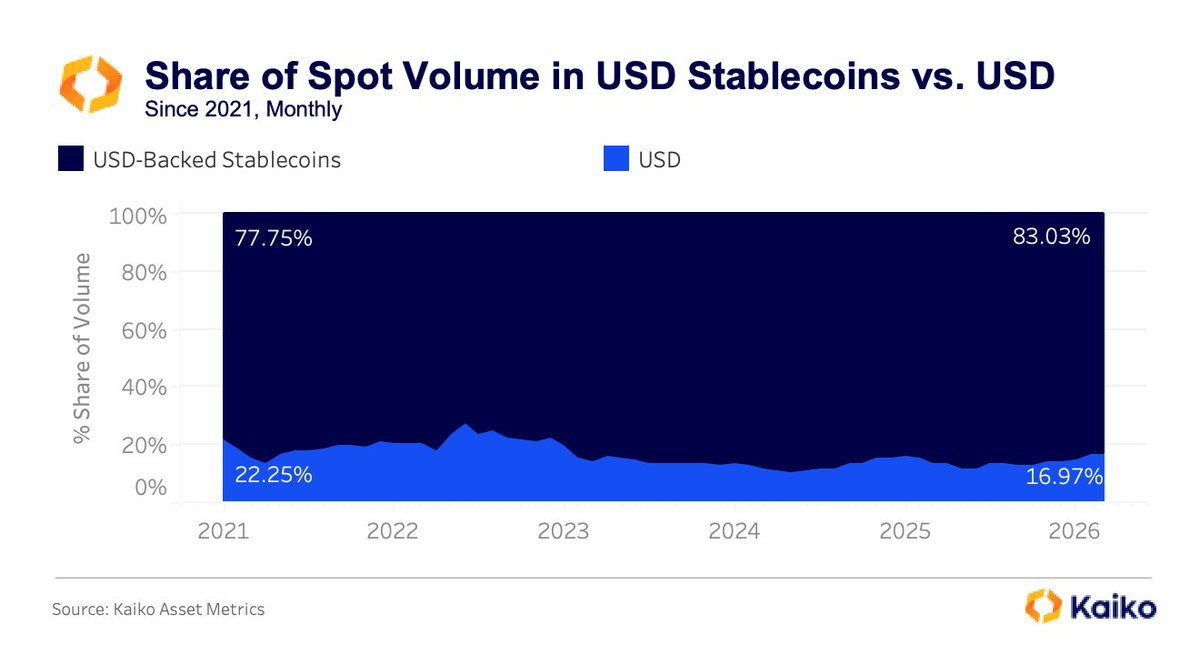
In the vast and tumultuous sea of crypto markets, a silent revolution has taken place. Stablecoins, those unassuming digital sentinels of value, now reign supreme, commanding a staggering 83.03% of all USD-denominated trading volume as of late-March 2026, according to the ever-watchful eyes at Kaiko.
Stablecoins: The New Overlords of Settlement in the Crypto Realm
The latest figures from Kaiko reveal a world turned upside down, where fiat USD pairs have been relegated to the shadows, clutching a mere 16.97% of total spot volume on centralized exchanges. A far cry from the days when traditional banking rails held sway, like an aging monarch clinging to a fading throne.
Cast your mind back to 2021, when stablecoins held a modest 77.75% of USD spot trading, while fiat pairs still boasted a respectable 22.25%. But time, that relentless march of progress, has steadily tipped the scales. By the 2024-2025 stretch, stablecoins had crossed the 80% threshold, never to look back, leaving fiat pairs in the dust like a forgotten relic of a bygone era.
Kaiko’s data paints this shift not as a mere convenience upgrade, but as a seismic transformation. Stablecoins have become the lifeblood of crypto markets, the operational dollar that handles settlement, liquidity, and pricing across nearly every major trading pair. A silent coup, executed with the precision of a Swiss watch.
The mechanics are as straightforward as they are ingenious. Fiat token pairs such as BTC/USDT and ETH/USDC offer deeper liquidity, tighter spreads, and round-the-clock access, unencumbered by the archaic constraints of traditional banking hours or settlement delays. A triumph of efficiency over inertia.
This accessibility has fueled adoption far beyond the ivory towers of U.S. trading desks. In regions where capital controls choke economic freedom or banking infrastructure is but a distant dream, stablecoins serve as a parallel dollar rail, facilitating remittances, payroll, and everyday transactions. A financial lifeline, thrown to those adrift in the sea of economic uncertainty.
Volume metrics reflect this global embrace. USD-backed stablecoins process hundreds of billions of dollars in daily spot volume, while euro-denominated stablecoins remain a mere footnote, despite the regulatory clarity provided by Europe’s MiCA framework. A testament to the irresistible allure of the dollar, even in its digital incarnation.
Market share among issuers remains as concentrated as a Tolstoy novel. Tether’s USDT continues to dominate, often exceeding 80% of stablecoin-driven volume, while USDC maintains a smaller but still significant foothold. A duopoly, as enduring as the Russian steppe.
Regulatory developments have played their part in this drama, reinforcing the trend. U.S. policy frameworks introduced in 2025 have encouraged issuance and compliance, while exchanges without direct access to U.S. banking increasingly route activity through stablecoin pairs. A regulatory embrace, as warm as a Russian winter is cold.
On regulated U.S. platforms, fiat pairs still exist, but their presence is as fleeting as a summer breeze. Depending on the venue and month, direct USD trading can fall into the low double digits-or even single digits-of total volume. A shadow of their former selves, lingering on the periphery of a new financial order.
Stablecoins also stand at the heart of decentralized finance (defi), powering liquidity pools, lending markets, and yield strategies. Their role has expanded from mere collateral to core infrastructure, anchoring both centralized and on-chain ecosystems. A quiet revolution, unfolding in the shadows of the financial world.
Yet, there are trade-offs. Market concentration, reserve transparency, and regulatory scrutiny remain ever-present specters, particularly as stablecoins edge closer to the scale of traditional payment networks. A double-edged sword, as sharp as it is necessary.
Still, the direction is as clear as a Tolstoy moral. Stablecoins have ascended from a supporting role to the main stage, quietly supplanting fiat rails in much of the crypto economy. A new order, born of innovation and necessity, marches inexorably forward.
FAQ 🔎
- What percentage of crypto spot trading uses stablecoins?
Stablecoins account for about 83% of USD-denominated spot trading volume as of March 2026. A dominance as absolute as a Tolstoy protagonist’s resolve. - Why are stablecoins replacing fiat USD pairs?
They offer faster settlement, deeper liquidity, and 24/7 access, unburdened by the shackles of traditional banking systems. A liberation, as sweet as it is inevitable. - Which stablecoins dominate trading activity?
USDT leads by a wide margin, with USDC serving as the second-largest contributor. A duopoly, as enduring as the Russian winter. - Do fiat USD trading pairs still exist?
Yes, but they now represent a smaller share of activity, mainly on regulated U.S. exchanges. A remnant of a bygone era, lingering on the fringes of progress.
Read More
- 20 Movies Where the Black Villain Was Secretly the Most Popular Character
- Top 20 Dinosaur Movies, Ranked
- 25 “Woke” Films That Used Black Trauma to Humanize White Leads
- Silver Rate Forecast
- Gold Rate Forecast
- 22 Films Where the White Protagonist Is Canonically the Sidekick to a Black Lead
- Can AI Lie with a Picture? Detecting Deception in Multimodal Models
- Top 10 Coolest Things About Invincible (Mark Grayson)
- Celebs Who Narrowly Escaped The 9/11 Attacks
- From Bids to Best Policies: Smarter Auto-Bidding with Generative AI
2026-03-25 03:57