
The current fascination with artificial intelligence, a fever dream of exponential returns, obscures a more fundamental truth: the concentration of power in the hands of those who control the underlying infrastructure. We speak of innovation, of disruption, yet the architecture of this new age rests upon a remarkably narrow foundation – the silicon wafers fabricated by a select few, and, increasingly, the specialized computational engines crafted by one dominant entity. To invest in AI, then, is not merely to chase a technological wave, but to acknowledge, and perhaps even endorse, this emerging asymmetry.
Nvidia, the name now whispered with reverence (and a certain calculating avarice), has become the indispensable artery of this digital expansion. Its graphical processing units, initially conceived for the rendering of illusory worlds, now serve as the very loom upon which the fabric of artificial intelligence is woven. The demand is not simply high; it is a relentless, almost desperate scramble for access to a finite resource. And in this scarcity lies both opportunity and, one might cautiously suggest, a certain moral weight.
The recent pronouncements from Nvidia’s CEO, Jensen Huang, regarding cumulative orders for Blackwell and Vera Rubin GPUs – a projected $1 trillion by 2027 – are not merely optimistic forecasts; they are a tacit admission of the company’s leverage. Last year’s estimate of $500 billion now appears a deliberate understatement, a carefully calibrated disclosure designed to manage expectations while simultaneously reinforcing the perception of inevitable growth. This is not the language of a humble innovator, but of a steward presiding over a critical bottleneck.
The market, in its characteristic shortsightedness, currently values Nvidia at a seemingly reasonable 21.5 times forward earnings, 36.4 times trailing earnings. Compared to the S&P 500’s multiples of 24.1 and 21.2 respectively, this suggests a degree of restraint, a reluctance to fully embrace the company’s potential. But this restraint, I contend, is a miscalculation. The market is applying a conventional metric to an unconventional situation – a near-monopoly on a foundational technology. It expects Nvidia to revert to the mean, to exhibit growth commensurate with the broader market. This is a naive assumption.
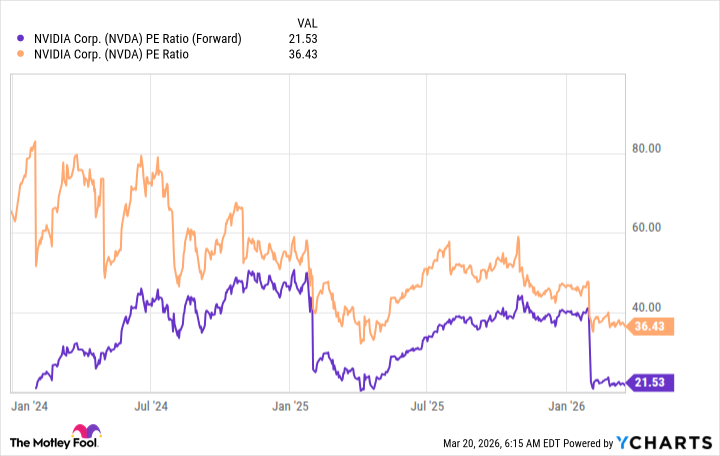
Wall Street analysts anticipate revenue growth of 71% this year, a substantial figure, followed by a more modest 29% next year. But these projections, derived from conventional modeling, fail to account for the inherent inelasticity of demand. The hyperscalers – the vast data centers that power the AI revolution – will continue to build, to expand, regardless of short-term economic fluctuations. And Nvidia, as the primary supplier of the necessary computational infrastructure, will benefit disproportionately. Huang’s quiet confidence in the $1 trillion revenue projection suggests a reality far exceeding these cautious estimates.
The prevailing market sentiment – a blend of AI investment fatigue and broader economic uncertainty – has created a temporary aberration, a window of opportunity for discerning investors. The data center build-outs will proceed apace, driven by forces beyond the reach of market whims. Nvidia, therefore, remains a compelling long-term investment, a bastion of stability in a world increasingly defined by volatility. To dismiss it as merely another technology stock is to misunderstand the fundamental dynamics at play – the concentration of power, the scarcity of resources, and the relentless march of technological progress. It is a weight of silicon, and it is only growing heavier.
Read More
- 20 Movies Where the Black Villain Was Secretly the Most Popular Character
- Top 20 Dinosaur Movies, Ranked
- 25 “Woke” Films That Used Black Trauma to Humanize White Leads
- Silver Rate Forecast
- Gold Rate Forecast
- 22 Films Where the White Protagonist Is Canonically the Sidekick to a Black Lead
- Can AI Lie with a Picture? Detecting Deception in Multimodal Models
- Top 10 Coolest Things About Invincible (Mark Grayson)
- When AI Teams Cheat: Lessons from Human Collusion
- From Bids to Best Policies: Smarter Auto-Bidding with Generative AI
2026-03-24 19:22