The Vanguard Dividend Appreciation ETF (VIG) and the ProShares S&P 500 Dividend Aristocrats ETF (NOBL) both invest in companies that have consistently increased their dividend payments. However, they differ in *how* they select those companies.
VIG invests in a wide range of large U.S. companies that consistently increase their dividends. NOBL, on the other hand, focuses specifically on companies within the S&P 500 that have a long history of raising dividends, giving equal weight to each stock. VIG is known for being less expensive and having better past performance, while NOBL provides a higher income stream and a concentrated investment strategy focused on consistently growing dividends.
As a market watcher, I’ve been looking closely at how different investment options stack up. This analysis breaks down those differences in terms of what they’ll cost you, how well they perform, the level of risk involved, and how they fit into your overall investment strategy. Ultimately, it’s all about giving investors the information they need to make smart choices.
Snapshot (cost & size)
| Metric | VIG | NOBL |
|---|---|---|
| Issuer | Vanguard | ProShares |
| Expense ratio | 0.04% | 0.35% |
| 1-yr total return (as of 2026-03-21) | 11.8% | 5.7% |
| Dividend yield | 1.6% | 2% |
| Beta | 0.81 | 0.76 |
| AUM | $123.8 billion | $10.9 billion |
Beta shows how much a stock’s price tends to move compared to the overall stock market, specifically the S&P 500. It’s calculated using five years of monthly returns. The 1-year return simply shows the total gain or loss over the past 12 months.
VIG is significantly cheaper than NOBL, with annual fees of only 0.04% compared to NOBL’s 0.35%. VIG also manages a much larger amount of money. While NOBL provides a slightly higher dividend yield (0.4% more), making it attractive for investors seeking immediate income, VIG offers lower costs.
Performance & risk comparison
| Metric | VIG | NOBL |
|---|---|---|
| Max drawdown (5 y) | -20.4% | -17.91% |
| Growth of $1,000 over 5 years | $1,478 | $1,229 |
What’s inside
NOBL invests in almost 70 different stocks, spreading its investments evenly across them and limiting any single sector to a maximum of 30% of the portfolio. Currently, its biggest investments are in industrial companies (22.5%), consumer staples (22.09%), and financial services (13.08%). As of March 20, its largest holdings are Chevron, ExxonMobil, and Linde, each representing a little over 1.7% of the fund’s total assets. NOBL has been operating for 12.4 years and aims to provide a concentrated but well-rounded investment in leading U.S. companies that consistently increase their dividend payments.
VIG, on the other hand, invests in a broader range of companies – 338 in total – and focuses heavily on technology (24.5%), financial services (20.6%), and healthcare (16.8%). As of February 28th, its biggest holdings were Broadcom (AVGO 2.99%), Apple (AAPL 0.38%), and Eli Lilly (LLY 1.18), which together represent between 3.7% and 5.9% of the fund’s total assets.
For more guidance on ETF investing, check out the full guide at this link.
What this means for investors
If you’re an investor looking for a reliable source of income without a lot of effort, dividend ETFs are a good option. They provide regular payments and automatically spread your investment across many different stocks. Two strong choices focused on companies that consistently increase their dividends are the Vanguard Dividend Appreciation ETF and the ProShares S&P 500 Dividend Aristocrats ETF.
As a portfolio manager, I focus on investing in what are known as Dividend Aristocrats®. These are S&P 500 companies that have consistently increased their dividend payments to shareholders for at least 25 years – it’s a pretty exclusive club! This strategy means I prioritize companies with solid financial foundations and a proven track record of growing earnings and cash flow, which allows them to reliably increase those dividend payouts year after year. It’s a focus on quality and consistent performance.
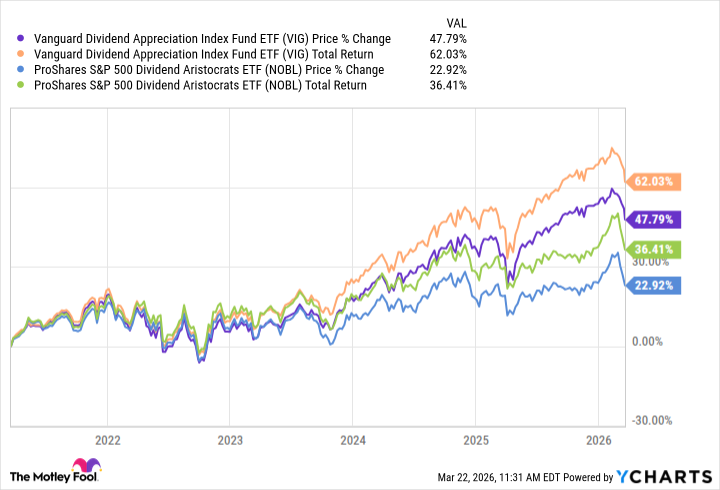
VIG also invests in companies that consistently increase their dividends, but it has slightly less strict requirements than NOBL. VIG follows the S&P U.S. Dividend Growers Index, which includes businesses that have raised dividends every year for at least a decade. Interestingly, the index deliberately leaves out the 25% of companies with the highest dividend yields, likely to avoid including companies with yields that might not be reliable. This focus on stability is a key reason why VIG has generally performed better than NOBL over the long term.
Although past results aren’t a promise of future success, VIG seems like a relatively safer investment, and it’s also much cheaper.
Read More
- Seeing Through the Lies: A New Approach to Detecting Image Forgeries
- Staying Ahead of the Fakes: A New Approach to Detecting AI-Generated Images
- Julia Roberts, 58, Turns Heads With Sexy Plunging Dress at the Golden Globes
- Top 10 Coolest Things About Invincible (Mark Grayson)
- Top 20 Dinosaur Movies, Ranked
- Silver Rate Forecast
- Gold Rate Forecast
- Smarter Reasoning, Less Compute: Teaching Models When to Stop
- Palantir and Tesla: A Tale of Two Stocks
- Unmasking falsehoods: A New Approach to AI Truthfulness
2026-03-22 18:32